


ISO 27001 Risk Treatment Plan: How to Identify, Evaluate and Treat Security Risks
ISO 27001 Risk Treatment Plan: How to Identify, Evaluate and Treat Security Risks
ISO 27001 Risk Treatment Plan: How to Identify, Evaluate and Treat Security Risks
>ISO 27001 Risk Treatment Plan: How to Identify, Evaluate and Treat Security Risks
ISO 27001 Risk Treatment Plan: How to Identify, Evaluate and Treat Security Risks
ISO 27001 Risk Treatment Plan: How to Identify, Evaluate and Treat Security Risks
Table of Contents
- What Is an ISO 27001 Risk Treatment Plan?
- Why Is Risk Treatment Important in ISO 27001?
- ISO 27001 Risk Assessment vs. Risk Treatment
- How to Create an ISO 27001 Risk Treatment Plan
- ISO 27001 Risk Treatment Plan Example
- Common Mistakes to Avoid
- ISO 27001 Risk Treatment Plan Checklist
- Frequently Asked Questions
- Conclusion
An ISO 27001 Risk Treatment Plan translates identified security risks into practical actions. Without one, an organization may understand what could happen but lack a clear plan for how to address the risk, who is responsible, and whether the residual risk is acceptable.
Risk treatment is a required part of implementing an Information Security Management System (ISMS). ISO/IEC 27001:2022 requires organizations to establish and implement an information security risk assessment and risk treatment process.
What Is an ISO 27001 Risk Treatment Plan?
ISO 27001 Risk Treatment Plan means documentation that shows how an organization is going to treat risks related to information security during its risk assessment process.
It links identified risks with the chosen treatment, required controls or actions, risk owners, target dates, and expected residual risk.
A risk treatment does not necessarily involve getting rid of the risk; the organization can choose to either avoid, mitigate, transfer, or accept a risk according to certain criteria.
Why Is Risk Treatment Important in ISO 27001?
Risk assessment lets you know what can go wrong and the significance of the risk. Risk treatment then asks: what will you do about it?
A process-oriented risk treatment process under ISO 27001 will help organizations:
- Prioritize risks
- Assign accountability
- Select appropriate controls
- Track remediation actions
- Document security decisions
- Evaluate residual risks
- Showcase a systematic approach to ISO 27001 risk management
ISO/IEC 27001 integrates risk assessment and treatment in the ISMS planning process. It also requires organizations to compare the controls they determine to be necessary with the controls in Annex A and produce a Statement of Applicability (SoA).
ISO 27001 Risk Assessment vs. Risk Treatment
These activities are connected but have different purposes.
Risk assessment focuses on understanding risk. It involves identifying risks, analyzing them, and evaluating them against the organization’s criteria.
Risk treatment focuses on deciding what to do with those risks.
Think of it this way:
Risk assessment = “How serious is this risk?”
Risk treatment = “What action should we take?”
Risk management is the broader process that brings these activities together, including identifying, analyzing, evaluating, treating, monitoring, and reviewing risks.
How to Create an ISO 27001 Risk Treatment Plan
The following ISO 27001 risk treatment process can be used as a practical starting point.
1.Information Security Risk Identification
Begin with your assets, systems, processes, people, and outside dependencies.
Identify any threats or vulnerabilities that may impact confidentiality, integrity, or availability.
Examples include:
- Unauthorized access to customer data
- Phishing and compromised credentials
- Cloud misconfiguration
- Ransomware affecting production systems
- Loss of a critical supplier
- Accidental deletion of important information
Document the cause, event, affected asset or process, and potential consequence for each risk.
2. Analyze and Evaluate the Risks
Identify the probability and possible effect of the risk according to the method determined by your company.
One way is by assessing the level as low, medium, and high. More sophisticated firms may use numerical ratings or some other criterion.
Consistency is important here. Risks that are similar must have the same criteria.
Afterwards, compare each assessment to your risk acceptance standards. This will help you identify the risks that need treatment and the ones that can be accepted.
3. Select a Risk Treatment Option
Treatments commonly available are:
Avoid the risk: Avoid taking the risk by altering or stopping the activity that presents the risk.
Mitigate the risk: Undertake controls that will decrease the probability and/or consequence of the risk.
Transfer the risk: Transfer part of the risk to a third party through contracts or insurance.
Accept the risk: Accept the risk when it lies within the criteria for acceptance.
The choice of which option to follow would depend on the nature of the risk, the needs of the business, the resources, and the level of risk exposure accepted. Risk treatment affects the risk in many ways.
4. Determine the Necessary Controls
Identify the necessary controls required to implement the chosen response.
This may include, for instance, where the threat is unauthorized access to the production environment, authentication, access review, privileged access management, logging, and monitoring.
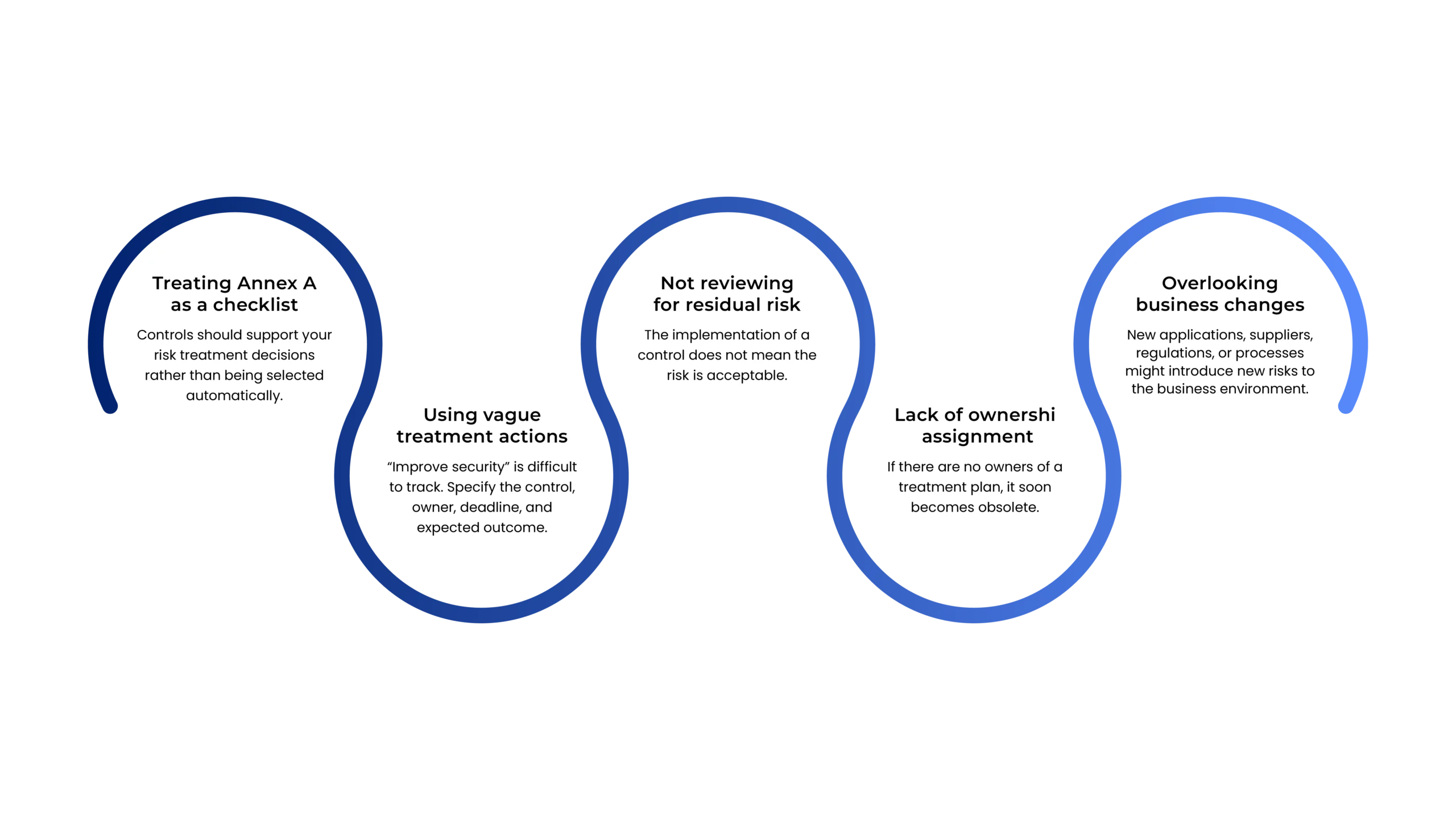
Annex A provides a reference set of information security controls. It should not simply be treated as a checklist where every control is automatically required. ISO/IEC 27001 guidance explains that organizations compare controls determined through risk treatment with Annex A and verify that necessary controls have not been omitted.
Organizations can also use controls outside Annex A when their risk treatment requires them. Necessary controls should be reflected in the Statement of Applicability.
5. Create the Statement of Applicability
The Statement of Applicability (SoA) documents the necessary controls, the justification for their inclusion, their implementation status, and the justification for excluding any Annex A controls.
The SoA and risk treatment plan have different purposes. The treatment plan focuses on actions for addressing risks, while the SoA provides a structured view of necessary controls and their status or justification.
6. Assign Risk Owners and Actions
Every treatment action should have clear ownership.
Record:
- Risk description and rating
- Treatment decision
- Required control or action
- Risk owner
- Target date
- Status
- Expected residual risk
- Required approval or acceptance
Clear ownership prevents the risk register from becoming a document that is updated but not acted upon.
7. Evaluate Residual Risk
After controls are implemented, reassess the risk.
The remaining exposure is called residual risk. Compare it with the organization’s risk acceptance criteria.
If the residual risk is acceptable, the appropriate risk owner can approve or accept it according to the organization’s process. If it remains unacceptable, additional treatment may be necessary.
ISO 27001 Risk Treatment Plan Example
Consider a SaaS company that stores customer information in a cloud database.
Risk: Unauthorized access to the production database.
Initial risk: High.
Treatment: Reduce the risk.
Planned actions:
- Enforce multi-factor authentication
- Restrict database access
- Review privileged accounts regularly
- Enable security logging and monitoring
- Remove unnecessary access
Risk owner: Head of Engineering
Target date: 60 days
Residual risk: Medium
Decision: Compare the residual risk with the organization’s acceptance criteria and obtain the required approval.
This ISO 27001 risk treatment plan example shows how a risk moves from identification to treatment and then to residual-risk evaluation.
Common Mistakes to Avoid
ISO 27001 Risk Treatment Plan Checklist
Before finalizing your plan, check that:
- Risks are clearly described
- Likelihood and impact are assessed consistently
- Risk acceptance criteria are documented
- Each risk has a treatment decision
- Necessary controls are identified
- Annex A has been considered
- The Statement of Applicability is maintained
- Risk owners are assigned
- Treatment actions have deadlines
- Residual risks are evaluated
- Required approvals are documented
- The plan is reviewed after significant changes
Frequently Asked Questions
What is an ISO 27001 Risk Treatment Plan?
It is a documented plan for deciding and tracking how identified information security risks will be addressed, including treatment actions, ownership, timelines, and residual-risk decisions.
What is ISO 27001 risk treatment?
ISO 27001 risk treatment is the process of deciding how to modify or manage identified information security risks. Options can include avoiding, reducing, sharing, or retaining risk.
How does risk assessment differ from risk treatment?
Risk assessment identifies, analyzes, and evaluates risks. Risk treatment determines what the organization will do about those risks and which controls or actions are needed.
Is an ISO 27001 Risk Treatment Plan mandatory?
ISO/IEC 27001:2022 requires organizations to establish and implement an information security risk treatment process and formulate a risk treatment plan as part of that process. The format and level of detail can be adapted to the organization’s context.
Does every ISO 27001 risk need a security control?
Not necessarily. The treatment decision depends on the organization’s risk criteria and chosen response. A risk may be accepted or addressed through another treatment option where appropriate.
What is the difference between a risk treatment plan and a Statement of Applicability?
The risk treatment plan describes how identified risks will be treated. The Statement of Applicability documents the controls determined to be necessary and explains their inclusion, implementation status, or exclusion justification.
Conclusion
A good ISO 27001 risk treatment plan turns risk assessment into concrete security action. This will help you not only identify risks but assign their owners, implement controls and make decisions regarding residual risk.
It is simple: conduct a consistent risk assessment, decide on treatment according to the criteria, pick up the right controls, record decisions, assign the risk owner and evaluate the residual risk.
If you are developing your ISMS or improving an existing one, risk treatment may be useful for ISO 27001 implementation.
Want to enhance your information security management system? Get in touch to learn more about your ISO 27001 needs.
Our Recent Posts
-
ISO 27001 Risk Treatment Plan: How to Identify, Evaluate and Treat Security Risks
-
How to Define Your SOC 2 Scope: A Practical Guide for Startups
-
ISO 42001 Certification: 2026 Guide to Requirements, Cost, Timeline & Process
-
Who Needs to Comply With CCPA? A Guide for SaaS Businesses
-
SOC 2 vs ISO 27001: What’s The Difference and Which Does Your SaaS Company Need?