

ISO 42001 Certification: 2026 Guide to Requirements, Cost, Timeline & Process
ISO 42001 Certification: 2026 Guide to Requirements, Cost, Timeline & Process
ISO 42001 Certification: 2026 Guide to Requirements, Cost, Timeline & Process
>ISO 42001 Certification: 2026 Guide to Requirements, Cost, Timeline & Process
ISO 42001 Certification: 2026 Guide to Requirements, Cost, Timeline & Process
ISO 42001 Certification: 2026 Guide to Requirements, Cost, Timeline & Process
Table of Contents
- What Is ISO 42001 Certification, Actually?
- Why Get ISO 42001 Certified? (The Business Case, Not Just the Compliance Case)
- Benefits of ISO 42001 Certification for Businesses
- ISO 42001 Certification Cost. What to Actually Budget For
- How Long Does ISO 42001 Certification Take?
- ISO 42001 Requirements Checklist
- How to Get ISO 42001 Certification for Startups: Step-by-Step Process
- How to Choose a Certification Body
- ISO 42001 vs Other Frameworks
- ISO 42001 vs. NIST AI RMF
- What Evidence Do Auditors Actually Ask For?
- How Automation Shortens ISO 42001 Certification
- Maintaining Certification: What Happens After You Pass
- Frequently Asked Questions
Getting ISO 42001 certified means demonstrating that your company manages AI systems through documented risk management, controls, oversight, and continuous monitoring, which are verified by an independent third-party auditor. ISO 42001 for AI SaaS companies is becoming increasingly important as SOC 2 already is: companies that develop, deploy, or provide AI-enabled software may benefit from understanding ISO 42001 regardless of being an AI startup with five people or a 500-people SaaS firm looking to implement AI into your product.
You may have come across this standard because of a customer security questionnaire, investor due diligence, or the growing focus on the EU AI Act and decided to prepare for potential questions from the regulators. No matter what led you here, this guide provides all the information that really matters – the cost of certification, duration of the process, expectations of the auditors, and much more.
What Is ISO 42001 Certification, Actually?
ISO/IEC 42001:2023 is the first international standard for an AI Management System (AIMS). Released in December 2023 by ISO and IEC, the standard offers companies a framework for managing the risks and responsibilities associated with the development or implementation of AI technology.
The following distinction is crucial: the standard refers to the document itself – a set of requirements, while the certification process is the procedure where an accredited independent auditor confirms compliance with the standard requirements and issues a certification valid for three years (assuming all annual surveillance audits go well).
In other words, when somebody claims that “we’re ISO 42001 certified”, they mean that an external auditor has checked that their AI governance system is implemented, not just created on paper.
Who is ISO 42001 intended for? Any organization involved in the development, provision, or implementation of AI technology, regardless of its size and industry. This is intentionally a broad definition; there is no need to develop foundation models to require this standard. If your SaaS product has AI functionality, if you apply AI in order to make decisions regarding your customers, or if you re-sell AI-powered solutions to your customers, the ISO 42001 standard is applicable.
If you’re also processing personal data, especially of users in India alongside your AI systems, it’s worth reading our DPDPA compliance guide alongside this one, since the two increasingly overlap for AI-driven products.
Why Get ISO 42001 Certified? (The Business Case, Not Just the Compliance Case)

Certification isn’t just a box to check for regulators. For most of the companies we work with, it’s a sales enabler.
Benefits of ISO 42001 Certification for Businesses
Here’s what an AI governance certification for startups and growing companies actually delivers in practice:
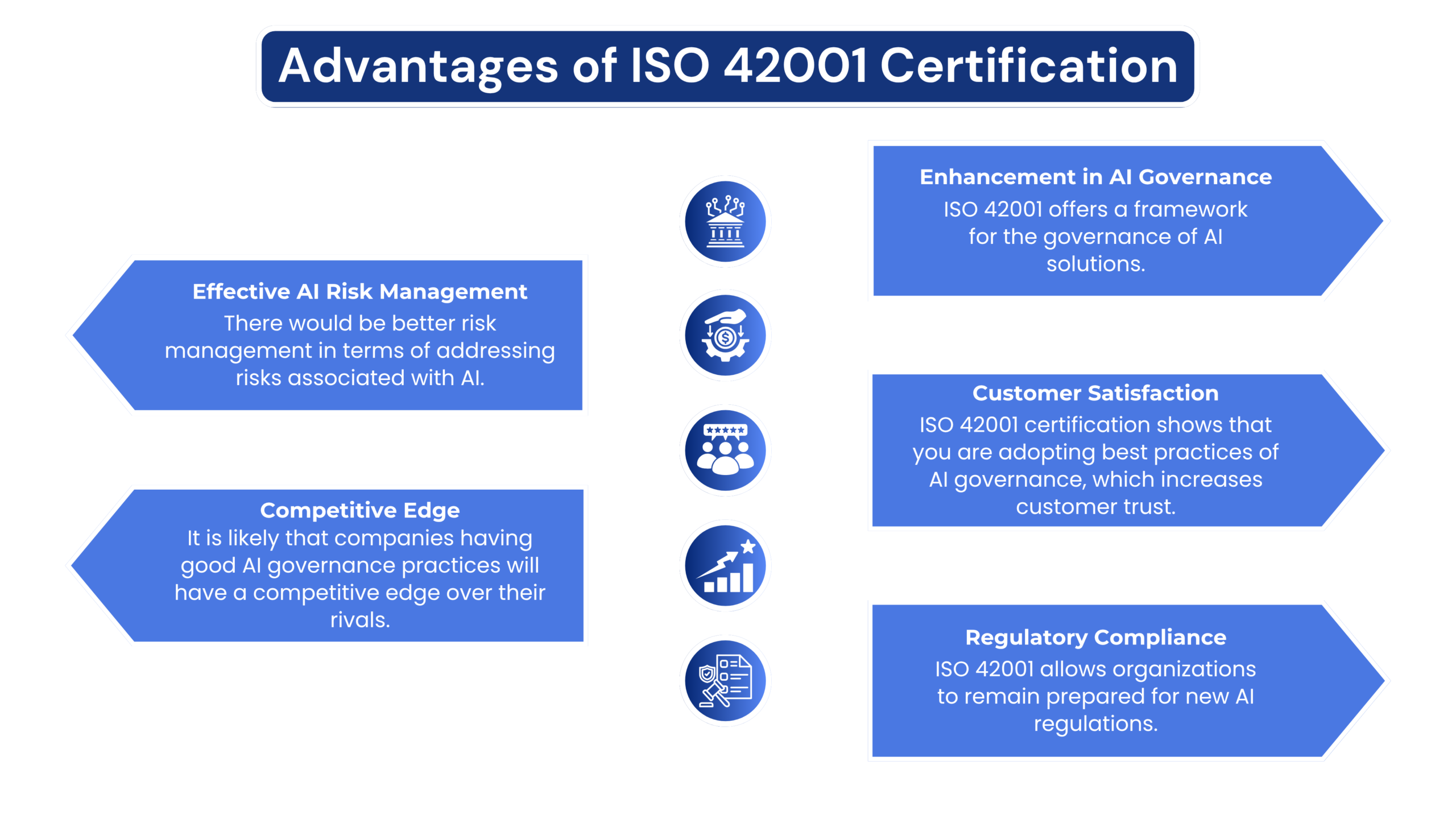
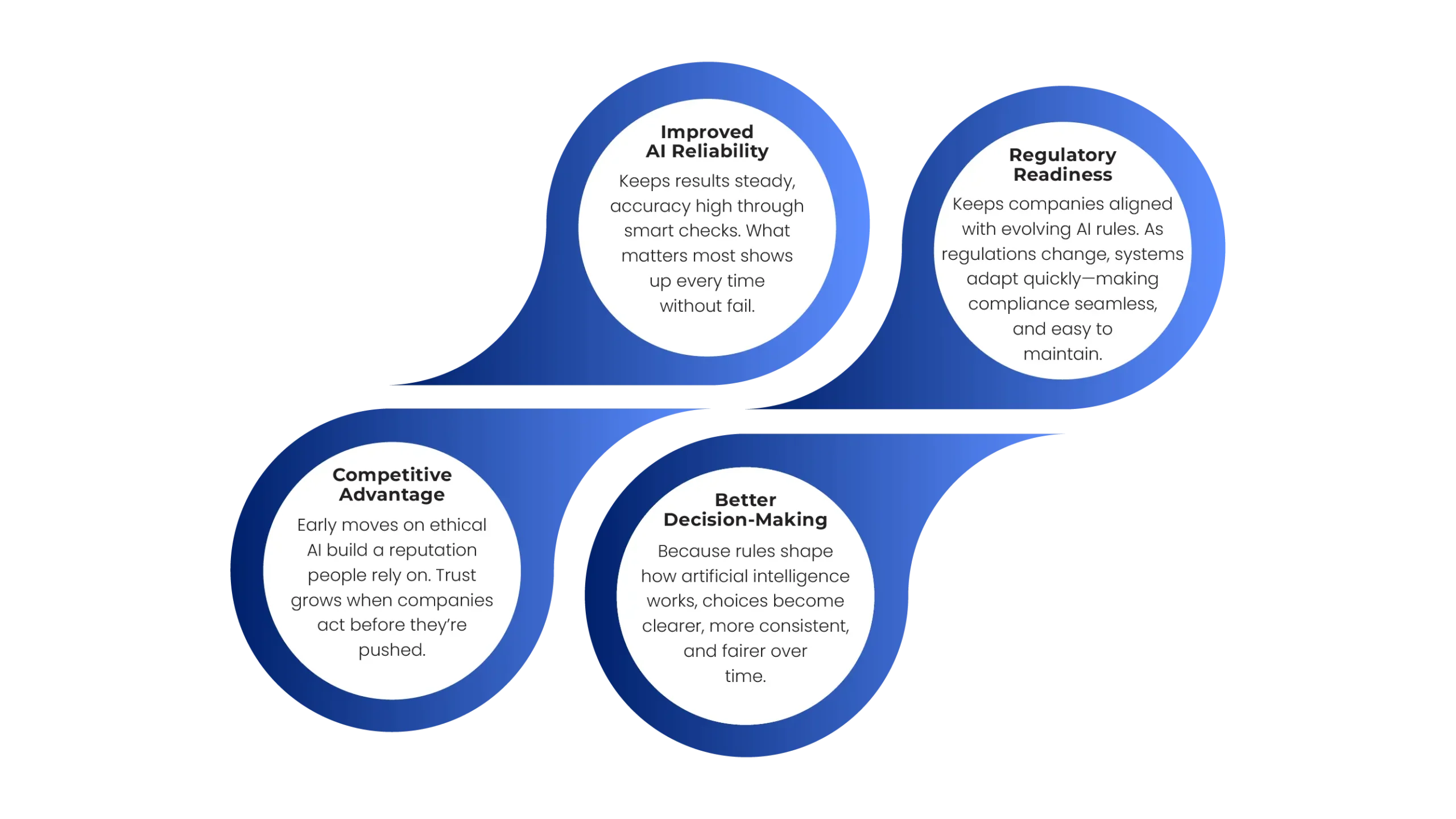
Enterprise clients are already demanding it. More and more enterprise customer security questionnaires now contain AI governance questions. Providing a certificate instead of a three-paragraph explanation of your internal AI policy can help streamline your sales process.
It prepares you for regulations in advance. The EU AI Act is being implemented in phases through 2026 and beyond. ISO 42001 won’t be a mandatory regulation under the Act and it won’t necessarily prove compliance, but an existing AIMS would make compliance significantly easier.
It is a clear competitive advantage. When competing with a rival in an RFP process, and you happen to have a proper AI governance certification while they don’t have anything of the sort, that’s an actual competitive advantage you can leverage. This is similar to how SOC 2 has helped SaaS companies demonstrate security and build trust with enterprise customers.
It replaces all the scattered documents with one framework. All scaling companies have some form of AI governance, some policy documents here, some approval processes there, but it’s always scattered and messy. ISO 42001 pushes you to build them all into a cohesive framework.
ISO 42001 Certification Cost. What to Actually Budget For
This is the question nobody seems to answer directly, so let’s break it down by component instead of throwing out one number that won’t apply to your situation.
ISO 42001 gap assessment / readiness review. Before implementation begins, you need to assess your gaps against the requirements of the standard. Typically, it is an engagement that is quite short and targeted, which may be either internal (using the time of your team) or conducted by a consultant or a platform. It is often the first item in the budget because it shows what needs to be addressed before implementation begins.
Internal implementation effort. This is the cost that gets overlooked in planning: the time of your own people. Policies, risk registers, an inventory of your AI systems, and monitoring processes – it all takes real time from your security team, engineers, and management. This is usually the single largest cost for startups in terms of weeks of effort, rather than money.
Certification body audit fees. You will pay a certification body for both the Stage 1 and Stage 2 audits. The charges will be different depending on various factors such as the certification body, size of your business, and audit scope.
Annual surveillance audits. Certification is not a one-time cost either. Surveillance audits will be done in the first and second years, after which there will be a recertification audit in the third year. This should be budgeted as a recurring expense.
Optional: consultant or automation platform. This is where the real cost difference shows up between approaches.
Approach | Typical Cost Profile | Typical Time Investment |
DIY (in-house only) | Lowest direct spend, highest hidden cost | Highest, months of internal time, especially evidence collection |
Consultant-led | Higher direct spend | Faster than DIY, but you’re still manually managing evidence and documentation long-term |
Automated platform (like SOCLY.io) | Predictable subscription cost | Fastest, automation handles evidence collection and monitoring continuously, not just for the audit |
However, the hidden cost in both of these methods is nearly always the same – manual data collection. Your team members will spend weeks gathering screenshots, exporting logs and compiling outdated Excel sheets. This is precisely what automation helps to solve, which we will discuss further down in this guide.
The total cost depends on your organization’s size, AI system scope, existing controls, certification body, and implementation approach.
Want a real number instead of a range?
Get a free ISO 42001 cost estimate based on your specific setup. We’ll walk through your current AI systems and existing certifications to give you an accurate picture.
How Long Does ISO 42001 Certification Take?
Nobody publishes a straight answer to this, so here’s a realistic ISO 42001 audit timeline, broken down phase by phase based on how certification projects typically unfold:
- Gap assessment — 1 to 2 weeks
- Policy and control implementation — 4 to 12 weeks, depending on how mature your AI governance already is
- Internal audit and management review — 1 to 2 weeks
- Stage 1 audit (documentation review) — around 1 week
- Stage 2 audit (implementation review) — 1 to 2 weeks
- Certificate issuance — 2 to 4 weeks after Stage 2 completes
Taken together, these steps mean a lean startup with relatively mature security practices may be able to complete the process in three to five months. And for a bigger business with more complex artificial intelligence and more approvals, the process will take longer.
What makes it faster:
- Existing SOC 2 and ISO 27001 means most of the underlying controls (access management, incident response, monitoring) are directly aligned with ISO 42001 requirements
- Automation for evidence gathering and continuous monitoring right from the beginning, rather than trying to figure out how to do it for the audit
What makes it slower:
- No existing inventory of places where artificial intelligence is actually being utilized
- Manual evidence gathering using spreadsheets that have to be redone each time something changes
If you are working on SOC 2 or ISO 27001, it would be a good idea to work on ISO 42001 as well you’ll save yourself some time by the amount of evidence overlapping alone.
ISO 42001 Requirements Checklist
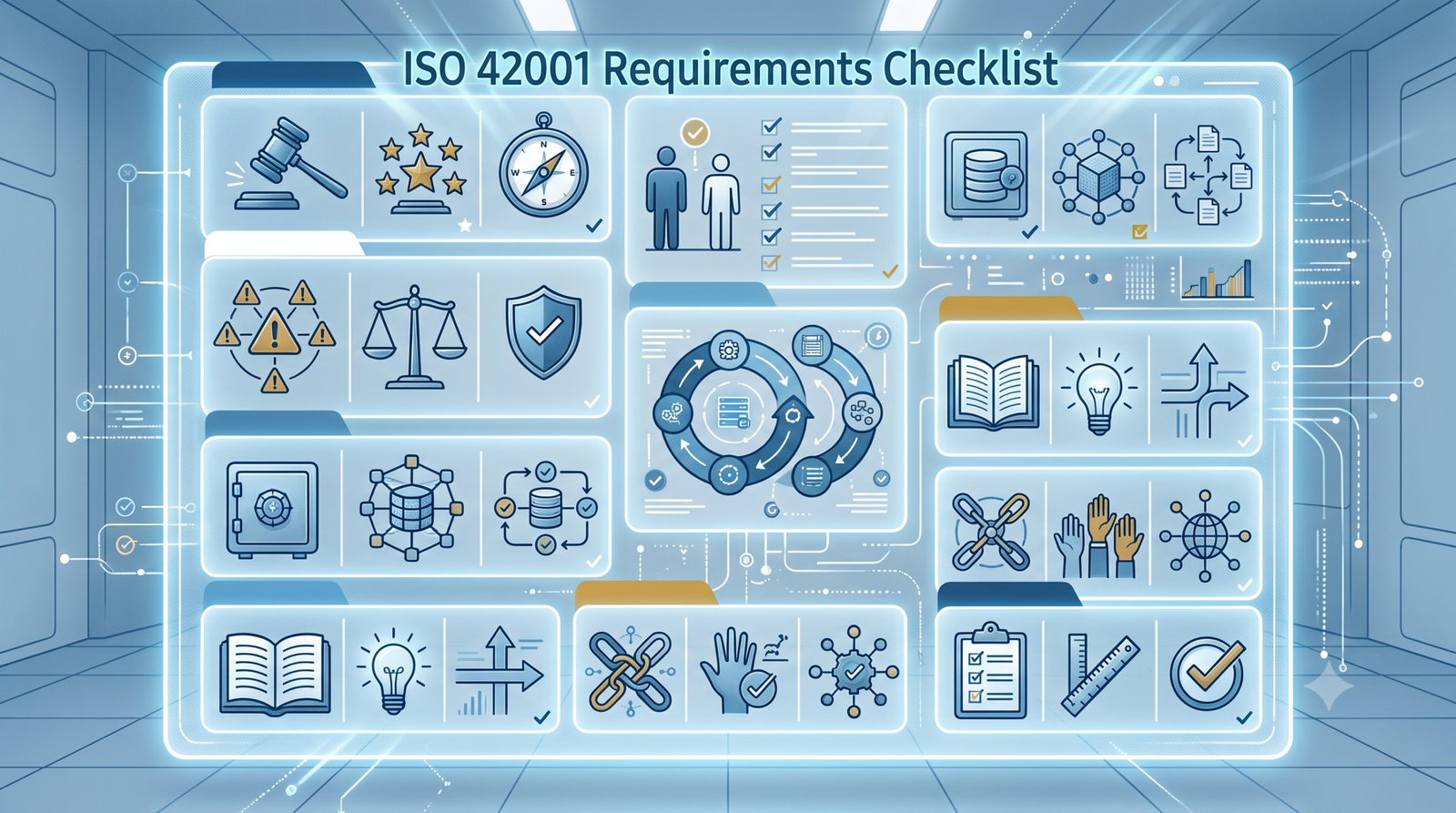
Use this as a working checklist, organized by the core pillars of an AI Management System:
Leadership & Policy
- Documented AI policy approved by leadership
- Clear ownership assigned for AI governance
- AI objectives defined and tied to business goals
Risk Management
- AI risk assessment process in place
- Risk treatment plans documented for identified risks
- Risks reviewed and updated on a regular cycle
Data Governance
- Data quality and provenance controls for AI training/input data
- Data privacy safeguards integrated into AI systems
Lifecycle Management
- Controls covering AI system design and development
- Deployment approval process
- Ongoing monitoring once systems are live
- Defined process for retiring or replacing AI systems
Transparency & Communication
- Clear communication to stakeholders about how AI is used
- Process for handling AI-related questions or complaints from customers
Third-Party & Vendor Management
- Risk assessment process for AI vendors and tools you rely on
- Contractual safeguards with AI vendors
Internal Audit & Continual Improvement
- Scheduled internal audits against the standard
- Management review process
- Documented Plan-Do-Check-Act cycle for continuous improvement
Save or bookmark this list, you’ll want to revisit it as you move through implementation.
How to Get ISO 42001 Certification for Startups: Step-by-Step Process
You don’t need a dedicated compliance team to pull this off. Here’s the realistic path for a lean team:
- Map where AI is actually used across your product and internal tools. Most teams underestimate this until they sit down and list it out.
- Run a gap assessment against the ISO/IEC 42001 clauses to see where you already meet requirements and where the gaps are.
- Assign an owner. This doesn’t need to be a full-time role; often, your head of security or engineering can take ownership alongside their existing responsibilities.
- Build and document the required policies and controls identified in your gap assessment.
- Automate evidence collection instead of manually tracking it in spreadsheets. This is the step most startups skip and pay for later in audit delays.
- Complete an internal audit and management review before you bring in an external auditor.
- Choose an accredited certification body (more on how to pick one below).
- Pass Stage 1 and Stage 2 audits.
- Maintain certification through continuous monitoring, not a scramble before each surveillance audit.
Teams can move through the process more efficiently when they plan for evidence collection and monitoring from the beginning.
This is basically the complete answer to the question of how you can achieve an ISO 42001 certification without wasting months on the effort of your team.
Not sure where your team stands on this list? Talk to a compliance specialist about your specific timeline and get a clear starting point.
How to Choose a Certification Body
This part rarely gets explained clearly, so here’s what actually matters.
“Accredited” has a specific meaning. A certification body needs to be accredited by a recognized accreditation body organizations like ANAB (in the US) or UKAS (in the UK) specifically for ISO/IEC 42001. Accreditation for ISO 42001 is still relatively new; ANAB launched its AIMS accreditation program in January 2024, and the pool of accredited certification bodies is smaller than it is for older standards like ISO 27001. Check the relevant accreditation body’s public directory before you commit to one.
Questions to ask before hiring a certification body:
- Do they have experience certifying companies whose AI systems resemble yours?
- What is their realistic audit turnaround for Stages 1 and 2?
- Is their billing system straightforward, or will there be surprise charges along the way?
- Do they provide a pre-assessment or readiness assessment prior to the formal audit?
A straight truth: SOCLY.io does not certify, no automation platform can do it. We prepare your evidence, control procedures and monitoring so you can be fast at Stage 1 and 2 with whichever certification body you select.
ISO 42001 vs Other Frameworks
ISO 42001 vs SOC 2 for AI Companies
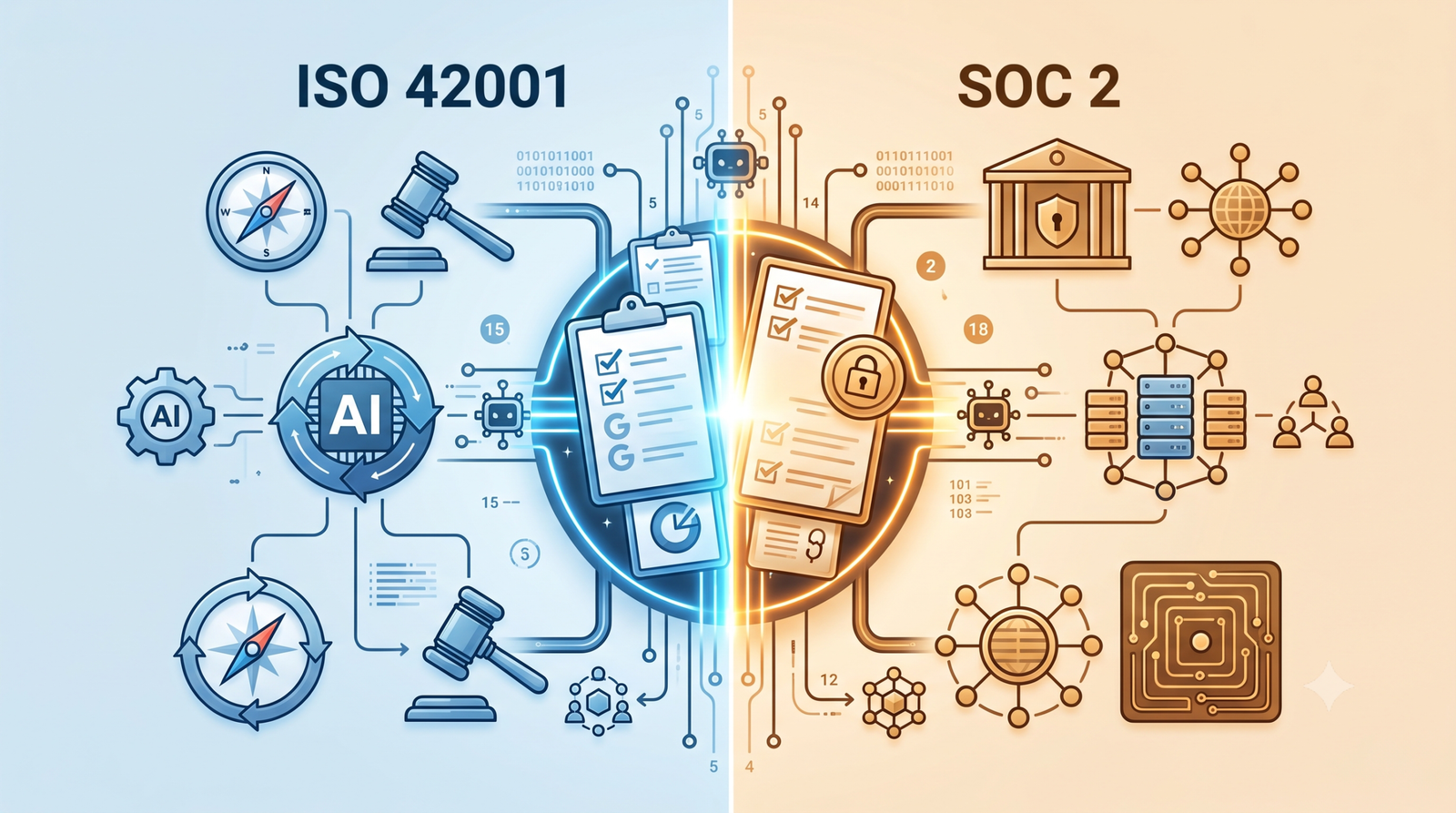
They are not competing frameworks; they address different areas. SOC 2 is all about controls surrounding security, availability, and confidentiality in relation to your systems. On the other hand, ISO 42001 is concerned with the governance of AI including risk management, lifecycle management, and responsible usage.
The good thing is that most SaaS businesses that have their attention on AI will try to get both standards because customers will be looking for both. The good thing here is that there are many commonalities when it comes to the evidence.
If you’re starting from scratch on the security side, our SOC 2 certification guide is a good place to begin.
ISO 42001 vs. NIST AI RMF
The AI Risk Management Framework developed by NIST is the American voluntary standard that has its use but is not certifiable, meaning there is no audit and there will be no certificate issued. In case you sell your product abroad, or you need some document for your security review, you should use the ISO 42001 standard.
Framework | Certifiable? | Region Focus | Best For |
ISO/IEC 42001 | Yes | Global | Companies needing third-party verified AI governance |
NIST AI RMF | No | US-focused | Companies wanting structured guidance without a formal audit |
Companies selling internationally, or selling into enterprises that expect a real certificate, tend to need ISO 42001 specifically — NIST AI RMF alone won’t satisfy that requirement.
What Evidence Do Auditors Actually Ask For?
That is when many organizations find themselves blindsided. The auditors aren’t merely interested in your policies but in the proof that you’ve put them into practice.
You should be prepared to supply:
- Inventory of your AI systems and where they are in use
- A record of risk register, outlining all of the risks and mitigation strategies employed
- Documentation of data governance, related to the data powering your AI systems
- Logs of monitoring activities that prove your AI systems are monitored and not merely deployed and left alone
- Incident management documentation, including all AI-related incidents and how you’ve managed them
- Proof that people who manage AI systems are trained and know about their responsibility in relation to AI systems
Notice the amount of overlap between this and what a SOC 2 and ISO 27001 auditor would need. This overlap is precisely why using one platform to deal with all of those frameworks saves you time.
How Automation Shortens ISO 42001 Certification

And here’s how manual preparation for certification really works: one person spends a week taking screenshots of access controls, one week trying to get engineering to provide system logs, and then finds out a month down the road that half the evidence is outdated since some change was made in production. Repeat that for each and every control in the standard, and you’ll understand why certification processes take three months or more.
The SOCLY.io platform automates several parts of the process:
- Evidence mapping automation – the evidence is collected and mapped to the ISO 42001 controls automatically and continuously, not gathered at the last minute.
- Real-time monitoring – your AI systems are monitored 24/7, so you won’t find gaps in coverage only when the auditor does;
- Centralized dashboard – all your controls status in one place, no need to dig through a bunch of documents;
- Human expertise support – compliance specialists who will help you before, during, and after the audit.
This is not an attempt to replace judgment with technology; rather, this is the removal of mundane aspects of compliance that cause errors and take your time away from focusing on decisions where human judgment is necessary.
Maintaining Certification: What Happens After You Pass
However, certification is not the end of the process. The validity of your certificate lasts three years, but there will be surveillance audits in the first year and second year to check whether you meet the standard, after which there will be a recertification audit in the third year.
In practice, that means:
- Constant monitoring of your AI systems, not just during the audit period
- Updating risk assessments when you introduce changes to existing AI systems or add new ones
- Periodic internal audits to detect the problems ahead of an external auditor
And it is exactly the reason why a platform is more likely to work better than a one-time consulting project. A consultant will help you become certified. A platform can help you remain audit-ready continuously, making each next surveillance audit easier and less time-consuming.
Frequently Asked Questions
Is ISO 42001 certification mandatory?
ISO 42001 is not mandatory. However, it is becoming more relevant to enterprise customers and can provide a structured governance framework as organizations prepare for regulations such as the EU AI Act. It does not automatically demonstrate legal compliance but gives rewards to companies having governance systems in place.
How much does ISO 42001 certification cost for a small startup?
The costs will vary depending on the certification body, scope of AI systems, and implementation method (in-house, consultant, or automated). The biggest cost underestimated by startups is the cost of manual data gathering, which automation tries to minimize.
How long does ISO 42001 certification take?
The period from kickoff to certificate for most organizations is generally between three and five months, based on how advanced their AI governance and security practices are.
Who can issue ISO 42001 certification?
ISO/IEC 42001 can only be certified by accredited certification bodies for ISO/IEC 42001 through a recognized accreditation body such as ANAB and UKAS. Always verify that the accreditation is valid first.
Does ISO 42001 apply to companies that use AI tools but don’t build them?
Yes. The standard applies to any organization that provides or uses AI systems; you don’t need to be building your own models to need an AI management system.
Can one platform manage ISO 42001 alongside SOC 2 or ISO 27001?
Yes, and it’s something that will definitely be worth your while. There is substantial similarity in the basic data and controls between the different systems, which makes it quicker to coordinate them as opposed to working on them separately.
What happens if you fail a Stage 2 audit?
You will normally be provided with a certain amount of time to rectify any non-conformities, after which you may be subject to re-evaluation, rather than having to start everything from scratch. Another good reason why it is important to prepare thoroughly for the audit.
How does ISO 42001 relate to the EU AI Act?
ISO 42001 is not a harmonized standard by the EU AI Act and does not guarantee any legal compliance for that matter. All ISO 42001 does is provide you with an operational governance framework that would make it much easier for you to showcase your risk management and oversight efforts.
Ready to Get Started?
ISO 42001 certification doesn’t have to mean months of manual work and scattered spreadsheets. The right process and automation will allow you to complete the task much faster than you anticipated.
Get your free ISO 42001 gap assessment and see exactly where you stand. Or, if you’re also working on SOC 2, ISO 27001, or DPDPA, check out our other compliance guides to see how these frameworks overlap.
Our Recent Posts
-
How to Define Your SOC 2 Scope: A Practical Guide for Startups
-
ISO 42001 Certification: 2026 Guide to Requirements, Cost, Timeline & Process
-
Who Needs to Comply With CCPA? A Guide for SaaS Businesses
-
SOC 2 vs ISO 27001: What’s The Difference and Which Does Your SaaS Company Need?
-
Why the DPDPA Act Matters for Indian Startups and SaaS Companies?