Categories
SOC 2

SOC 2 Compliance for SaaS Startups: What Does It Actually Prove?

SOC 2 Compliance for SaaS Startups: What Does It Actually Prove?

SOC 2 Compliance for SaaS Startups: What Does It Actually Prove?

SOC 2 Compliance for SaaS Startups: What Does It Actually Prove?

>SOC 2 Compliance for SaaS Startups: What Does It Actually Prove?

SOC 2 Compliance for SaaS Startups: What Does It Actually Prove?

Learn what SOC 2 compliance actually proves, how it demonstrates the effectiveness of security controls, and why it matters for building enterprise customer trust and accelerating sales.

SOC 2 Compliance for SaaS Startups: What Does It Actually Prove?

SOC 2 Compliance for SaaS Startups

Somewhere around your first $500K enterprise deal, a procurement manager is going to ask you a question that stops your sales cycle cold: “Can you send us your SOC 2 report?”

Because saying you take security seriously and proving that you do are two very different things.

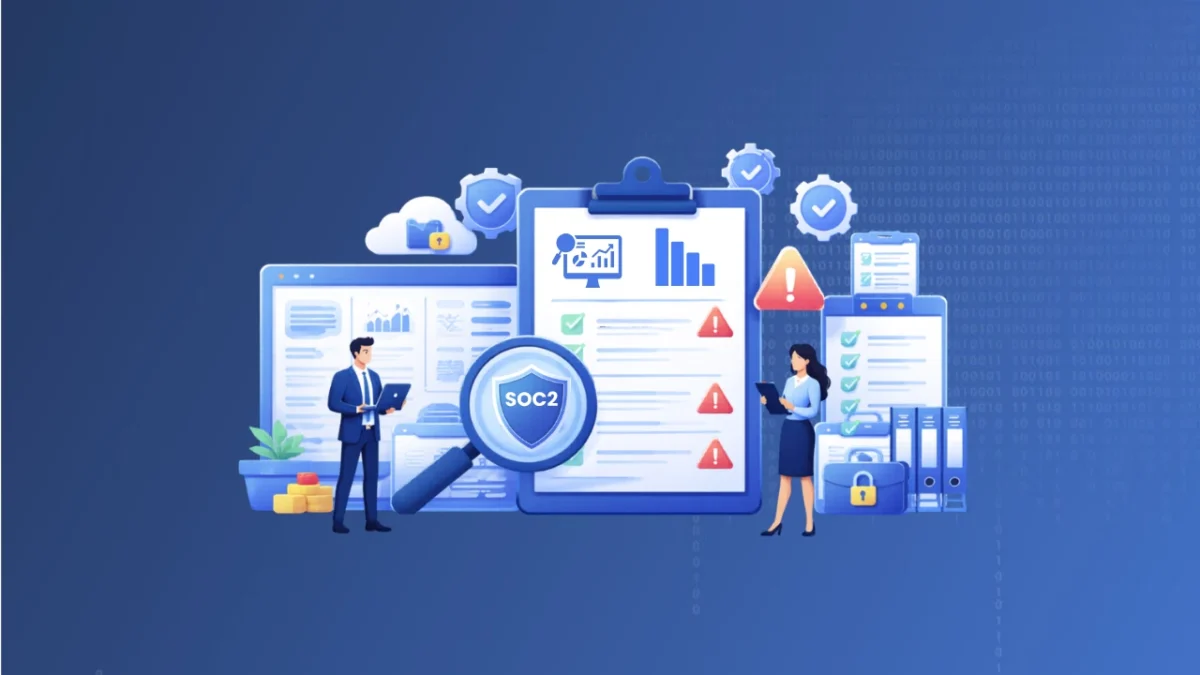
That is the real value of SOC 2 compliance. It gives customers something more useful than a security promise: independently examined evidence about the controls your company has in place to protect the systems and information it handles.

But what does SOC 2 actually prove? And what doesn’t it prove?

Let’s get into it.

First, What Is SOC 2?

SOC 2 is an attestation framework set by the American Institute of Certified Public Accountants (AICPA) to evaluate controls in service organizations that handle customer data and systems.

The AICPA defines SOC 2 around five Trust Services Criteria: security, availability, processing integrity, confidentiality and privacy. An organization doesn’t necessarily have to be tested under all five. It depends on the engagement.

In the case of a SaaS company, it can entail reviewing controls for items like:

  • Who gets access to production systems
  • How user access is administered
  • How security incidents are identified and dealt with
  • How customer information is secured
  • How changes to production systems are controlled
  • Whether systems are monitored and backed up
  • Management of vendors and third parties

In other words, SOC 2 compliance is not simply a case of slapping a “secure” badge on your website. It involves establishing security controls and ensuring those controls work.

SOC Type I vs Type II: What Separates the Two That Affects Your Sales

You have surely heard the term ‘SOC certification’, however, SOC 2 is an attestation report and not a certification. There are two types of SOC reports.

SOC 2 Type 1 looks into whether the controls are designed properly and implemented as of a specified date.

SOC 2 Type 2 goes further by looking into the operating effectiveness of the controls over a specified examination period.

  • So, while Type 1 is asking: “Do you have the right controls?”
  • Type 2 is asking: “Are these controls being executed properly?”

For enterprise buyers, that distinction can be significant. A beautifully written security policy is one thing. Evidence that your team consistently followed the associated process is another.

So, What Does A SOC 2 Report Cover?
SOC 2 Report Cover

A SOC 2 report shows, on the date(s) audited, your organization had documented, operating controls that were mapped to one or more of the Trust Services Criteria: Security (mandatory), Availability, Confidentiality, Processing Integrity, and Privacy.

Security shows up in every report. Availability appears in roughly 55-65% of reports, and Confidentiality in 35-45%, according to Agency Insights’ 2026 market data. Meaning most companies scope in only what their customer base actually requires, not all five.

In practical terms, SOC 2 compliance can provide evidence that:

The company maintains security controls.

The review considers controls applicable to criteria like security, availability, processing integrity, confidentiality, and privacy. It depends on the scope of the engagement which criteria will be used.

Those controls are intended to mitigate specific risks.

SOC 2 reviews how controls help the company fulfill its service commitment and system requirements. You’re not just looking at a list of security tools. You’re looking at whether the organization has processes designed to manage relevant risks.

The company can demonstrate how its controls operate.

A SOC 2 report includes a description of the system being examined and, depending on the report type, information about the auditor’s testing and results. This shows your relevant controls are designed and, for a Type II examination, how effectively those controls operated during the examination period.

Type II report offers evidence over a period of time.

That is one of the reasons why enterprise customers care about Type II vs Type I. Type I only considers controls at a specific moment in time. Type II not only assesses controls but also their effectiveness during the whole period of time.

An independent auditor reviewed the controls.

That’s what makes a SOC 2 report more meaningful than a company’s own claim that it has “robust security.” The auditor performs an examination and provides an opinion within the defined scope.

Common SOC 2 Misconceptions You Need to Understand
SOC 2 Misconceptions

Considering that the average cost of a data breach has hit $4.99 million, per IBM’s 2026 research, which is a rise of 12% year over year, it is easy to conclude that being SOC 2 compliant ensures full protection from a data breach. It doesn’t.

So, here are some things a SOC 2 report does not cover:

Your entire business isn’t secure

An enterprise prospect may still have additional security, privacy, availability or contractual requirements.

Your business doesn’t meet all privacy laws

SOC 2 compliance and compliance with privacy laws are not synonymous. Your business may be required to comply with things like GDPR or HIPAA, even if you’re SOC 2 compliant.

You can still have a data breach
data breach

While SOC 2 assesses your security controls, this doesn’t mean that you will never face cyber threats.

One report doesn’t last forever

A SOC 2 report doesn’t technically expire, but it covers a specific point in time. Type II reports are performed within a specific time frame, and customers expect the latest report, which is normally done yearly.

It’s not just for companies selling to big enterprises

Bessemer Venture Partners data found that 72% of enterprise-track SaaS startups now complete SOC 2 compliance before their Series A, up from just 31% in 2020.

What Else Does Getting SOC 2 Do for You?

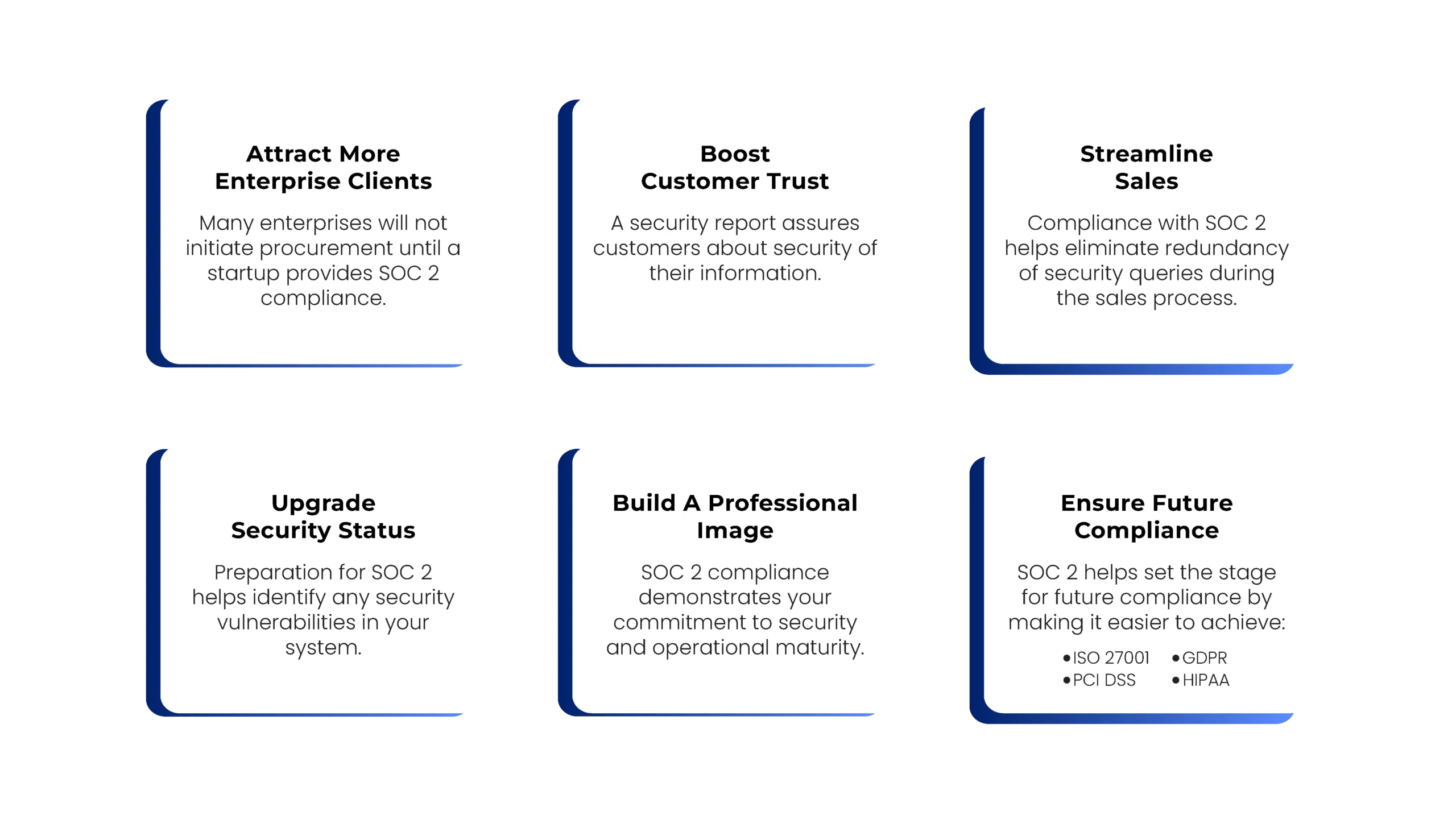
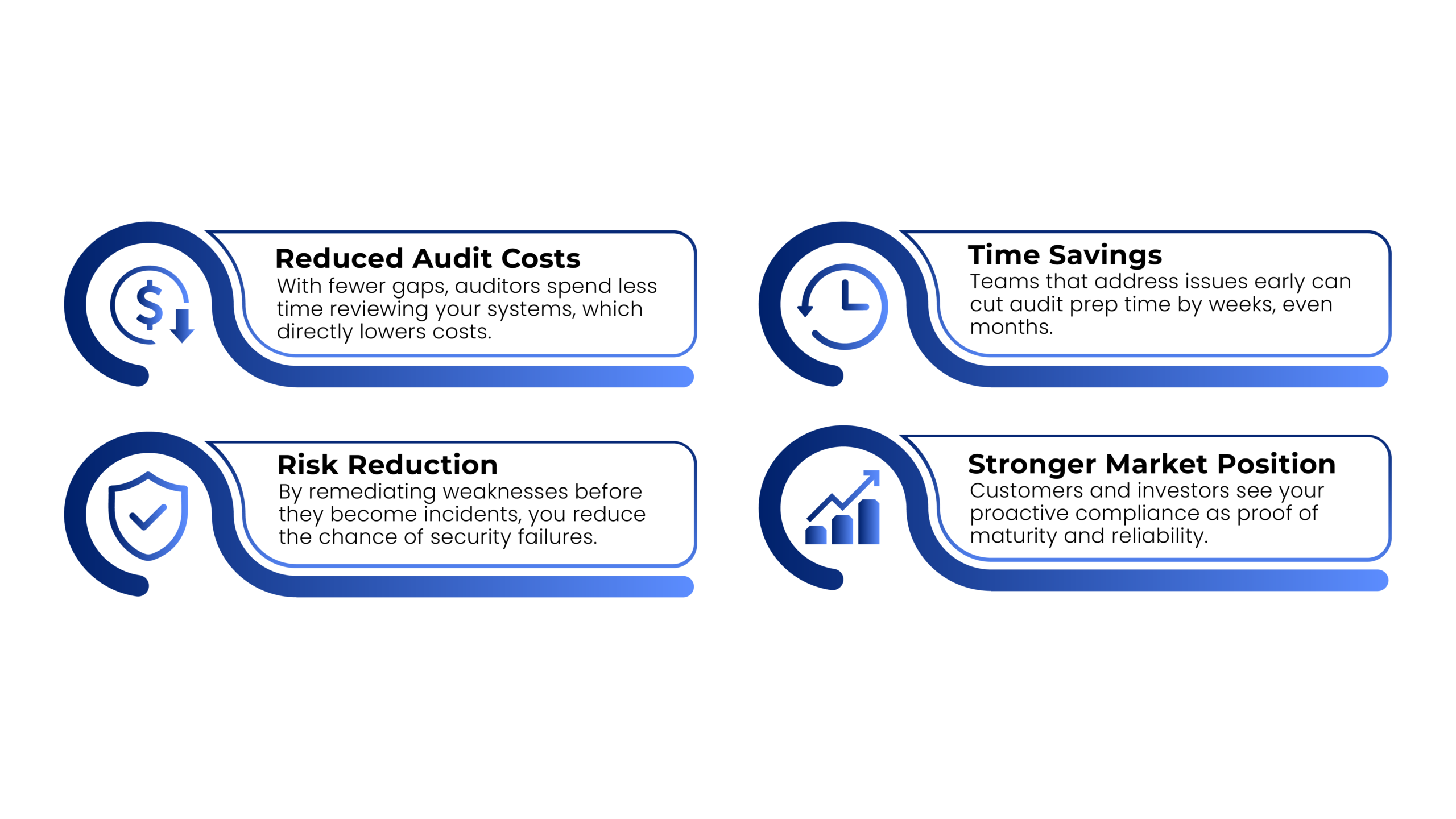
1. Close enterprise deals with fewer obstacles

When purchasing a solution, an enterprise has to evaluate the risk of transferring its information to your application. A SOC 2 report helps your sales and security teams provide something tangible to your audience, rather than explaining everything from scratch every time.

2. Turn security claims into evidence

Saying “we have strong security” doesn’t tell a buyer much. SOC 2 examines the controls behind that claim, including controls related to security, availability, processing integrity, confidentiality and privacy. In other words, a SOC 2 report provides assurance about how access to systems and data is controlled within its defined scope.

3. Identify your gaps before your customers do

Who has access to production data? Are former employees removed promptly? Proof that security assessments were performed? What’s your response to an incident? Preparing for SOC 2 can uncover vulnerabilities that you wouldn’t discover otherwise during regular operation.

4. Build a security program that scales with you

SOC 2 gives you a structured way to establish, operate and demonstrate those controls. And with the right support, getting there doesn’t have to become another massive project competing with your product roadmap. As your customers, team and infrastructure grow, your security processes need to grow with them.

The Practical Takeaway

SOC 2 doesn’t prove you’re perfect; it proves you’re accountable. That someone outside your own organization evaluated how you handle client data and was willing to sign their name on the answer.

For a SaaS start-up seeking to close its first enterprise logos, that is not a compliance checkbox, it’s an asset, and a growing one at that.

The challenge is getting there without turning your engineering team into a full-time compliance department.

That’s where SOCLY.io comes in.

Get SOC 2 Ready Without the Chaos
SOC 2 Ready

Our SOC 2 compliance preparation uses intelligent automation together with hands-on expertise to help SaaS companies move from readiness and gap assessment to implementation, evidence collection, auditing, and compliance.

Rather than trying to piece together evidence through spreadsheets, creating policies from scratch, and identifying gaps during the audit, SOCLY.io will help you determine what’s lacking, develop effective controls, and maintain audit readiness with ongoing monitoring.

Getting ready for SOC 2 compliance, have an enterprise requesting a SOC 2 report, or just looking to find out where your security program stands? Contact SOCLY.io.

Get a custom SOC 2 compliance roadmap for your organization.
Categories
SOC 2

How SOC 2 Automation Reduces Audit Time and Effort?

How SOC 2 Automation Reduces Audit Time and Effort?

How SOC 2 Automation Reduces Audit Time and Effort?

How SOC 2 Automation Reduces Audit Time and Effort?

>How SOC 2 Automation Reduces Audit Time and Effort?

How SOC 2 Automation Reduces Audit Time and Effort?

Learn how SOC 2 Automation streamlines evidence collection, continuous control monitoring, and compliance management to reduce audit time, minimize repetitive work, and improve audit readiness.

How SOC 2 Automation Reduces Audit Time and Effort?

SOC 2 Automation Reduces Audit Time

A SOC 2 audit can be a time-consuming process for a SaaS company when evidence gathering, control monitoring, and documentation are performed manually. SOC 2 Automation takes care of evidence gathering, control monitoring, and compliance management all in one place, continuously.

For SaaS companies undergoing SOC 2 audit for the first time, automation is not only about saving some time but also about getting rid of repetitive processes, minimizing compliance risks, improving audit readiness, and letting security teams concentrate on building their product.

What Is SOC 2 Automation?

SOC 2 Automation makes use of software that enables automation of the processes that occur in preparation for and maintenance of SOC 2 compliance.

It eliminates the need to manually gather evidence from the cloud infrastructure, HR systems, code repositories, identity providers, and other business tools but connects to these tools and gathers the necessary evidence automatically.

Depending on the platform, automation can help with:

  • Evidence collection
  • Security control monitoring
  • Policy management
  • Employee security training tracking
  • Access reviews
  • Vulnerability management
  • Risk assessments
  • Compliance task management
  • Audit preparation
  • Auditor evidence requests

It’s similar to having an automated compliance assistant who keeps checking on important controls and organizing supporting evidence.

Why a Traditional SOC 2 Audit Is Such a Time-Consuming Process

Compliance procedures appear simple enough at first glance.

A startup might maintain a spreadsheet containing its security controls, store policies in Google Drive, collect screenshots from different systems, and assign compliance tasks through email or project-management software. The problem appears when the audit approaches.

Teams suddenly need to answer questions such as:

  • When was this access review completed?
  • Who approved this user?
  • Where is the evidence for this security control?
  • Have employees completed security awareness training? 
  • Has this vulnerability been fixed?
  • Is this evidence collected during the right auditing period?
  • Which controls still need supporting documentation?

Employees may spend hours searching through different systems and manually organizing evidence.

This creates what is often called compliance busywork that is necessary but doesn’t directly contribute to building or improving the company’s product.

How SOC 2 Automation Reduces Audit Time

The biggest advantage of automation is that compliance activities can happen continuously instead of becoming a last-minute project.

Here’s how.

1. Automates Evidence Collection

Automated Evidence Collection is among the most tedious processes when preparing for SOC 2.
Without automation, the team will need to take screenshots, download reports, and export log files.

SOC 2 compliance automation can connect with commonly used business and technology systems to collect relevant evidence automatically.
For example, a SaaS startup may need evidence related to:

User Access

Multi-Factor Authentication

Employee Onboarding and Offboarding

Security Monitoring

Cloud Configuration

Code Changes

Vulneraibility Management

Security Training

Rather than asking an engineer or security manager to collect this information manually, automated integrations can continuously gather relevant evidence.
Result: Less manual evidence chasing and a more organized audit trail.

2. Continuously Monitors Security Controls

Traditional compliance often involves checking controls periodically.
Automation enables continuous monitoring. Rather than manually checking whether access is appropriate, an automated system can monitor the identity and access management system. 

If there is any configuration anomaly, the compliance officer would conduct investigations before the audit takes place.

This changes the approach from:

“Let’s prepare for the audit.”

to:

“We’re continuously ready for the audit.”

That shift can significantly reduce the workload during audit preparation.

3. Reduces Spreadsheet-Based Compliance Work

Spreadsheets can be useful when a company is small.

But as the startup grows, spreadsheet-based compliance becomes increasingly difficult to maintain.

A single compliance spreadsheet might contain:

  • Control owners
  • Evidence status
  • Risk information
  • Task deadlines
  • Policy status
  • Audit requests

As more individuals make changes to the spreadsheet, errors and out-of-date information may arise.

Having a dedicated compliance management system for SOC 2 compliance will consolidate all this information and provide a better understanding of the compliance progress.

The compliance officers will no longer have to ask various people for an update since the information will be in one place.

4. Makes Audit Evidence Easier to Find

It is necessary for auditors to gather evidence of proper design and effective operation of controls.

The process of finding appropriate evidence manually can be very time-consuming.

Using SOC 2 audit automation, evidence can be organized by controls, and it becomes easy to determine what evidence is available and what needs to be gathered.

Example:

Control: Access to production systems is restricted.

Supporting evidence might include:

  • Access-control configuration
  • User access lists
  • Access review records
  • Employee termination records
  • Approval documentation

When this information is organized within a compliance platform, teams spend less time searching for individual files.

5. Automates Employee Compliance Tasks

SOC 2 isn’t only a technical exercise.

The employees might have to undergo security awareness training, accept corporate policies, be involved in access reviews, or do other things related to compliance.

Manual tracking of all this might become challenging with the increase in the size of the team.

Automation will help manage these compliance activities. 

For example:

  1. A new employee joins the company.
  2. Required security training is assigned.
  3. The employee receives notifications.
  4. Completion is recorded.
  5. The compliance dashboard updates automatically.

This removes repetitive administrative work from HR and security teams.

How SOC 2 Automation Speeds Up Audit Preparation

The most common error made by startups is that they consider the SOC 2 readiness project as something they have to do just once.

What startups should focus on is continuous readiness.

Through automation, there are many processes that can occur throughout the year:

Continuous monitoring → Automated evidence collection → Compliance gap detection → Remediation → Audit-ready evidence

At the start of the audit engagement, some of the evidence might already have been gathered.

Example: A SaaS Startup Preparing for SOC 2

Imagine a 40-person SaaS company preparing for its first SOC 2 audit.

With a manual process, the team might need to:

The CTO, engineering team, HR team, and operations staff may all become involved.

With SOC 2 compliance automation, many of these activities can be tracked continuously.

The compliance department will discover any gaps in advance, while integration processes will help preserve all evidence during the auditing period.

The difference isn’t just speed. It’s predictable.

How to Automate SOC 2 Compliance: A Practical Approach

If you’re wondering how to automate SOC 2 compliance, start with the processes that consume the most manual time.

Step 1: Identify Repetitive Compliance Tasks

List every recurring compliance activity.

Look for tasks such as:

  • Manual screenshots
  • Spreadsheet updates
  • Evidence requests
  • Access reviews
  • Training reminders
  • Policy acknowledgments
  • Vulnerability tracking

These are strong candidates for automation.

Step 2: Map Controls to Your Existing Systems

Identify where the evidence already exists.

For example:

  • Identity provider → Access information
  • Cloud provider → Infrastructure configuration
  • HR platform → Employee lifecycle information
  • Code repository → Development activity
  • Ticketing system → Security remediation records

The objective is to connect compliance requirements with the systems that already generate the evidence.

Step 3: Choose a SOC 2 Compliance Platform

When evaluating a platform, SaaS startups should look beyond the number of integrations.

Consider:

  • Automated evidence collection
  • Continuous monitoring
  • Control mapping
  • Policy management
  • Risk management
  • Task automation
  • Auditor collaboration
  • Reporting capabilities
  • Ease of implementation
  • Scalability

The best SOC 2 automation platform for startups isn’t necessarily the platform with the longest feature list. It should be one that fits your existing technology stack and reduces the amount of manual compliance work your team performs.

Step 4: Establish Continuous Monitoring

Once your systems are connected, configure monitoring around important controls.

Don’t wait until the audit begins to discover compliance gaps.

Continuous monitoring allows your team to identify and address issues earlier.

Step 5: Review Your Compliance Dashboard Regularly

Automation does not remove human accountability.

There needs to be someone to check compliance status, investigate alerts, assign remediation actions, and make risk decisions. 

Automation handles repetitive tasks; decision-making remains your responsibility. 

SOC 2 Automation vs. Manual Compliance
AreaManual ComplianceSOC 2 Automation
Evidence collectionRepeated manuallyAutomated/continuous
MonitoringPeriodic checksContinuous monitoring
DocumentationMultiple folders/spreadsheetsCentralized platform
Employee tasksManual remindersAutomated workflows
Audit preparationOften last-minuteContinuous readiness
Gap detectionManual reviewsAutomated alerts
ScalabilityBecomes harder over timeEasier to scale

The key difference is consistency.

Manual systems rely largely on people knowing what is required. Automation enables repetitive processes to keep running even when the team is occupied. 

What SOC 2 Automation Doesn’t Replace

Automation is powerful, but it doesn’t mean your startup can completely remove people from the compliance process.

You still need people to:

  • Define security policies
  • Assess business risks
  • Make security decisions
  • Investigate unusual activity
  • Remediate issues
  • Assign control ownership
  • Communicate with auditors
  • Maintain an appropriate security culture

Automation does not aim at eliminating the human element in compliance processes.

Rather, it is about eliminating the unnecessary human effort and enabling people to make better decisions.

Key Benefits of SOC 2 Automation for SaaS Startups

For growing SaaS companies, the benefits extend beyond the audit itself.

SOC 2 Automation Reduces Audit Time
Is SOC 2 Automation Worth It for a Startup?

For a very small company with limited systems, manual compliance may initially be manageable.

But automation becomes increasingly valuable when:

  • Your company is preparing for its first SOC 2 audit.
  • You have multiple cloud and SaaS systems.
  • Your team is growing quickly.
  • Engineers are spending significant time on compliance tasks.
  • Customers are requesting security documentation.
  • You plan to pursue additional compliance frameworks.
  • You need continuous evidence collection.

For startups selling to enterprise customers, reducing compliance friction can also help security reviews and customer due diligence move more efficiently.

How SOCLY.io Helps SaaS Startups Automate SOC 2 Compliance

It is quite time-consuming for SaaS companies to manage SOC 2 manually. SOCLY.io allows you to streamline compliance management by integrating the whole process of evidence, control, task, and audit management.

With SOCLY.io, startups can:

  • Automate the process of gathering evidence.
  • Perform compliance monitoring continuously rather than just preparing for an audit.
  • Centralize the tracking of your controls and compliance risks.
  • Efficiently manage your policies and compliance activities.
  • Organize audit evidence to simplify the management of auditor requests.

SOCLY.io eliminates spreadsheets, scattered information, and manual tracking allowing SaaS companies to focus more on their product and growth than on compliance management. 

Frequently Asked Questions

1.How can SOC 2 automation save time in audits?

SOC 2 automation can save time in audits by automating evidence collection, control monitoring, compliance processes, and documentation. This means that there is no need to collect evidence at the end of the auditing period.

 2. How do you automate SOC 2 compliance?

SOC 2 compliance can be automated by identifying repeatable compliance activities,   integrating your current business and technology systems with a compliance management system, automating evidence gathering and monitoring, and continuous tracking of control performance and remediation.

3. What is SOC 2 audit automation?

The SOC 2 audit automation process entails automating repetitive processes that are involved in SOC 2 audit preparation, such as evidence gathering, control, task management, and compliance documentation using software.

4. Is SOC 2 automation suitable for SaaS startups?

Yes. SOC 2 automation can prove to be very useful for SaaS startup companies, since these usually operate in cloud environments, use multiple SaaS applications, and have remote employees.

5. What should I look for in a SOC 2 compliance platform?

Look for automated evidence collection, continuous monitoring, integrations with your technology stack, control mapping, policy management, risk tracking, remediation workflows, and features that make auditor collaboration easier.

6. Does SOC 2 automation eliminate the need for an auditor?

Not at all. SOC 2 automation aids in the gathering of evidence, control testing, and compliance activities; however, an independent auditor is still necessary in order to evaluate if the company’s controls meet SOC 2 requirements.

7. How does SOC 2 automation speed up audit preparation?

SOC 2 automation simplifies the process of auditing preparation by doing most of the job through continuous evidence gathering, controls monitoring, detecting gaps, and documenting everything.

Conclusion: Make SOC 2 Compliance Less Manual

SOC 2 should not be made into a regular fire drill for your SaaS startup.

SOC 2 Automation makes it possible to turn the concept of compliance into an ongoing and organized process that is not merely based on spreadsheets, screenshots, emails, and urgent requests.

This can help startups cut down the time and effort needed for audits.

But more importantly, by leveraging automation, you allow your security and engineering teams to dedicate less time to proving the existence of controls and more time enhancing the underlying systems. 

If your startup is ready to undergo SOC 2 attestation or seeks to automate its existing compliance process, consider using SOCLY.io services.

Ready to reduce the manual work behind SOC 2?
Categories
SOC 2

SOC 2 Type I vs Type II: Which One Does Your Startup Really Need?

SOC 2 Type I vs Type II: Which One Does Your Startup Really Need?

SOC 2 Type I vs Type II: Which One Does Your Startup Really Need?

SOC 2 Type I vs Type II: Which One Does Your Startup Really Need?

>SOC 2 Type I vs Type II: Which One Does Your Startup Really Need?

SOC 2 Type I vs Type II: Which One Does Your Startup Really Need?

Understand the key differences between SOC 2 Type I and Type II, including their timelines, costs, benefits, and how to choose the right report for your startup's compliance journey.

SOC 2 Type I vs Type II: Which One Does Your Startup Really Need?

SOC 2 Type I vs Type II

Trust is among the major competitive advantages that SaaS startups have. Besides the impressive features offered, enterprise clients require assurance that your company will be able to handle and keep their confidential information. This is the reason many startups start their road to compliance from SOC 2.

Nevertheless, one of the common questions raised at the very beginning of the process is which SOC 2 report should your startup choose, SOC 2 Type I or SOC 2 Type II?

The choice of the report may influence your sales process, reputation, compliance process, budget and others. Despite the fact that both SOC 2 reports are based on the Trust Services Criteria, they serve different purposes and stages of development.

This article will explain the difference between SOC 2 Type I and Type II, analyze their advantages, timelines, costs and will help you make your choice.

What Is SOC 2?

SOC 2 (System and Organization Controls 2) is a security certification framework created by the American Institute of Certified Public Accountants (AICPA). This framework assesses how companies secure the data of customers through the Trust Services Criteria.

The five Trust Services Criteria include:

  • Security
  • Availability
  • Processing Integrity
  • Confidentiality
  • Privacy

Most software-as-a-service (SaaS) companies start off with security and then broaden their horizons based on customer needs and regulations.

What Is SOC 2 Type I?

The SOC 2 Type 1 Report looks at whether your company’s security controls are designed correctly at a particular point in time.

It can be seen as an image of your organization’s compliance program.

Your auditor will assess whether the correct policies, procedures, and security controls have been put in place.

Best suited for:

  • Early-stage SaaS startups
  • Companies preparing for enterprise sales
  • Organizations beginning their compliance journey
What Is SOC 2 Type II?

A SOC 2 Type II report goes a step further.

Instead of reviewing controls at one point in time, auditors evaluate how effectively those controls operate over a defined period typically between three and twelve months.

This demonstrates that your organization not only designed effective controls but consistently follows them.

Best suited for:

  • Growth-stage SaaS companies
  • Businesses selling to enterprise customers
  • Companies renewing enterprise contracts
  • Organizations with mature security processes
SOC 2 Type I vs Type II: Key Differences

Feature

SOC 2 Type I

SOC 2 Type II

Evaluation

Point-in-time assessment

Assessment over a defined period

Focus

Design of controls

Design and operating effectiveness

Audit Duration

Shorter

Longer

Customer Confidence

Good

Stronger

Enterprise Acceptance

Moderate

High

Best For

Startups beginning compliance

Growing SaaS companies

The distinction between SOC 2 Type I and SOC 2 Type II will assist startup companies in deciding which report is appropriate for their objectives at that particular stage of their business.

Which SOC 2 Report Does My Startup Need?

There are many startup founders who would like to know: Which SOC 2 report do you require

Choose SOC 2 Type I if you:

  • Are preparing for your first enterprise customers
  • Need to demonstrate security controls quickly
  • Are building your compliance program
  • Have limited resources and time

Choose SOC 2 Type II if you:

  • Already have enterprise customers
  • Receive frequent security questionnaires
  • Need stronger proof of ongoing compliance
  • Want a competitive advantage during procurement
SOC 2 Type I vs Type II Timeline

One of the biggest considerations for startups is implementation time.

SOC 2 Type I

  • Preparation: 4–8 weeks
  • Audit: 2–4 weeks

SOC 2 Type II

  • Preparation: 4–8 weeks
  • Observation period: 3–12 months
  • Audit completion after observation

The exact SOC 2 Type I vs Type II timeline depends on your organization’s readiness and the maturity of your security controls.

SOC 2 Type I vs Type II Cost

Budget is another common consideration.

The SOC 2 Type I vs Type II cost varies depending on:

  • Company size
  • Infrastructure complexity
  • Number of systems
  • Scope of audit
  • Auditor selection
  • Compliance readiness

Although Type II generally costs more because of its extended evaluation period, many organizations see greater long-term value through improved customer trust and faster enterprise sales.

SOC 2 Type I vs Type II Benefits

Benefits of SOC 2 Type I

  • Faster compliance
  • Shorter audit timeline
  • Demonstrates security commitment
  • Helps begin enterprise conversations

Benefits of SOC 2 Type II

  • Higher customer confidence
  • Stronger competitive advantage
  • Greater enterprise acceptance
  • Demonstrates continuous security practices
  • Supports larger procurement processes

Understanding the SOC 2 Type I vs Type II benefits helps organizations choose the right investment based on business objectives.

Why SOC 2 Compliance Matters for Startups

Strong SOC 2 compliance for startups provides benefits beyond passing an audit.

It helps organizations:

  • Build customer trust
  • Accelerate enterprise sales
  • Reduce lengthy security reviews
  • Improve internal security processes
  • Strengthen operational maturity

For SaaS businesses, SOC 2 often becomes a key differentiator when competing for enterprise customers.

Common Mistakes Startups Make

Many startups delay compliance until customers request it.

Common mistakes include:

SOC 2 Type I vs Type II

Planning early helps reduce stress and speeds up certification.

How SOCLY.io Helps Simplify SOC 2 Compliance

SOC 2 audit for SaaS startups is usually tedious if done manually. Gathering proof, creating documentation, checking controls, and getting ready for audits often take lots of effort.

SOCLY.io makes the process of compliance easy with the help of an automated solution.

With SOCLY.io, organizations can:

  • Automate evidence collection
  • Monitor security controls continuously
  • Centralize policies and documentation
  • Find compliance gaps early on
  • Streamline audit prep process
  • Be audit-ready all year round with continuous monitoring

Whatever your situation, be it your first SOC 2 Type I attestation report or SOC 2 Type II audit prep, SOCLY.io will help make it  easier.

Frequently Asked Questions

What is the difference between SOC 2 Type I and Type II?

SOC 2 Type I is concerned with evaluating the design of the control over a particular period of time, whereas SOC 2 Type II examines the design as well as effectiveness of the control over a period of time.

What SOC 2 report do I need for my startup?

While startups tend to begin with Type I, Type II SOC 2 is beneficial for companies dealing with enterprise customers.

How long does it take to perform a SOC 2 audit?

Type I audit can be performed quite quickly after preparation, as it usually takes no more than a few weeks. However, Type II includes an observation period of three to twelve months.

Is SOC 2 Type II better than Type I?

While Type II offers better proof of consistent compliance and is generally favored by enterprise customers, the decision should be made based on your current stage and the needs of your customers.

Can startups meet the SOC 2 standards?

Absolutely. Startups can easily get SOC 2 certification by setting up security controls and automation tools to facilitate compliance.

Conclusion

The choice between SOC 2 Type I and Type II depends on the current and future positioning of your startup. Type I will help you to prove that your security controls are properly designed, whereas Type II will be useful when you need to show that your controls function as intended.

Instead of perceiving the process of becoming compliant as a formality, successful SaaS companies leverage SOC 2 to establish trust, accelerate sales processes, and set themselves up for success.

Looking to get started with your SOC 2 certification?

Contact Us or Visit our website to see how SOCLY.io can assist your startup with becoming audit ready in less time.

Categories
SOC 2

What Is SOC 2 Compliance for SaaS Startups? A Complete Guide

What Is SOC 2 Compliance for SaaS Startups? A Complete Guide

What Is SOC 2 Compliance for SaaS Startups? A Complete Guide

What Is SOC 2 Compliance for SaaS Startups? A Complete Guide

>What Is SOC 2 Compliance for SaaS Startups? A Complete Guide

What Is SOC 2 Compliance for SaaS Startups? A Complete Guide

Learn how SOC 2 Compliance empowers SaaS startups to protect customer data, earn enterprise trust, simplify security audits, and accelerate growth with confidence.

What Is SOC 2 Compliance for SaaS Startups? A Complete Guide

SOC 2 Compliance for SaaS Startups

Starting up a SaaS company is an exhilarating process, but gaining the trust of customers may be as difficult as making the product itself. In today’s world, companies demand proof that their confidential information is safe before signing up.

That’s where SOC 2 Compliance for SaaS Startups comes in. Whether you’re selling to small businesses or enterprise customers, SOC 2 demonstrates that your company follows recognized security and privacy standards. It has become an advantage for many SaaS startups rather than a compliance obligation.

In this guide, you’ll find all the information about SOC 2 Compliance for SaaS Startups including its significance, procedures to follow, and how automation software such as SOCLY.io can facilitate everything.

What Is SOC 2 Compliance for SaaS Startups?

SOC 2 Compliance for SaaS Startups refers to the independent security audit which confirms whether the SaaS company has proper controls in place to secure client data.

The auditing process follows the Trust Services Criteria (TSC), created by the American Institute of Certified Public Accountants (AICPA). The TSC evaluates your organization’s controls for: 

  • Security
  • Availability
  • Processing Integrity
  • Confidentiality
  • Privacy

As opposed to other frameworks that only emphasize technical Configurations, SOC 2 Compliance will look into your organization’s people, processes, policies, and technology.

Simple Example

Imagine your SaaS platform stores customer payroll information.

Without SOC 2:

  • Customers must simply trust your security claims.

With SOC 2:

  • An independent auditor verifies your security controls, giving customers confidence that their data is protected.
Why SOC 2 Compliance Matters for SaaS Startups

Consumers now not only want functionality from software solutions but also security.

Based on various industry surveys, security issues constitute one of the major barriers for enterprise buyers when considering SaaS providers.

SOC 2 ensures that startups can get rid of such barriers by showing that security becomes part of day-to-day activities.

Key Benefits

  • Builds customer trust faster
  • Speeds up enterprise sales cycles
  • Reduces lengthy security questionnaires
  • Improves internal security practices
  • Supports investor due diligence
  • Strengthens competitive positioning
  • Helps meet procurement requirements
Why Enterprise Customers Ask for SOC 2

Many large corporations usually have strong vendor risk management programs.

When it comes to buying software, they generally inquire:

  • How do you protect customer data?
  • Do you have security monitoring?
  • How do employees access sensitive information?
  • Is your infrastructure secure?
  • Have you been independently audited?

This SOC 2 report provides the answer to all these queries, thus making procurement much simpler.

Understanding the Five Trust Services Criteria

SOC 2 is built around five security principles.

1. Security

Protects systems from unauthorized access through:

  • Multi-factor authentication (MFA)
  • Firewalls
  • Encryption
  • Access controls
  • Security monitoring

This is the only mandatory criterion.

2. Availability

Ensures your service remains accessible and reliable.

Examples include:

  • System monitoring
  • Backup strategies
  • Disaster recovery
  • Incident response

3. Processing Integrity

Confirms that your application processes data accurately and consistently.

Examples:

  • Input validation
  • Automated testing
  • Error monitoring
  • Data verification

4. Confidentiality

Protects confidential business information through:

  • Encryption
  • Secure storage
  • Role-based access
  • Data classification

5. Privacy

Ensures personal information is collected, stored, and deleted responsibly.

Examples include:

  • Privacy policies
  • Consent management
  • Data retention procedures
SOC 2 Type I vs. SOC 2 Type II

Many startups are unsure which report they need.

SOC 2 Type I

SOC 2 Type II

Reviews controls at a single point in time

Evaluates controls over several months

Faster to obtain

More trusted by enterprise customers

Good for early-stage startups

Preferred by larger organizations

Many SaaS startups begin with Type I and later move to Type II as they mature.

Who Needs SOC 2 Compliance?

SOC 2 is especially valuable for companies that:

  • Offer cloud-based software
  • Handle customer information
  • Process financial data
  • Store healthcare information
  • Serve enterprise clients
  • Work with regulated industries

Examples include:

  • HR software
  • CRM platforms
  • AI SaaS applications
  • FinTech startups
  • HealthTech companies
  • Collaboration tools
  • Marketing automation platforms
How to Achieve SOC 2 Compliance for SaaS Startups

In case you are thinking about how to attain SOC 2 Compliance for SaaS companies, the task is quite feasible with the help of the following steps.

Step 1: Define the Audit Scope

Identify:

  • Systems
  • Applications
  • Cloud infrastructure
  • Employees
  • Vendors

that affect customer data.

Step 2: Perform a Gap Assessment

Review your existing security controls.

Look for gaps in:

  • Access management
  • Logging
  • Policies
  • Monitoring
  • Vendor management
  • Incident response

Step 3: Create Security Policies

Develop documented policies for:

  • Information security
  • Password management
  • Asset management
  • Vendor management
  • Business continuity
  • Incident response

Step 4: Implement Technical Controls

Examples include:

  • Multi-factor authentication
  • Endpoint protection
  • Centralized logging
  • Encryption
  • Vulnerability scanning
  • Security monitoring

Step 5: Collect Compliance Evidence

Gather documentation such as:

  • Employee onboarding records
  • Access reviews
  • Security logs
  • Backup reports
  • Vendor assessments

Step 6: Conduct Internal Reviews

Verify that your controls are operating effectively before the audit.

Step 7: Complete the SOC 2 Audit

An independent CPA firm evaluates your controls and issues your SOC 2 report.

Common Challenges SaaS Startups Face

Many startups assume SOC 2 is only about installing security tools.

In reality, most challenges involve building repeatable security processes.

Common obstacles include:

  • Limited security staff
  • Manual evidence collection
  • Missing documentation
  • Inconsistent employee practices
  • Rapid infrastructure changes
  • Tight startup budgets

Automation significantly reduces these challenges.

Benefits of SOC 2 Compliance for SaaS Startups

SOC 2 compliance can help SaaS startups reap numerous benefits apart from merely surviving an audit.

SOC 2 Compliance for SaaS Startups
SOC 2 Compliance Checklist

Use this checklist before beginning your audit:

✅ Multi-factor authentication enabled

✅ Security policies documented

✅ Employee security training completed

✅ Incident response plan established

✅ Vendor risk management process implemented

✅ Regular vulnerability scans

✅ Access reviews conducted

✅ Backup and disaster recovery tested

✅ Logging and monitoring enabled

✅ Independent audit scheduled

How SOCLY.io Helps SaaS Startups Achieve SOC 2 Compliance

SOC 2 compliance manually can be quite an extensive process taking months for documenting and gathering evidence and continuous monitoring. This is especially challenging for the rapidly growing SaaS companies because it distracts engineers and operations teams from developing products.

SOCLY.io will help you to simplify all the processes of compliance with SOC 2 through automation. By automating compliance workflows and continuously monitoring security controls, SOCLY.io helps startups improve both SaaS Security Compliance and Data Security for SaaS without adding unnecessary manual effort. 

Key Benefits of SOCLY.io

Automated Evidence Collection

Evidence gathering for compliance is done automatically by SOCLY.io through your cloud infrastructure and tooling.

Continuous Compliance Monitoring

Instead of checking controls only before an audit, SOCLY.io will provide you with continuous monitoring of your security posture.

Policy and Documentation Management

Manage all the security policies needed from a single platform to make sure you always stay ready for an audit.

Seamless Integrations

SOCLY.io integrates with all major cloud platforms, identity providers, HR systems, source code repositories, and productivity applications.

Faster Audit Readiness

Thanks to automated processes, built-in checklists, and real-time compliance management, SOC 2 preparation will happen much quicker in comparison with the conventional approach.

Built for Growing SaaS Companies

Whether you are getting ready for your initial SOC 2 Type I assessment or working on maintaining Type II compliance, SOCLY.io is scalable enough to suit your business and helps make compliance easier.

In case your startup needs to decrease its focus on compliance management and increase its product development activities, SOCLY.io is a good choice for attaining and maintaining SOC 2 compliance.

Beyond meeting customer expectations, SOC 2 also strengthens overall SaaS Security Compliance, making it easier for startups to demonstrate their commitment to security during vendor assessments and enterprise procurement processes. 

Best Practices for Maintaining SOC 2 Compliance

SOC 2 isn’t a one-time project.

Maintain compliance by:

  • Monitoring security continuously
  • Reviewing user access regularly
  • Updating policies annually
  • Conducting employee security training
  • Performing internal audits
  • Managing vendor risks
  • Tracking security incidents

Consistency is essential for long-term compliance success.

Frequently Asked Questions (FAQs)

1. What is SOC 2 compliance for SaaS Startups?

SOC 2 compliance means that you have conducted an independent audit confirming the presence of effective measures to ensure the protection of customer information following the AICPA Trust Services Criteria.

2. How long does it take to achieve SOC 2 compliance for SaaS startups?

It depends on your security maturity level. Most startups conduct a Type I audit within several months while conducting a Type II audit involves proving the effectiveness of your measures throughout the observation period.

3. Is SOC 2 mandatory for SaaS startups?

SOC 2 compliance is not legally obligatory, however, many enterprises require SOC 2 from SaaS companies.

4. What are the benefits of SOC 2 compliance for SaaS startups?

There are several benefits of obtaining SOC 2 for startups including gaining customer trust, getting enterprise clients, improving the quality of security practices, reducing sales cycles and enhancing your company’s reputation in the market.

5. How can startups simplify SOC 2 compliance?

Conducting SOC 2 audits becomes easier with the help of the automated compliance platform like SOCLY.io.

6. What is the difference between SOC 2 Type I and Type II?

Type I is a security assessment done on certain controls at a certain point in time, whereas Type II is a security assessment of the effectiveness of these controls over several months.

Conclusion

In the case of modern SaaS companies, security is not an option anymore, but a major element of getting more clients and growing. SOC 2 Compliance for SaaS Startups is the proof that your company has what it takes to ensure data security and establish trust in the future.

Regardless of whether you are preparing for the first deal with an enterprise client or want to enter a regulated market, reaching SOC 2 compliance will be a strong competitive advantage for your startup.

Instead of managing compliance manually, let SOCLY.io simplify the process.

Ready to simplify your SOC 2 journey? Contact Us Today and take the first step toward faster and smarter compliance.

Categories
SOC 2

Why SOC 2 Is the Most Trusted Security Framework for SaaS Companies

Why SOC 2 Is the Most Trusted Security Framework for SaaS Companies

Why SOC 2 Is the Most Trusted Security Framework for SaaS Companies

Why SOC 2 Is the Most Trusted Security Framework for SaaS Companies

>Why SOC 2 Is the Most Trusted Security Framework for SaaS Companies

Why SOC 2 Is the Most Trusted Security Framework for SaaS Companies

Discover how SOC 2 helps SaaS companies build customer trust, strengthen security, accelerate enterprise sales, and achieve compliance with confidence.

Why SOC 2 Is the Most Trusted Security Framework for SaaS Companies

SOC 2 Most Trusted Security Framework

Trust is the key currency of the SaaS business model. Regardless of how innovative your software offering is, no one is going to want to pay for your product if they do not trust you regarding your approach to security measures. That is precisely why SOC 2 has emerged as the benchmark when it comes to SaaS companies all around the world.

Both startups and enterprise-level SaaS businesses are being required to show evidence of how they protect, handle and process their customers’ personal information in a safe and responsible manner.

In this article, we will find out what makes SOC 2 such a valuable SaaS Security Framework, how it helps startup companies, why SaaS companies need SOC 2 compliance, and why using a SOC 2 Automation Platform can dramatically simplify the compliance journey. 

What is SOC 2?

SOC 2 (System and Organizational Controls 2) is a framework created by the American Institute of Certified Public Accountants to help assess how well businesses handle their customers’ data.

SOC 2 specializes in five criteria of trust services including:

  1. Security
  2. Availability
  3. Processing integrity
  4. Confidentiality
  5. Privacy

While the security Standard is typically required for SaaS companies, others may be selected based on your needs and expectations of your customers.

Unlike generic cybersecurity assessment tools, SOC 2 helps ensure that your controls are working reliably over time.

Why SaaS Companies Should Have SOC 2

Security is Now a Priority Among Buyers

SOC 2 has evolved into a trusted SaaS Security Framework because it combines operational security, continuous monitoring, and independent validation. 

Modern buyers prioritize security more than ever before. For enterprise-level buyers, they even demand SOC 2 compliance before they commit to the deal.

What happens without SOC 2?

  1. Extended sales cycle time
  2. Delayed  procurement process
  3. Loss of potential enterprise customers
  4. Weak consumer trust 

SOC 2 acts as independent proof that your organization takes data security seriously.

SaaS Businesses Handle Sensitive Data

Some of the sensitive data handled by SaaS companies include the following:

  1. Customer details
  2. Transaction details
  3. Employee details
  4. API credentials
  5. Internal communications
  6. Intellectual property

SOC 2 can help protect such data using control processes and security policies.

It Builds Competitive Advantage

In competitive SaaS environments, security could be the most Unique factor.
Consider two vendors whose software is very similar to each other.

  • One is SOC 2 certified.
  • The other one is not.

Enterprises generally prefer SOC 2-compliant vendors since they’re considered less risky.

Why SOC 2 Became the Most Trusted Security Framework
SOC 2 Most Trusted Security Framework

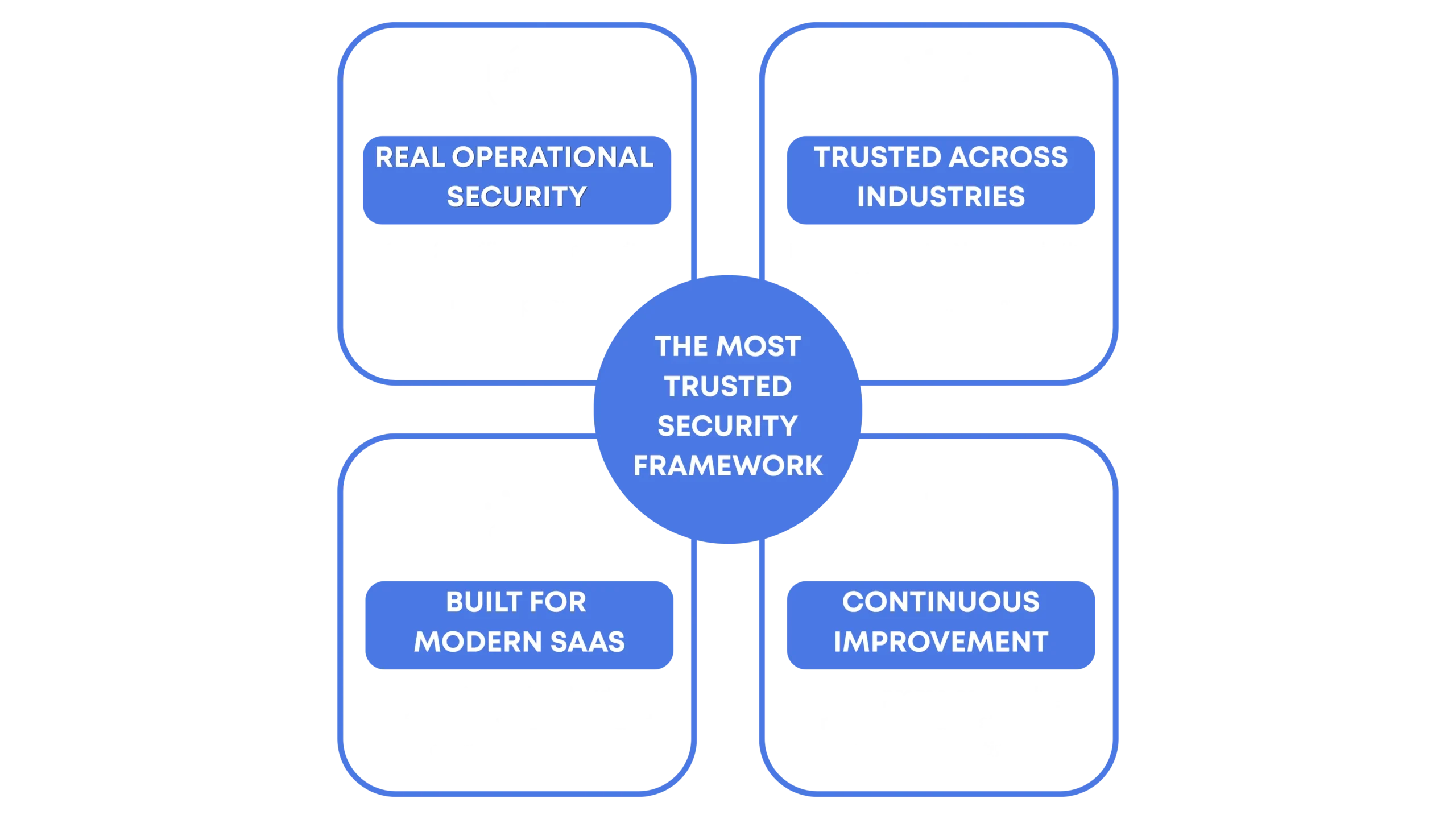
1. It Focuses on Real Operational Security

SOC 2 is not just about documentation. It evaluates how security controls actually function in day-to-day operations.

Auditors examine:

  • Access controls
  • Incident response processes
  • Vendor management
  • Monitoring systems
  • Change management
  • Employee security training

This practical approach makes SOC 2 more credible than surface-level compliance programs.

2. It Is Widely Accepted Across Industries

SOC 2 has become a universal benchmark for SaaS security.

Industries that frequently request SOC 2 reports include:

  • FinTech
  • Health Tech
  • HR Tech
  • EdTech
  • AI platforms
  • Cloud infrastructure providers

Because it is recognized globally, SOC 2 helps SaaS companies scale faster across markets.

3. It Aligns With Modern Cloud Security Needs

Traditional compliance frameworks were not built specifically for cloud-native SaaS environments.

SOC 2, however, fits naturally with:

  • Remote infrastructure
  • Cloud hosting
  • DevOps workflows
  • Continuous deployment
  • Distributed teams

This flexibility makes it especially relevant for modern SaaS startups.

4. SOC 2 Encourages Continuous Improvement

SOC 2 is not a “one-time certification.” It promotes ongoing monitoring and operational discipline.

This encourages companies to:

  • Continuously assess risk
  • Improve security maturity
  • Detect vulnerabilities early
  • Strengthen internal accountability

As cybersecurity threats evolve, continuous compliance becomes essential.

The Growing Importance of SOC 2 Automation Platforms

Manual compliance processes can overwhelm growing SaaS teams. Collecting evidence, tracking controls, and preparing for audits often consume hundreds of hours.

That’s why many companies now use a SOC 2 Automation Platform to simplify SOC 2 Compliance compliance management.

What Does a SOC 2 Automation Platform Do?

A modern automation platform helps organizations:

  • Automate evidence collection
  • Monitor cloud infrastructure
  • Track compliance controls
  • Identify security gaps
  • Simplify audit preparation
  • Reduce manual effort

Instead of managing spreadsheets and screenshots, teams gain centralized visibility into compliance activities. When evaluating the best SOC 2 automation platform for SaaS startups, organizations often look for solutions that reduce manual effort and simplify audit preparation. 

Benefits of Using a SOC 2 Automation Platform

Faster Compliance Readiness

The
best SOC 2 automation platform for SaaS startups can significantly reduce preparation time and improve overall compliance efficiency. Automation greatly cuts down on the time needed for preparing for audits.

Many SaaS businesses reduce compliance cycle times from months to only weeks.

Reduced Human Error

Manual evidence collection often leads to:

  • Missing documentation
  • Inconsistent records
  • Audit delays

Automation provides greater consistency and accuracy in the compliance procedure.

Continuous Monitoring

Effective SOC 2 automation applications continuously monitor systems, whereas other processes perform monitoring at intervals.

This allows security teams to:

  • Detect misconfigurations quickly
  • Rapidly respond to risks
  • Ensure continuous compliance

Increased Team Productivity

Development and Engineering teams are usually responsible for undertaking difficult tasks. With automation, repetitive compliance tasks will be automated to allow teams to focus on product development.

Common Challenges SaaS Startups Face With SOC 2

Limited Security Resources

Since there are no security teams to handle this work, the founders and engineers have to oversee auditing along with developing products.

Fast Changes to the Infrastructure

The infrastructure of a SaaS solution evolves quickly; it’s impossible to stay ahead by documenting everything manually.

Complicated Vendor Environment

Modern SaaS companies depend on:

  • Cloud providers
  • Third-party API integration
  • Tools for collaboration
  • CI/CD systems

Each vendor introduces additional security considerations.

The best way to manage all these elements would be through a SOC 2 Automation Platform. These challenges highlight why SaaS companies need SOC 2 compliance solutions that can scale alongside business growth. 

Practical Example: How SOC 2 Impacts SaaS Growth

Consider a SaaS business that delivers workflow automation solutions for other businesses.

Without SOC 2:

  • Enterprise customers hesitate
  • Procurement teams request additional security reviews
  • Sales cycles stretch for months

After achieving SOC 2 compliance:

  • Buyer trust improves
  • Security questionnaires become easier
  • Enterprise deals close faster

SOC 2 plays an important part in helping SaaS organizations increase their income.

Best Practices for Achieving SOC 2 Compliance

Identify Security Gaps 

First, it is necessary to find out what your company lacks.

Develop Security Policies

Document policies for:

  • Access management
  • Incident response
  • Data retention
  • Employee onboarding
  • Vendor management

Train Employees Regularly

Human error continues to be one of the biggest threats in cybersecurity. Security awareness training is essential.

Automate with a SOC 2 Automation Solution

Automation lowers the cost of operations and makes long-term compliance management easier.

Monitor in Real-Time

Security doesn’t stand still. Real-time monitoring keeps you audit-ready all year round.

Why SOC 2 is Key for Sustainable Growth as a SaaS

SOC 2 isn’t just about boosting your cybersecurity posture. It lays the groundwork for sustainable growth.

As SaaS companies expand:

  • Customer expectations increase
  • Regulatory scrutiny grows
  • Vendor risk management becomes essential

SOC 2 establishes a scalable foundation for handling these challenges efficiently.

How Does SOCLY.io Make It Easy To Gain SOC 2 Compliance?

The journey to SOC 2 compliance is not easy for most growing SaaS companies because of resource constraints, among other reasons. However, using a systematic approach to automate compliance can make things much easier for such organizations. In fact, SOCLY.io provides an easy solution by automating the whole compliance process to ensure ease and efficiency.

Using SOCLY.io makes it easy for SaaS organizations to:

Automatically collect evidence from cloud infrastructure, dev environments, and ID management systems. Monitor compliance controls continuously, thus identifying any gaps. Consolidate policies, controls, risks, and other audit documentation. Save lots of time by automating manual compliance work. Remain ready for audit all year round. Leverage expert advice during the process.

Unlike other compliance solutions that use a consultant-oriented process based on screenshots and spreadsheets, SOCLY.io enables SaaS firms to develop and scale their compliance programs. This way, companies do not spend too much time or energy on compliance while focusing on developing their products and services.

Whether you are getting SOC 2 certified for the first time or simply trying to simplify an already existing program, SOCLY.io makes compliance easier.

Frequently Asked Questions (FAQ)

What is SOC 2 compliance in SaaS?

SOC 2 compliance is a framework designed to measure the level of protection offered by SaaS providers to customers through certain controls and processes.

Why Does SOC 2 Matter to SaaS Startups?

SOC 2 compliance helps startups gain customer trust, close large deals with enterprises, and demonstrate best-in-class security right from the start.

How much time is required for SOC 2 Certification?

It depends on several factors, but typically the entire process takes about 2-6 months to be completed successfully. A SOC 2 Automation Platform can substantially cut down that duration.

Can small SaaS businesses be SOC 2 compliant?

Absolutely. Many new SaaS companies gain SOC 2 compliance through effective security controls and automation solutions.

Is SOC 2 necessary for enterprise SaaS sales?

For most enterprises, SOC 2 is mandatory. Enterprises are demanding that software providers produce SOC 2 reports before any business can be transacted.

Final Thoughts

SOC 2 is well known as the most credible security framework for SaaS providers since it’s not just about meeting compliance standards; it actually assesses security practices that really matter to clients, investors and enterprise users.

For growing SaaS companies, implementing SOC 2 should be a top priority, and not something that you think about when you need to.

With the combination of proven security controls and a reliable SOC 2 Automation Platform, it’s easy to receive SOC 2 compliance and earn your customers’ trust.

Want to lock down your SaaS operations and streamline compliance?

Start now, schedule a consultation or Contact us today.

Categories
SOC 2

How to Conduct a SOC 2 Gap Analysis to Prepare for Your First Audit

How to Conduct a SOC 2 Gap Analysis to Prepare for Your First Audit

How to Conduct a SOC 2 Gap Analysis to Prepare for Your First Audit

How to Conduct a SOC 2 Gap Analysis to Prepare for Your First Audit

>How to Conduct a SOC 2 Gap Analysis to Prepare for Your First Audit

How to Conduct a SOC 2 Gap Analysis to Prepare for Your First Audit

For growing startups and mid-sized businesses, a SOC 2 audit can feel overwhelming. Securing enterprise clients often requires it, but the journey to achieve compliance can seem challenging.

How to Conduct a SOC 2 Gap Analysis to Prepare for Your First Audit

SOC 2 Gap Analysis

For many founders of small and mid-sized companies, the phrase “SOC 2 audit” feels like an approaching storm. Winning big clients means facing it head on  yet the road there? Paved with policy drafts, scattered controls, sudden document demands. Getting ready seems less like a straight line, more like wandering through fog. Each step forward brings another checklist, another question about who did what and when. The goal matters, sure, but the way there trips up even sharp leaders. One day you’re building features, next you’re chasing logs nobody tracked last quarter. Trust needs proof, yes  but proving it takes time most can’t spare. Still, skipping it shuts doors fast. So you start somewhere, even if unsure which folder counts as evidence. No magic fix appears, just steady work piling up behind the scenes.

This moment marks the start of a SOC 2 gap analysis. Picture it like practice just before the main event. When handled carefully, it shows precisely what’s absent, what functions well, besides revealing ways to correct problems ahead of review. Performed properly, fewer hours are spent, expenses drop along with stress when facing that initial audit..

What exactly is a SOC 2 Gap Analysis?

A close look at how your present safeguards line up with SOC 2 standards forms the core of a gap analysis. Well before any outside audit happens, you spot weak points on your own. What exists today gets measured against what’s required – revealing mismatches early. This process helps prepare rather than react when scrutiny arrives

A quick check before the real thing, giving you time to see if your safeguards line up with the TSC rules

  • Security (mandatory for all SOC 2 audits)
  • Availability
  • Confidentiality
  • Processing Integrity
  • Privacy

Start with these five zones, see how your habits stack up. That view shows where you stand. Better yet, skipping the audit unprepared won’t happen when you’ve lined things up ahead.

Why SOC 2 Gap Analysis Matters for Growing Companies

One study found most people leave a business when unsure about data safety. Think about it, founders often pour everything into their idea, yet trust can vanish fast. A solid offering is good. What matters just as much? Proof through a verified audit process. Without a clear path to SOC 2 compliance, big clients stay cautious. They wait. Deals stall. Last year alone saw almost half again as many requests for these reports compared to before. Some companies now refuse any partnership missing this one document. Skipping the groundwork isn’t a risk, it becomes isolation.

Breaking Down the SOC 2 Gap Analysis Process

So, what does a gap analysis actually involve? While every organization’s journey looks a little different, the process can usually be broken into four key steps:

Step 1: Scope the Assessment

Each SOC 2 review follows the Trust Services Criteria Security, Availability, Confidentiality, Processing Integrity, and Privacy. Though Security must always be included, the rest depend on what your company does. A software service working with banks might focus on Availability along with data protection rules. Meanwhile, a health tech firm could place more weight on handling personal information properly. Getting clarity early means less effort spent on areas outside your needs.

Step 2: Map Existing Controls

Start by looking at what’s already there. Build a list of assets, go over rules, look into how systems are set up while walking through daily processes. Strongest gap reviews tackle these four questions

  • What data do we process?

  • Where does it reside?

  • How does it flow through systems?

  • Who has access to it?

Step 3: Identify Compliance Gaps

Start by laying out your controls, then watch weaknesses appear. Perhaps scans for flaws happen only once in a while, rules are outdated, or staff departures get handled differently each time. Some holes show up in tech, say, no data scrambling; others live in routines of poor oversight of system changes  or daily work records spread everywhere, tough to check. Rank these issues by how serious they are and what they mean for operations, so the biggest threats get attention ahead of smaller ones.

Spot gaps across three categories:

  • Technical (weak access controls, no continuous monitoring)
  • Procedural (no incident response plan)
  • Operational (evidence not documented or accessible)

Rank these gaps by urgency and potential business impact.

Step 4: Build a Remediation Plan

Picture how things will roll out step by step dates, key checkpoints, who handles what. Roll changes slowly so daily work stays on track. Begin with must have safeguards like multi-factor authentication. Later bring in less urgent upgrades, say checking system logs more closely.

Different Approaches to SOC 2 Gap Analysis

Some founders start by going through everything themselves, matching rules to what they have now. That path costs less, yet mistakes slip in easily, especially when people are busy. Another route involves bringing in outside firms that specialize in audits or standards checks. These experts offer fresh eyes, though hiring them means spending more. A few weigh both before picking one.

One choice gaining ground? Automated tools that handle compliance tasks. Take SOCLY.io it links straight into existing setups such as cloud services, employee records, or coding platforms. Evidence flows in by itself, controls get matched up on the fly, problems show up instantly. When you are building a company but lack a big team focused on safety checks, this kind of system saves long stretches of effort. Mistakes stay low because oversight becomes continuous, not occasional.

What Founders Often Miss in SOC 2 Gap Analysis

Small to medium businesses often trip over similar issues. Not seeing how much paperwork matters lands many in trouble. When auditors come by, they do not stop at checking if things run; they ask for rules written down, records of who accessed what, signs that checks happen regularly. Skipping these details causes problems. Some teams pour effort into tech fixes but forget about people parts. Training staff on safety steps? Managing third-party risks? These get left behind. What looks strong on the surface cracks under review.

This is why automated platforms like SOCLY.io are so useful automating routine tasks while offering ready made policy blueprints. Dashboards show real-time progress on documentation needs. Monitoring runs nonstop, catching gaps before they become problems. Founders no longer lose sleep building documents step by step. Engineers aren’t interrupted for proof files every few days. All records live in one place, prepared ahead of audits.

A well-executed SOC 2 gap analysis delivers benefits that go far beyond audit prep:

Starting early makes things easier, so aim for three or four months ahead if it is a Type 1 SOC 2 review. When the check needs proof of steady control use, that is the Type 2 kind  counts for half a year, maybe even up to a full one. Begin sooner rather than later; motion beats waiting every single time.

Preparing for the Future of Compliance

When rules grow stricter, while companies expect more, passing SOC 2 feels like earning a common seal of trust across industries.

With platforms such as SOCLY.io, picking either product development or compliance isn’t necessary. Repetitive tasks gathering proof, watching systems are taken care of automatically. Your people spend time moving forward, not checking boxes. What once slowed things down now shows reliability. Deals move faster because confidence grows. Investors notice when responsibility is built into how work gets done.

Starting out on a SOC 2 audit might seem overwhelming at first. Yet clarity often comes from simply knowing where you stand. With a gap analysis, steps become clear and confidence builds along the way.

Starting smart makes SOC 2 feel lighter, almost natural. The correct tools shift the weight  suddenly; it’s not overhead but strength. A good platform turns pressure into progress, slowly building edge instead of stress.

 If you’re ready to simplify your SOC 2 journey. Book a demo with SOCLY.io and see how automation makes compliance faster, easier and investor-ready.

Categories
GDPR ISO 27001 SOC 2

How to Choose the Right Compliance Framework for Your Business

How to Choose the Right Compliance Framework for Your Business

How to Choose the Right Compliance Framework for Your Business

How to Choose the Right Compliance Framework for Your Business

>How to Choose the Right Compliance Framework for Your Business

How to Choose the Right Compliance Framework for Your Business

For tech startups, healthcare entrepreneurs, and e-commerce founders, selecting the right framework is critical: the wrong choice can waste resources, while the right one builds trust and legal assurance..

How to Choose the Right Compliance Framework for Your Business

Right Compliance Framework for Your Business

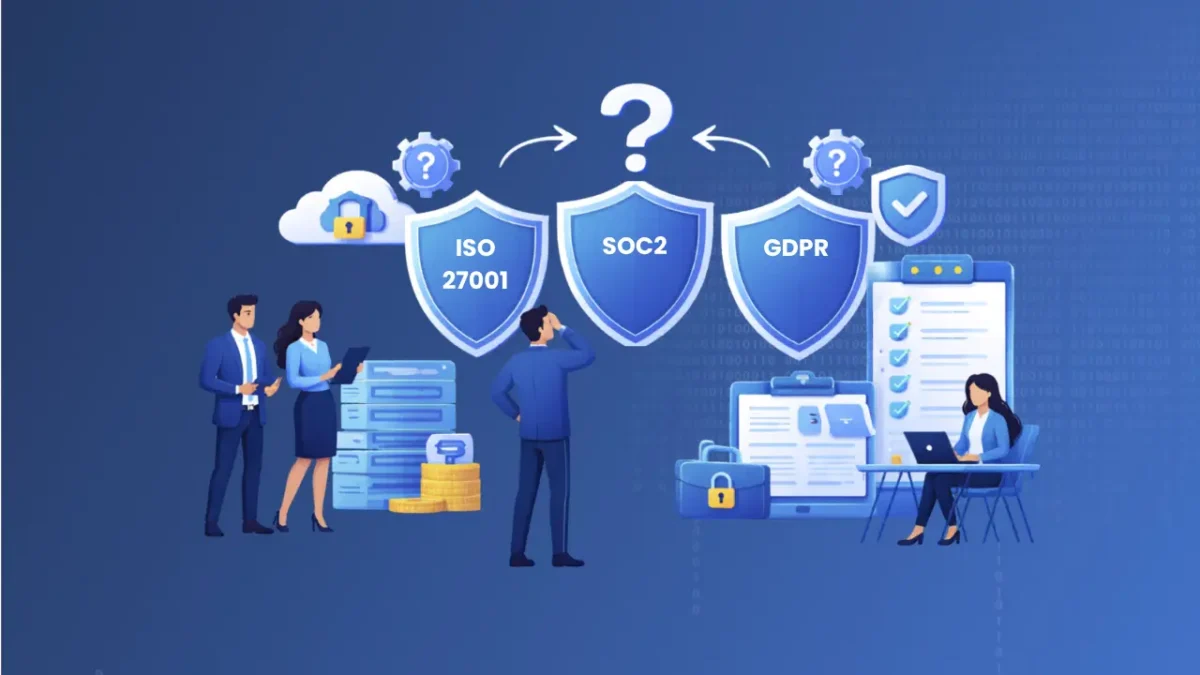
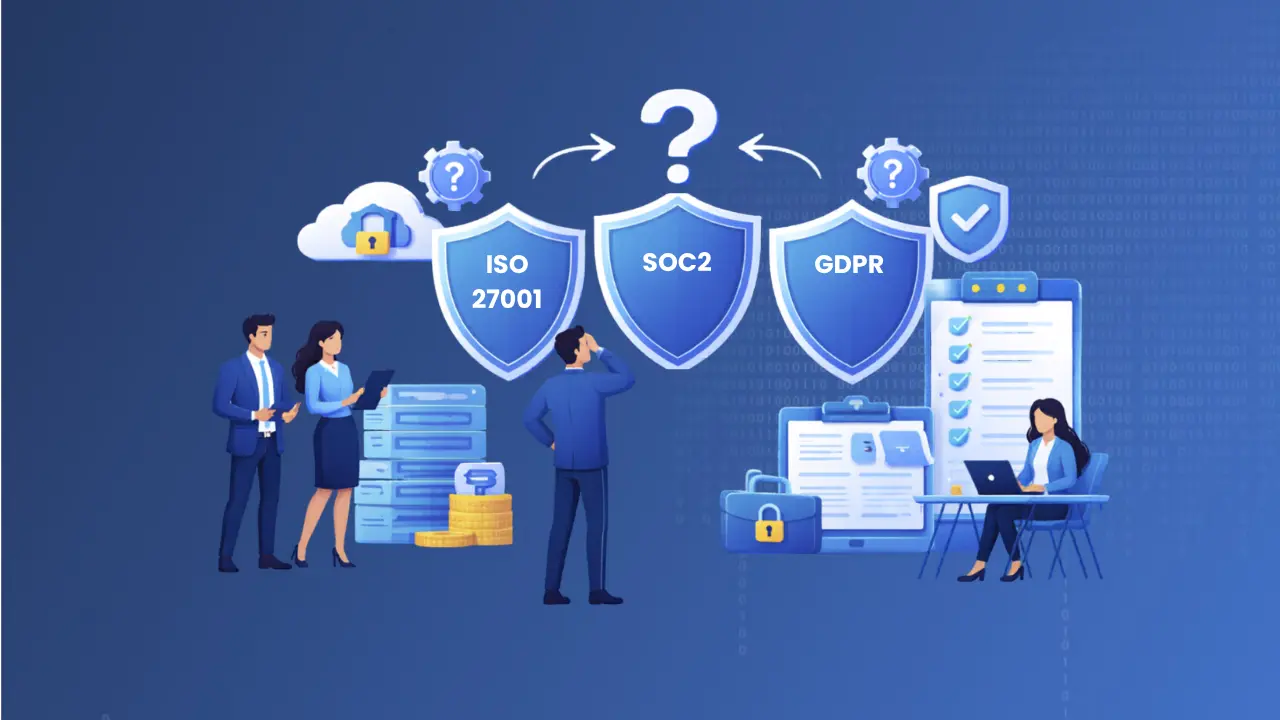
Compliance frameworks are structured guidelines and standards that help companies protect data, manage risks, and meet legal or customer requirements. For tech startups, healthcare entrepreneurs, and e-commerce founders, selecting the right framework is critical: the wrong choice can waste resources, while the right one builds trust and legal assurance. Think of ISO 27001 as one road. SOC 2 shows another way forward. Then there’s HIPAA tighter, focused. GDPR walks its own line across borders. One rule guards patient details. Another watches how info moves globally. Each sets limits based on work type. Who needs what shifts fast. A small app maker may skip some steps. Big clients demand proof sometimes. Matching needs to rule matters most here. Fit drives less stress later. Rules shape around people served usually. Business kind shapes tool choice always.

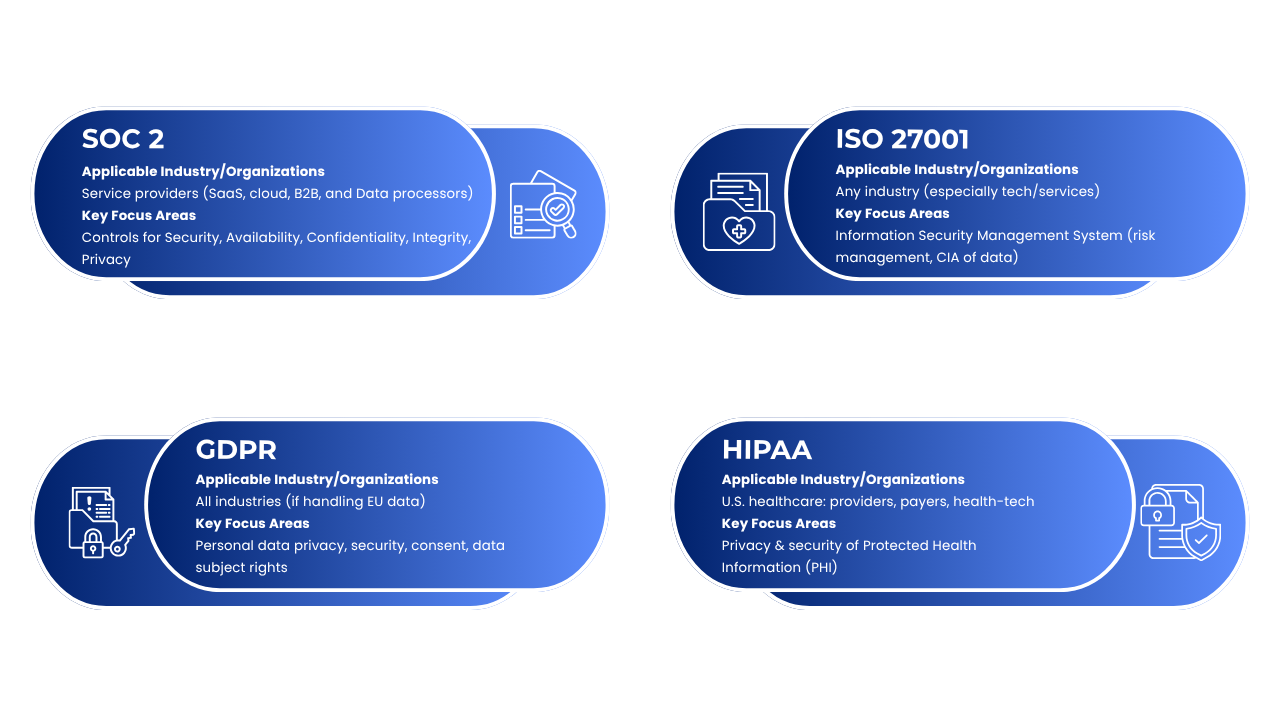
ISO 27001 Global Standard for Information Security

One way to look at ISO 27001 is as a globally recognized benchmark for handling information safely. What it does is lay out what organizations must do when setting up, running, updating, and refining their ISMS. For real world use, the standard gives companies a flexible structure built around assessing risks tied to data protection. Security here isn’t limited instead, it stretches across human behaviour, operational workflows, and digital tools, aiming always to keep information private, accurate, and accessible.

Any organization (of any size or industry) can adopt ISO 27001. Many tech startups often grab it simply because it shows others they stick to standards used worldwide.

One tool puts everything together risk checks, rules, control steps all lined up neatly inside SOCLY.io. Founders who lack full time compliance help find it easier to manage what needs doing when there is no team around. Paperwork feels lighter. Matching safeguards to requirements stops feeling like a maze.

  • Who it’s for: Perfect for businesses aiming to build strong data protection, particularly those in tech or services that work with large clients.
  • What it covers: Policies and procedures for risk assessment, asset management, access controls, incident response, and continuous improvement.
  • Certification: Organizations can be certified by accredited auditors, demonstrating to customers a formal security program.
SOC 2 – Service Organization Control (Trust) Report

Audit standards called SOC 2 come from the AICPA in the United States. These rules help service businesses protect client information properly. Rather than issuing certificates, auditors give reports after checking control systems against set benchmarks. Reports show if safeguards work as intended.

These criteria are called the Trust Services Criteria (TSC) and include:

  • Security (mandatory)
  • Availability
  • Processing Integrity
  • Confidentiality
  • Privacy

SOC 2 reports come in two types: Type I (controls at a point in time) and Type II (controls over a period, typically 3–12 months).

Who needs SOC 2?

Picture a startup handling user information through its online platform. That kind of company usually needs SOC 2 compliance. Think cloud based tools or software services managing sensitive data. Large businesses tend to request proof before working together. Meeting those expectations means having an audit done. It builds trust when contracts come up for discussion. So firms aiming at corporate clients prepare ahead. Evidence of security practices makes conversations smoother. Without it, deals might stall unexpectedly.

SOC 2 vs ISO 27001:

One way to look at it ISO 27001 sets clear rules worldwide for managing information risk. Meanwhile, SOC 2 checks how well certain safeguards work, especially in American companies. Where ISO demands structure, SOC 2 allows room to adapt. Think of ISO as a full blueprint; SOC 2 more like a custom review. Global reach defines one, regional habits shape the other.

  • Who it’s for: Service providers (SaaS, cloud, B2B tech) that handle customer or sensitive data.
  • What it covers: Internal controls for data security, availability, confidentiality, integrity, and or privacy.
  • Implementation: Define scope, select relevant criteria, implement policies, then hire an auditor.
HIPAA – U.S. Healthcare Data Regulation

HIPAA (Health Insurance Portability and Accountability Act) Most people think it’s optional, but HIPAA isn’t a suggestion it’s a real law made by the U.S. government. Electronic health data gets special protection under these rules, meant to keep private details secure. Doctors, hospitals, insurance companies fall under its reach, along with firms that process claims or manage records. Anyone who works with those groups and touches patient info must follow the same standards, no exceptions.

HIPAA compliance is mandatory for healthcare businesses and vendors. It covers:

  • PHI Privacy: Protects all individually identifiable health information.
  • Security Safeguards: Requires administrative, physical and technical measures.
  • Breach & Consent rules: Dictates how to handle disclosures, authorization and breach notifications.

A health tech or medical startup must follow HIPAA whenever patient information is involved. Handling such data requires checking potential risks, using strong encryption methods. Training team members regularly matters just as much as setting up legal contracts with outside partners. Skipping any part can lead to serious consequences.

GDPR – EU Personal Data Protection

The General Data Protection Regulation (GDPR) EU that guards how private details are used. Anyone, anywhere, dealing with information from people in the EU must follow it. Suppose you work with data  keeping it, using it, offering something to those living there  even from afar it pulls you into its reach. Being far from Europe does not matter when handling such personal info.

GDPR covers:

  • Lawful processing: Legal basis (consent, contract, etc.) for each use of personal data.
  • Data subject rights: Right to access, correct, delete, or port data.
  • Security and breach notification: Protect data and report breaches quickly.
  • Accountability: Document compliance (policies, DPOs, data processing records).

Fines might hit €20 million or climb to 4% of worldwide income making following rules non negotiable. Running an online store? Expect to collect permission before sending promotions, protect shopper details carefully, plus post straightforward privacy terms.

What keeps SOCLY.io useful is how it tracks who said yes to what, logs every step firms take to follow privacy rules. Steps matter when working with people in Europe, since showing proof builds confidence over time. Recording each move helps teams stay clear about their responsibilities, especially around personal information handling.

How to Choose the Right Framework?

Choosing a compliance framework depends on your industry, customers, and the data you handle. Ask:

  • Does regulation demand it? (Healthcare = HIPAA, EU customers = GDPR)
  • Do customers expect it? (Enterprise SaaS buyers often ask for SOC 2 or ISO 27001)
  • What data is at risk? (Personal data = GDPR; PHI = HIPAA; broad security = ISO/SOC 2)
  • What resources do you have? (ISO 27001 is more resource heavy, SOC 2 is more flexible)

Begin by checking what could go wrong, pay close attention to customer feedback. Some new companies gradually add structure take a health technology firm, it might start with HIPAA rules, later bring in SOC 2 or ISO 27001 to build stronger safeguards over time.

Running several compliance systems at once? SOCLY.io brings them together so new companies can keep up without extra hassle. Growing faster won’t mean more complexity here.

Implementation Readiness With Tips and Best Practices
  • Perform a gap analysis. Start by checking where things stand now. Then measure that against what the framework asks for.
  • Define scope clearly. Start by drawing clear lines. Figure out which pieces of your work fit inside. Pick where to focus without guessing.
  • Write update policies. Examples: information security, incident response, privacy notices.
  • Implement technical controls. Encryption, MFA, monitoring, access controls.
  • Train your team. Security awareness, HIPAA privacy rules, GDPR rights.
  • Document everything. Policies, training records, risk assessments, audit logs.
  • Do internal audits. Fix issues before formal assessments.
  • Plan for continuous compliance. Set up ongoing monitoring and reviews.
Compliance Framework

Compliance often seems like a tangled web to startup founders full of rules, proof demands, frequent checks. One wrong turn slows progress. SOCLY.io changes how that works. Instead of juggling separate systems, teams get everything in one place. Think ISO 27001 sitting next to SOC 2, HIPAA lined up with GDPR. Startups move faster when structure isn’t scattered. Growing businesses gain clarity without swapping tools

  • Conduct gap analyses with clarity
  • Automate evidence collection and policy management
  • Track multiple frameworks side by side
  • Ready for an audit at any time, so there is no rush when dates approach

Finding it tough to stay compliant? SOCLY.io simplifies the process for small teams, building customer confidence while supporting secure growth.

Depending on how your company operates, what field it’s in, and who your customers are, certain standards will fit better than others. New companies frequently go for SOC 2 or ISO 27001 early on  shows they take protection seriously. If health data is involved, following HIPAA rules isn’t optional. For online stores serving Europe, meeting GDPR demands comes first.

A wrong pick might cost you later. Yet going with a solid fit keeps fines away while quietly winning client confidence at the same time. Strength grows where rules are followed well.

Not sure which compliance standard is right for you? Talk to our experts today.

Categories
SOC 2

How Automated Evidence Collection Speeds Up SOC 2 Audits

How Automated Evidence Collection Speeds Up SOC 2 Audits

How Automated Evidence Collection Speeds Up SOC 2 Audits

How Automated Evidence Collection Speeds Up SOC 2 Audits

>How Automated Evidence Collection Speeds Up SOC 2 Audits

How Automated Evidence Collection Speeds Up SOC 2 Audits

At its core, SOC 2 is about trust. But the manual approach undermines that very goal. By moving from manual evidence collection to automation, compliance becomes lighter. Faster. Continuous.

How Automated Evidence Collection Speeds Up SOC 2 Audits

SOC 2 Audits

For most startups and mid-sized companies, the path to SOC 2 compliance starts with good intentions but quickly spirals into chaos. Teams set aside a quarter, bring in consultants and begin “the evidence hunt.” What follows feels less like a process and more like an endless scavenger hunt:

  • Exporting user lists from cloud apps.
  • Taking screenshots of security groups.
  • Digging through Jira tickets and Git commits.
  • Formatting spreadsheets no auditor will ever fully read

The irony? These same companies are cloud native, product driven and automated everywhere else. Yet, when it comes to proving compliance, they’re stuck in a model that could have been designed in the early 2000s.

This slows progress and a backlog of “compliance work” that distracts.

Why Manual Evidence Collection Breaks Modern Companies

At its core, SOC 2 is about trust. But the manual approach undermines that very goal:

  • Lagging evidence: By the time you’ve gathered proof, it’s already out of date.
  • Human error: Copy pasting controls into spreadsheets almost always creates gaps.
  • Workflow disruption: Engineers pulled into audit prep stop focusing on building and shipping features.
  • High costs: Consultants charge by the hour often for work your team is already doing.

This model doesn’t just waste resources, it actually makes it harder to stay compliant. Compliance becomes episodic, a dreaded “audit season” instead of a continuous state of readiness.

And in a world where customers demand transparency every day, that’s no longer good enough.

Turning Evidence into an Always On Process

Your evidence already exists inside the systems you use daily. Cloud providers, HRIS, version control, ticketing tools,they’re already generating logs, events and audit trails.

Instead of chasing down exports twice a year, automated compliance platforms plug directly into those systems. Evidence is pulled continuously, validated against controls and packaged for auditor review.

This isn’t just convenient. It’s a fundamental reframe:

  • From static to real time: Evidence refreshes daily or hourly.
  • From manual to integrated: No more screenshots, just system-to-system pulls.
  • From reactive to proactive: Continuous monitoring catches issues before they derail an audit.

Think of it like finance moving from ledgers to live dashboards. Compliance should be just as dynamic.

How SOCLY.io Reimagines SOC 2 Evidence Collection

Lots of platforms claim “automation,” but SOCLY.io goes beyond evidence collection to re-architect the compliance journey itself.

Here’s what changes when teams use SOCLY.io:

1. A Clear Compliance Journey

Instead of dropping you into endless tasks, SOCLY.io maps the path: 

Onboarding → Gap Analysis → Mitigation → Evidence Validation → Attestation.
Every step is structured, guided, and tied to outcomes.

2.Automatic Evidence Collection

By integrating with cloud providers, HR and code tools, SOCLY.io reduces manual effort by up to 90%. That means fewer screenshots, fewer exports and far less back-and-forth with auditors.

3. Continuous Monitoring and Alerts

Evidence isn’t static. With 24/7 monitoring, SOCLY.io ensures controls stay active and alerts you if something drifts. Instead of waiting for auditors to flag gaps, you catch and fix them in real time.

4. Governance & Reporting Dashboards

Compliance isn’t just for auditors it’s for leadership, investors and customers too. SOCLY.io provides real-time reporting and centralized dashboards that unify your posture across frameworks.

5. Business Impact Beyond Compliance

  • Lower costs: Cut audit expenses by at least 40% compared to manual methods.
  • Faster compliance: Reduce time to compliance by more than 80%.
  • Less effort: Keep stakeholder involvement under 20 hours.
  • Deal acceleration: Replace messy PDF evidence with a live, always-updated Trust Center powered by SOCLY.io.

Enterprise buyers, especially in the U.S. and Europe, aren’t asking “if” you’re SOC 2 compliant they’re asking “how fast can you prove it?” The companies that can answer instantly move forward. Those still stuck chasing documents are left behind.

With SOCLY.io, compliance is no longer something that slows down sales, it becomes a sign of trust and maturity. Founders use it to:

  • Unlock new markets faster.
  • Shorten enterprise sales cycles.
  • Increase investor confidence with audit-ready transparency.

In other words SOC 2 stops being a chore and starts being a lever for growth.

SOC 2 doesn’t need to be a twice a year fire drill. It doesn’t need to drain engineering hours or delay your next funding round.

By moving from manual evidence collection to automation and by choosing platforms like SOCLY.io that don’t just patch the old process but reimagine it and align compliance with the pace of modern business.

Compliance becomes lighter. Faster. Continuous.
And most importantly it becomes proof of the trust your customers, investors and partners are already looking for.

Ready to simplify your SOC 2 journey? Get in touch with our team today

Categories
SOC 2

Why SOC 2 Could Be the Secret Sales Weapon for Startups

Why SOC 2 Could Be the Secret Sales Weapon for Startups

Why SOC 2 Could Be the Secret Sales Weapon for Startups

Why SOC 2 Could Be the Secret Sales Weapon for Startups

>Why SOC 2 Could Be the Secret Sales Weapon for Startups

Why SOC 2 Could Be the Secret Sales Weapon for Startups

Deals Rarely Collapse Over Features. They Collapse Over Trust

Why SOC 2 Could Be the Secret Sales Weapon for Startups

SOC 2 Could Be the Secret Sales Weapon for Startups

Every founder has faced it. The pitch is solid, the demo gets approval, the investor is excited and then the email arrives: “Our security team needs to review your controls.”

Suddenly, you’re buried in questionnaires, compliance calls, and legal back-and-forth. The deal that felt a week away now stretches into months.

This isn’t about product gaps. It’s about trust gaps. And in today’s SaaS and cloud market, those gaps are filled or left unfilled.

The Silent Weight on Your Pipeline

Founders often underestimate just how much security slows down their revenue engine. It’s not obvious at first, you blame longer sales cycles on seasonality, on customer budgets, on too many stakeholders. But the real bottleneck usually sits in procurement.

Think of the impact:

  • Security questionnaires can run to hundreds of questions, each requiring engineer time.
  • Legal teams won’t move forward without documented proof of data protection.
  • Risk committees flag “non-compliant” vendors as too risky to onboard, even if the business team loves you.

Deals slip. Forecasts stretch. And in a market where the runway is finite, drag can kill momentum.

SOC 2 is the shortcut around that drag. It’s the independent attestation that says: 

“We don’t just claim to be secure. We’ve been tested.”

SOC 2 Is Less About Compliance, More About Velocity

Most people hear “SOC 2” and think about paperwork, audits, and overhead. But the founders who win fastest reframe it as a sales tool.

  • Instead of six weeks of back-and-forth, procurement can check your SOC 2 report in minutes.
  • Even as a 10-person team, SOC 2 makes you look like an enterprise ready partner.
  • Between two startups with similar features, the compliant one always looks safer.
  • Many North American firms flat out refuse to engage with vendors who aren’t SOC 2 certified.

    SOC 2 doesn’t just reduce friction, it changes how you’re perceived in the market. It makes “yes” the easier option.

Why Founders Delay (and Why That’s Expensive)

There’s a reason most startups put off SOC 2 until late. Traditional compliance is brutal:

  • 4-12 months of work
  • $50k–$80k in cost
  • Thousands of documents and engineer hours

When you’re juggling fundraising, shipping features, and building a sales engine, compliance feels like the wrong battle to fight.

But by waiting, you’re paying a hidden tax. Every enterprise deal takes longer. Every engineer hour spent on questionnaires is an hour not spent building. Every delayed procurement cycle is lost revenue.

Delay feels like saving money. In practice, it’s costing you deals.

How SOCLY.io Turns Compliance Into a Sales Accelerator

This is the moment where most founders ask: “If SOC 2 is essential, how do I get there without burning a year of runway?”

That’s exactly the problem SOCLY.io was built to solve.

Instead of treating SOC 2 as an audit chore, SOCLY.io delivers Compliance-as-a-Service, a fast, automated, founder friendly path that flips compliance from a burden into a growth lever.

  • You can achieve compliance up to 80% faster, completing it in weeks instead of quarters.
  • The cost is up to 40% lower, making compliance affordable for startups
  • Your team will need to spend less than 20 hours, keeping the effort minimal.
  • Automated monitoring and evidence collection keep you compliant without scramble.
  • With Truday, you get a live trust center. Instead of sending static PDFs, you give prospects a real-time view of your security posture making their buying process faster and easier.
The Mindset Shift Founders Need

Startups don’t fail because they didn’t write the perfect line of code. They fail because they run out of time.

SOC 2, done right, is not about bureaucracy; it’s about buying back time. It’s about removing the silent drag on your deals. It’s about giving your sales team the ability to move with the same speed as your product team.

The mindset shift is this: SOC 2 is not an expense. It’s acceleration.

  • Without it, every deal is slowed by doubt.
  • With it, deals move at the speed of trust.

The old way made compliance painful. SOCLY.io makes it fast, affordable, and directly tied to growth. It doesn’t just get you a certificate, it gets you deals closed faster, pipelines moving quicker, and forecasts you can trust.

Book a 15-minute demo today with SOCLY.io

Categories
GDPR ISO 27001 SOC 2

How SOCLY.io simplifies your compliance

How SOCLY.io simplifies your compliance

How SOCLY.io simplifies your compliance

How SOCLY.io simplifies your compliance

>How SOCLY.io simplifies your compliance

How SOCLY.io simplifies your compliance

When Compliance Feels Like It’s Slowing Down Your Business

How SOCLY.io simplifies your compliance

Socly.io Simplifies your compliance

For many founders, compliance isn’t just another task, it’s the task that takes over everything. One week you are preparing an investor pitch, the next you are knee deep in policy documents, chasing your team for evidence, or trying to decode the latest changes in data privacy laws.

Compliance is no longer optional. Clients, investors, and partners expect it as proof that you can be trusted with their data. Without it, deals stall, opportunities vanish and your competitors, the ones who are certified get ahead.

The problem is, traditional compliance processes are designed for large enterprises with dedicated teams. For small and medium businesses, that same workload can paralyze growth. This is exactly where SOCLY.io changes the game for your organization.

SOC 2: The Deal Maker That’s Often a Deal Breaker

If you have ever pitched to a large client, you’ve probably heard the question:

 Are you SOC 2 compliant?


It’s more than a checkbox, SOC 2 is the trust signal that shows you have your security and processes under control. Without it, many enterprise deals won’t even make it past the first meeting.

But the challenge? 

SOC 2 can take months, sometimes longer, when handled manually. Every document, every screenshot, every log has to be collected, verified and organized for auditors. Miss one piece of evidence, and the whole process slows to a crawl.

SOCLY.io removes that friction by:

  • Automated evidence collection means you’re not chasing team members for screenshots or reports.
  • Pre-built audit ready templates cut policy creation from weeks to hours.
  • Real-time progress tracking ensures you know exactly what’s done and what’s pending.

Instead of compliance blocking your sales pipeline, SOC 2 becomes a fast pass to bigger opportunities.

ISO 27001 Without the Year-Long Marathon

ISO 27001 is the gold standard for information security. It tells the world you have an Information ISMS – Security Management System that protects sensitive data. For companies eyeing global markets, it’s a credibility booster.

But ask any team that’s gone through it manually. ISO 27001 is a marathon of documentation, audits and process alignment. Many projects drag on for a year or more, draining resources and morale.

SOCLY.io changes the pace, as our platform structures your ISMS, provides industry specific policy templates, and automates the evidence process. Instead of interrupting your daily operations for months, your team works in parallel, staying productive while still moving toward certification.

And you get the credibility and trust of ISO 27001 without the burnout that usually comes with it. automation software

Privacy Laws That Change Faster Than You Can Keep Up

GDPR, HIPAA, CCPA, DPDPA, each with its own rules, deadlines and consequences.
And these aren’t static frameworks. Privacy regulations evolve constantly, adding new requirements that can be difficult for even experienced compliance teams to track.

The risk of getting it wrong isn’t just theoretical. Fines can reach millions, public trust can be lost overnight, and legal disputes can consume months of your time.

SOCLY.io can become your single source of truth.
As we bring all your compliance frameworks into one platform, monitor them continuously, and alert you when requirements change. You don’t have to scramble for updates, you’re always one step ahead, audit ready across every regulation you follow.

From Last Minute Panic to Year Round Readiness

The traditional approach to compliance is reactive, teams scramble to get audit ready a few weeks before the deadline. That’s when mistakes happen: missing evidence, outdated policies, controls that haven’t been tested.

SOCLY.io flips the model with automated monitoring, gap analysis and clear task assignments, your compliance stays in shape all year long. That means:

  • No pre-audit chaos
  • No sudden surprises
  • No pulling your team off critical projects just to chase document
Why Automation Is the Secret Weapon in Compliance

Compliance used to mean hiring consultants, building giant spreadsheets, and holding endless meetings to chase small details. That’s why so many businesses delayed it. The cost, both in money and time, was too high.

But SOCLY.io integrates with your existing tools, pulling evidence directly from your systems. Policy creation is as simple as selecting a template and customizing it to your needs. And instead of running manual checks, our platform monitors compliance continuously, notifying you if something drifts out of place.

This isn’t just faster, it’s more accurate as automation removes the risk of human error that can derail an audit.

Turning Proof of Compliance Into an Advantage

Getting compliant is one step. Showing that compliance to clients and investors is the next. That’s often where businesses lose time, buried in security questionnaires and back and forth email chains.

That’s why we built Truday, a public facing Trust Center powered by SOCLY.io. It gives you a single, professional page to showcase your security posture, policies, and certifications. Prospects can even request your reports and certificates directly from that page, eliminating endless admin work.

Your Guide Through the Compliance Maze

Even with automation, compliance can feel like a maze. 

What controls do you need? 

How do you structure policies? 

Which requirements apply to your business?

This is where the SOCLY.io Compliance Co-Pilot guides you. Think of it as your personal guide  walking you through every stage of compliance, from defining the right controls to preparing for audits. It ensures you never miss a step, even if this is your first time facing a major certification.

With Co-Pilot by your side, compliance feels less like a burden and more like a guided journey.

Turning Compliance Into a Selling Point

Here’s the truth most companies don’t realize: compliance isn’t just about avoiding fines or passing audits it’s a sales tool.
When you can show clients and investors a professional Trust Center, backed by recognized certifications, it sets you apart. It says: “We take your data seriously, and here’s the proof.”

SOCLY.io helps you get there faster. Our platform not only prepares you for audits but also gives you the assets and documentation you can present during sales conversations, turning compliance into a business advantage.

The Cost of Doing Nothing Is Higher Than You Think

Some founders postpone compliance, thinking they’ll “deal with it later.” But later often means:

  • Losing deals to competitors who are already certified
  • Spending twice as much to fix last-minute gaps
  • Facing penalties for accidental non-compliance

The smartest businesses see compliance as an investment in growth, not just a legal requirement. With SOCLY.io, that investment pays off faster.

Ready to Make Compliance Your Strength To Grow Your Business?

You can keep fighting compliance battles with spreadsheets and scattered files or you can let SOCLY.io automate, organize, and accelerate the process.

We’ve helped businesses just like yours get audit ready in weeks instead of months, without the stress or disruption of traditional methods.

Book your free 15-minute demo today and see how compliance can go from your biggest tension to your strongest selling point.

Let's Talk

Tell us about your compliance needs and we’ll get back to you within 24 hours.

By submitting, you agree to our Privacy Policy and Terms of Service