


What Is SOC 2 Compliance for SaaS Startups? A Complete Guide
What Is SOC 2 Compliance for SaaS Startups? A Complete Guide
What Is SOC 2 Compliance for SaaS Startups? A Complete Guide
>What Is SOC 2 Compliance for SaaS Startups? A Complete Guide
What Is SOC 2 Compliance for SaaS Startups? A Complete Guide
What Is SOC 2 Compliance for SaaS Startups? A Complete Guide
Starting up a SaaS company is an exhilarating process, but gaining the trust of customers may be as difficult as making the product itself. In today’s world, companies demand proof that their confidential information is safe before signing up.
That’s where SOC 2 Compliance for SaaS Startups comes in. Whether you’re selling to small businesses or enterprise customers, SOC 2 demonstrates that your company follows recognized security and privacy standards. It has become an advantage for many SaaS startups rather than a compliance obligation.
In this guide, you’ll find all the information about SOC 2 Compliance for SaaS Startups including its significance, procedures to follow, and how automation software such as SOCLY.io can facilitate everything.
What Is SOC 2 Compliance for SaaS Startups?
SOC 2 Compliance for SaaS Startups refers to the independent security audit which confirms whether the SaaS company has proper controls in place to secure client data.
The auditing process follows the Trust Services Criteria (TSC), created by the American Institute of Certified Public Accountants (AICPA). The TSC evaluates your organization’s controls for:
- Security
- Availability
- Processing Integrity
- Confidentiality
- Privacy
As opposed to other frameworks that only emphasize technical Configurations, SOC 2 Compliance will look into your organization’s people, processes, policies, and technology.
Simple Example
Imagine your SaaS platform stores customer payroll information.
Without SOC 2:
- Customers must simply trust your security claims.
With SOC 2:
- An independent auditor verifies your security controls, giving customers confidence that their data is protected.
Why SOC 2 Compliance Matters for SaaS Startups
Consumers now not only want functionality from software solutions but also security.
Based on various industry surveys, security issues constitute one of the major barriers for enterprise buyers when considering SaaS providers.
SOC 2 ensures that startups can get rid of such barriers by showing that security becomes part of day-to-day activities.
Key Benefits
- Builds customer trust faster
- Speeds up enterprise sales cycles
- Reduces lengthy security questionnaires
- Improves internal security practices
- Supports investor due diligence
- Strengthens competitive positioning
- Helps meet procurement requirements
Why Enterprise Customers Ask for SOC 2
Many large corporations usually have strong vendor risk management programs.
When it comes to buying software, they generally inquire:
- How do you protect customer data?
- Do you have security monitoring?
- How do employees access sensitive information?
- Is your infrastructure secure?
- Have you been independently audited?
This SOC 2 report provides the answer to all these queries, thus making procurement much simpler.
Understanding the Five Trust Services Criteria
SOC 2 is built around five security principles.
1. Security
Protects systems from unauthorized access through:
- Multi-factor authentication (MFA)
- Firewalls
- Encryption
- Access controls
- Security monitoring
This is the only mandatory criterion.
2. Availability
Ensures your service remains accessible and reliable.
Examples include:
- System monitoring
- Backup strategies
- Disaster recovery
- Incident response
3. Processing Integrity
Confirms that your application processes data accurately and consistently.
Examples:
- Input validation
- Automated testing
- Error monitoring
- Data verification
4. Confidentiality
Protects confidential business information through:
- Encryption
- Secure storage
- Role-based access
- Data classification
5. Privacy
Ensures personal information is collected, stored, and deleted responsibly.
Examples include:
- Privacy policies
- Consent management
- Data retention procedures
SOC 2 Type I vs. SOC 2 Type II
Many startups are unsure which report they need.
SOC 2 Type I | SOC 2 Type II |
|---|---|
Reviews controls at a single point in time | Evaluates controls over several months |
Faster to obtain | More trusted by enterprise customers |
Good for early-stage startups | Preferred by larger organizations |
Many SaaS startups begin with Type I and later move to Type II as they mature.
Who Needs SOC 2 Compliance?
SOC 2 is especially valuable for companies that:
- Offer cloud-based software
- Handle customer information
- Process financial data
- Store healthcare information
- Serve enterprise clients
- Work with regulated industries
Examples include:
- HR software
- CRM platforms
- AI SaaS applications
- FinTech startups
- HealthTech companies
- Collaboration tools
- Marketing automation platforms
How to Achieve SOC 2 Compliance for SaaS Startups
In case you are thinking about how to attain SOC 2 Compliance for SaaS companies, the task is quite feasible with the help of the following steps.
Step 1: Define the Audit Scope
Identify:
- Systems
- Applications
- Cloud infrastructure
- Employees
- Vendors
that affect customer data.
Step 2: Perform a Gap Assessment
Review your existing security controls.
Look for gaps in:
- Access management
- Logging
- Policies
- Monitoring
- Vendor management
- Incident response
Step 3: Create Security Policies
Develop documented policies for:
- Information security
- Password management
- Asset management
- Vendor management
- Business continuity
- Incident response
Step 4: Implement Technical Controls
Examples include:
- Multi-factor authentication
- Endpoint protection
- Centralized logging
- Encryption
- Vulnerability scanning
- Security monitoring
Step 5: Collect Compliance Evidence
Gather documentation such as:
- Employee onboarding records
- Access reviews
- Security logs
- Backup reports
- Vendor assessments
Step 6: Conduct Internal Reviews
Verify that your controls are operating effectively before the audit.
Step 7: Complete the SOC 2 Audit
An independent CPA firm evaluates your controls and issues your SOC 2 report.
Common Challenges SaaS Startups Face
Many startups assume SOC 2 is only about installing security tools.
In reality, most challenges involve building repeatable security processes.
Common obstacles include:
- Limited security staff
- Manual evidence collection
- Missing documentation
- Inconsistent employee practices
- Rapid infrastructure changes
- Tight startup budgets
Automation significantly reduces these challenges.
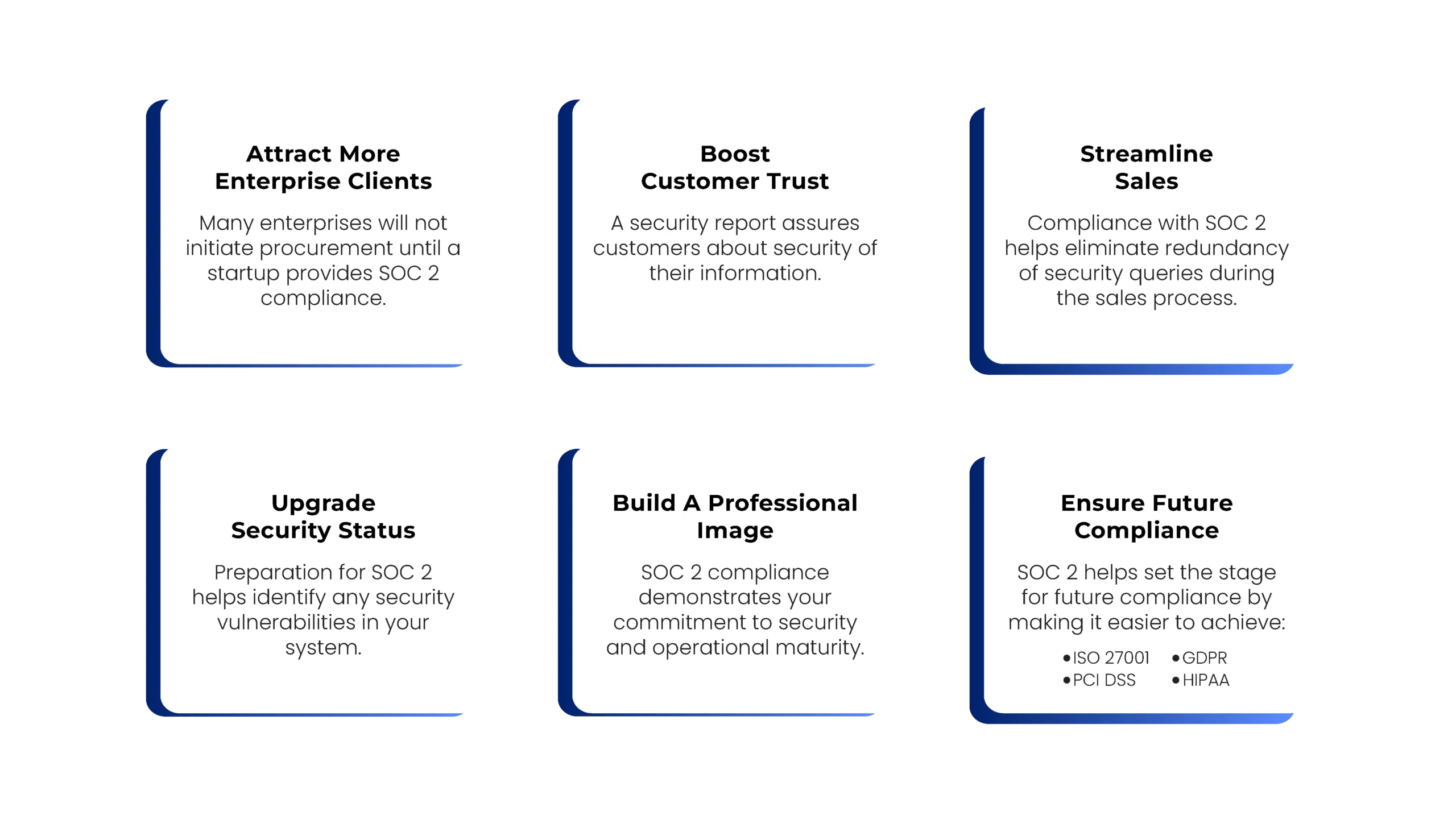
Benefits of SOC 2 Compliance for SaaS Startups
SOC 2 compliance can help SaaS startups reap numerous benefits apart from merely surviving an audit.
SOC 2 Compliance Checklist
Use this checklist before beginning your audit:
✅ Multi-factor authentication enabled
✅ Security policies documented
✅ Employee security training completed
✅ Incident response plan established
✅ Vendor risk management process implemented
✅ Regular vulnerability scans
✅ Access reviews conducted
✅ Backup and disaster recovery tested
✅ Logging and monitoring enabled
✅ Independent audit scheduled
How SOCLY.io Helps SaaS Startups Achieve SOC 2 Compliance
SOC 2 compliance manually can be quite an extensive process taking months for documenting and gathering evidence and continuous monitoring. This is especially challenging for the rapidly growing SaaS companies because it distracts engineers and operations teams from developing products.
SOCLY.io will help you to simplify all the processes of compliance with SOC 2 through automation. By automating compliance workflows and continuously monitoring security controls, SOCLY.io helps startups improve both SaaS Security Compliance and Data Security for SaaS without adding unnecessary manual effort.
Key Benefits of SOCLY.io
Automated Evidence Collection
Evidence gathering for compliance is done automatically by SOCLY.io through your cloud infrastructure and tooling.
Continuous Compliance Monitoring
Instead of checking controls only before an audit, SOCLY.io will provide you with continuous monitoring of your security posture.
Policy and Documentation Management
Manage all the security policies needed from a single platform to make sure you always stay ready for an audit.
Seamless Integrations
SOCLY.io integrates with all major cloud platforms, identity providers, HR systems, source code repositories, and productivity applications.
Faster Audit Readiness
Thanks to automated processes, built-in checklists, and real-time compliance management, SOC 2 preparation will happen much quicker in comparison with the conventional approach.
Built for Growing SaaS Companies
Whether you are getting ready for your initial SOC 2 Type I assessment or working on maintaining Type II compliance, SOCLY.io is scalable enough to suit your business and helps make compliance easier.
In case your startup needs to decrease its focus on compliance management and increase its product development activities, SOCLY.io is a good choice for attaining and maintaining SOC 2 compliance.
Beyond meeting customer expectations, SOC 2 also strengthens overall SaaS Security Compliance, making it easier for startups to demonstrate their commitment to security during vendor assessments and enterprise procurement processes.
Best Practices for Maintaining SOC 2 Compliance
SOC 2 isn’t a one-time project.
Maintain compliance by:
- Monitoring security continuously
- Reviewing user access regularly
- Updating policies annually
- Conducting employee security training
- Performing internal audits
- Managing vendor risks
- Tracking security incidents
Consistency is essential for long-term compliance success.
Frequently Asked Questions (FAQs)
1. What is SOC 2 compliance for SaaS Startups?
SOC 2 compliance means that you have conducted an independent audit confirming the presence of effective measures to ensure the protection of customer information following the AICPA Trust Services Criteria.
2. How long does it take to achieve SOC 2 compliance for SaaS startups?
It depends on your security maturity level. Most startups conduct a Type I audit within several months while conducting a Type II audit involves proving the effectiveness of your measures throughout the observation period.
3. Is SOC 2 mandatory for SaaS startups?
SOC 2 compliance is not legally obligatory, however, many enterprises require SOC 2 from SaaS companies.
4. What are the benefits of SOC 2 compliance for SaaS startups?
There are several benefits of obtaining SOC 2 for startups including gaining customer trust, getting enterprise clients, improving the quality of security practices, reducing sales cycles and enhancing your company’s reputation in the market.
5. How can startups simplify SOC 2 compliance?
Conducting SOC 2 audits becomes easier with the help of the automated compliance platform like SOCLY.io.
6. What is the difference between SOC 2 Type I and Type II?
Type I is a security assessment done on certain controls at a certain point in time, whereas Type II is a security assessment of the effectiveness of these controls over several months.
Conclusion
In the case of modern SaaS companies, security is not an option anymore, but a major element of getting more clients and growing. SOC 2 Compliance for SaaS Startups is the proof that your company has what it takes to ensure data security and establish trust in the future.
Regardless of whether you are preparing for the first deal with an enterprise client or want to enter a regulated market, reaching SOC 2 compliance will be a strong competitive advantage for your startup.
Instead of managing compliance manually, let SOCLY.io simplify the process.
Ready to simplify your SOC 2 journey? Contact Us Today and take the first step toward faster and smarter compliance.
Our Recent Posts
-
How to Define Your SOC 2 Scope: A Practical Guide for Startups
-
ISO 42001 Certification: 2026 Guide to Requirements, Cost, Timeline & Process
-
Who Needs to Comply With CCPA? A Guide for SaaS Businesses
-
SOC 2 vs ISO 27001: What’s The Difference and Which Does Your SaaS Company Need?
-
Why the DPDPA Act Matters for Indian Startups and SaaS Companies?