Categories
GDPR ISO 27001 SOC 2

How to Choose the Right Compliance Framework for Your Business

How to Choose the Right Compliance Framework for Your Business
How to Choose the Right Compliance Framework for Your Business

How to Choose the Right Compliance Framework for Your Business

>How to Choose the Right Compliance Framework for Your Business

How to Choose the Right Compliance Framework for Your Business

For tech startups, healthcare entrepreneurs, and e-commerce founders, selecting the right framework is critical: the wrong choice can waste resources, while the right one builds trust and legal assurance..

How to Choose the Right Compliance Framework for Your Business

Right Compliance Framework for Your Business

Compliance frameworks are structured guidelines and standards that help companies protect data, manage risks, and meet legal or customer requirements. For tech startups, healthcare entrepreneurs, and e-commerce founders, selecting the right framework is critical: the wrong choice can waste resources, while the right one builds trust and legal assurance. Think of ISO 27001 as one road. SOC 2 shows another way forward. Then there’s HIPAA tighter, focused. GDPR walks its own line across borders. One rule guards patient details. Another watches how info moves globally. Each sets limits based on work type. Who needs what shifts fast. A small app maker may skip some steps. Big clients demand proof sometimes. Matching needs to rule matters most here. Fit drives less stress later. Rules shape around people served usually. Business kind shapes tool choice always.

ISO 27001 Global Standard for Information Security

One way to look at ISO 27001 is as a globally recognized benchmark for handling information safely. What it does is lay out what organizations must do when setting up, running, updating, and refining their ISMS. For real world use, the standard gives companies a flexible structure built around assessing risks tied to data protection. Security here isn’t limited instead, it stretches across human behaviour, operational workflows, and digital tools, aiming always to keep information private, accurate, and accessible.

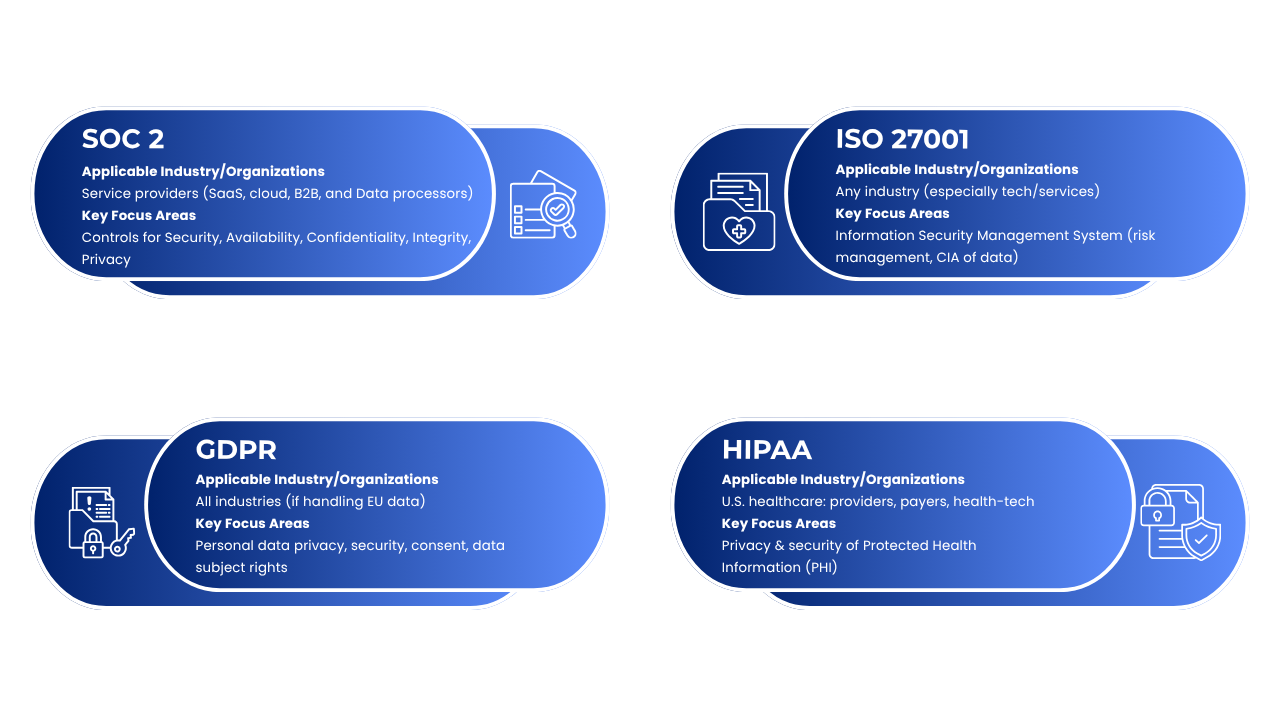
Any organization (of any size or industry) can adopt ISO 27001. Many tech startups often grab it simply because it shows others they stick to standards used worldwide.

One tool puts everything together risk checks, rules, control steps all lined up neatly inside SOCLY.io. Founders who lack full time compliance help find it easier to manage what needs doing when there is no team around. Paperwork feels lighter. Matching safeguards to requirements stops feeling like a maze.

  • Who it’s for: Perfect for businesses aiming to build strong data protection, particularly those in tech or services that work with large clients.
  • What it covers: Policies and procedures for risk assessment, asset management, access controls, incident response, and continuous improvement.
  • Certification: Organizations can be certified by accredited auditors, demonstrating to customers a formal security program.
SOC 2 – Service Organization Control (Trust) Report

Audit standards called SOC 2 come from the AICPA in the United States. These rules help service businesses protect client information properly. Rather than issuing certificates, auditors give reports after checking control systems against set benchmarks. Reports show if safeguards work as intended.

These criteria are called the Trust Services Criteria (TSC) and include:

  • Security (mandatory)
  • Availability
  • Processing Integrity
  • Confidentiality
  • Privacy

SOC 2 reports come in two types: Type I (controls at a point in time) and Type II (controls over a period, typically 3–12 months).

Who needs SOC 2?

Picture a startup handling user information through its online platform. That kind of company usually needs SOC 2 compliance. Think cloud based tools or software services managing sensitive data. Large businesses tend to request proof before working together. Meeting those expectations means having an audit done. It builds trust when contracts come up for discussion. So firms aiming at corporate clients prepare ahead. Evidence of security practices makes conversations smoother. Without it, deals might stall unexpectedly.

SOC 2 vs ISO 27001:

One way to look at it ISO 27001 sets clear rules worldwide for managing information risk. Meanwhile, SOC 2 checks how well certain safeguards work, especially in American companies. Where ISO demands structure, SOC 2 allows room to adapt. Think of ISO as a full blueprint; SOC 2 more like a custom review. Global reach defines one, regional habits shape the other.

  • Who it’s for: Service providers (SaaS, cloud, B2B tech) that handle customer or sensitive data.
  • What it covers: Internal controls for data security, availability, confidentiality, integrity, and or privacy.
  • Implementation: Define scope, select relevant criteria, implement policies, then hire an auditor.
HIPAA – U.S. Healthcare Data Regulation

HIPAA (Health Insurance Portability and Accountability Act) Most people think it’s optional, but HIPAA isn’t a suggestion it’s a real law made by the U.S. government. Electronic health data gets special protection under these rules, meant to keep private details secure. Doctors, hospitals, insurance companies fall under its reach, along with firms that process claims or manage records. Anyone who works with those groups and touches patient info must follow the same standards, no exceptions.

HIPAA compliance is mandatory for healthcare businesses and vendors. It covers:

  • PHI Privacy: Protects all individually identifiable health information.
  • Security Safeguards: Requires administrative, physical and technical measures.
  • Breach & Consent rules: Dictates how to handle disclosures, authorization and breach notifications.

A health tech or medical startup must follow HIPAA whenever patient information is involved. Handling such data requires checking potential risks, using strong encryption methods. Training team members regularly matters just as much as setting up legal contracts with outside partners. Skipping any part can lead to serious consequences.

GDPR – EU Personal Data Protection

The General Data Protection Regulation (GDPR) EU that guards how private details are used. Anyone, anywhere, dealing with information from people in the EU must follow it. Suppose you work with data  keeping it, using it, offering something to those living there  even from afar it pulls you into its reach. Being far from Europe does not matter when handling such personal info.

GDPR covers:

  • Lawful processing: Legal basis (consent, contract, etc.) for each use of personal data.
  • Data subject rights: Right to access, correct, delete, or port data.
  • Security and breach notification: Protect data and report breaches quickly.
  • Accountability: Document compliance (policies, DPOs, data processing records).

Fines might hit €20 million or climb to 4% of worldwide income making following rules non negotiable. Running an online store? Expect to collect permission before sending promotions, protect shopper details carefully, plus post straightforward privacy terms.

What keeps SOCLY.io useful is how it tracks who said yes to what, logs every step firms take to follow privacy rules. Steps matter when working with people in Europe, since showing proof builds confidence over time. Recording each move helps teams stay clear about their responsibilities, especially around personal information handling.

How to Choose the Right Framework?

Choosing a compliance framework depends on your industry, customers, and the data you handle. Ask:

  • Does regulation demand it? (Healthcare = HIPAA, EU customers = GDPR)
  • Do customers expect it? (Enterprise SaaS buyers often ask for SOC 2 or ISO 27001)
  • What data is at risk? (Personal data = GDPR; PHI = HIPAA; broad security = ISO/SOC 2)
  • What resources do you have? (ISO 27001 is more resource heavy, SOC 2 is more flexible)

Begin by checking what could go wrong, pay close attention to customer feedback. Some new companies gradually add structure take a health technology firm, it might start with HIPAA rules, later bring in SOC 2 or ISO 27001 to build stronger safeguards over time.

Running several compliance systems at once? SOCLY.io brings them together so new companies can keep up without extra hassle. Growing faster won’t mean more complexity here.

Implementation Readiness With Tips and Best Practices
  • Perform a gap analysis. Start by checking where things stand now. Then measure that against what the framework asks for.
  • Define scope clearly. Start by drawing clear lines. Figure out which pieces of your work fit inside. Pick where to focus without guessing.
  • Write update policies. Examples: information security, incident response, privacy notices.
  • Implement technical controls. Encryption, MFA, monitoring, access controls.
  • Train your team. Security awareness, HIPAA privacy rules, GDPR rights.
  • Document everything. Policies, training records, risk assessments, audit logs.
  • Do internal audits. Fix issues before formal assessments.
  • Plan for continuous compliance. Set up ongoing monitoring and reviews.
Compliance Framework

Compliance often seems like a tangled web to startup founders full of rules, proof demands, frequent checks. One wrong turn slows progress. SOCLY.io changes how that works. Instead of juggling separate systems, teams get everything in one place. Think ISO 27001 sitting next to SOC 2, HIPAA lined up with GDPR. Startups move faster when structure isn’t scattered. Growing businesses gain clarity without swapping tools

  • Conduct gap analyses with clarity
  • Automate evidence collection and policy management
  • Track multiple frameworks side by side
  • Ready for an audit at any time, so there is no rush when dates approach

Finding it tough to stay compliant? SOCLY.io simplifies the process for small teams, building customer confidence while supporting secure growth.

Depending on how your company operates, what field it’s in, and who your customers are, certain standards will fit better than others. New companies frequently go for SOC 2 or ISO 27001 early on  shows they take protection seriously. If health data is involved, following HIPAA rules isn’t optional. For online stores serving Europe, meeting GDPR demands comes first.

A wrong pick might cost you later. Yet going with a solid fit keeps fines away while quietly winning client confidence at the same time. Strength grows where rules are followed well.

Not sure which compliance standard is right for you? Talk to our experts today.

Categories
SOC 2

How Automated Evidence Collection Speeds Up SOC 2 Audits

How Automated Evidence Collection Speeds Up SOC 2 Audits

How Automated Evidence Collection Speeds Up SOC 2 Audits

How Automated Evidence Collection Speeds Up SOC 2 Audits

>How Automated Evidence Collection Speeds Up SOC 2 Audits

How Automated Evidence Collection Speeds Up SOC 2 Audits

At its core, SOC 2 is about trust. But the manual approach undermines that very goal. By moving from manual evidence collection to automation, compliance becomes lighter. Faster. Continuous.

How Automated Evidence Collection Speeds Up SOC 2 Audits

SOC 2 Audits

For most startups and mid-sized companies, the path to SOC 2 compliance starts with good intentions but quickly spirals into chaos. Teams set aside a quarter, bring in consultants and begin “the evidence hunt.” What follows feels less like a process and more like an endless scavenger hunt:

  • Exporting user lists from cloud apps.
  • Taking screenshots of security groups.
  • Digging through Jira tickets and Git commits.
  • Formatting spreadsheets no auditor will ever fully read

The irony? These same companies are cloud native, product driven and automated everywhere else. Yet, when it comes to proving compliance, they’re stuck in a model that could have been designed in the early 2000s.

This slows progress and a backlog of “compliance work” that distracts.

Why Manual Evidence Collection Breaks Modern Companies

At its core, SOC 2 is about trust. But the manual approach undermines that very goal:

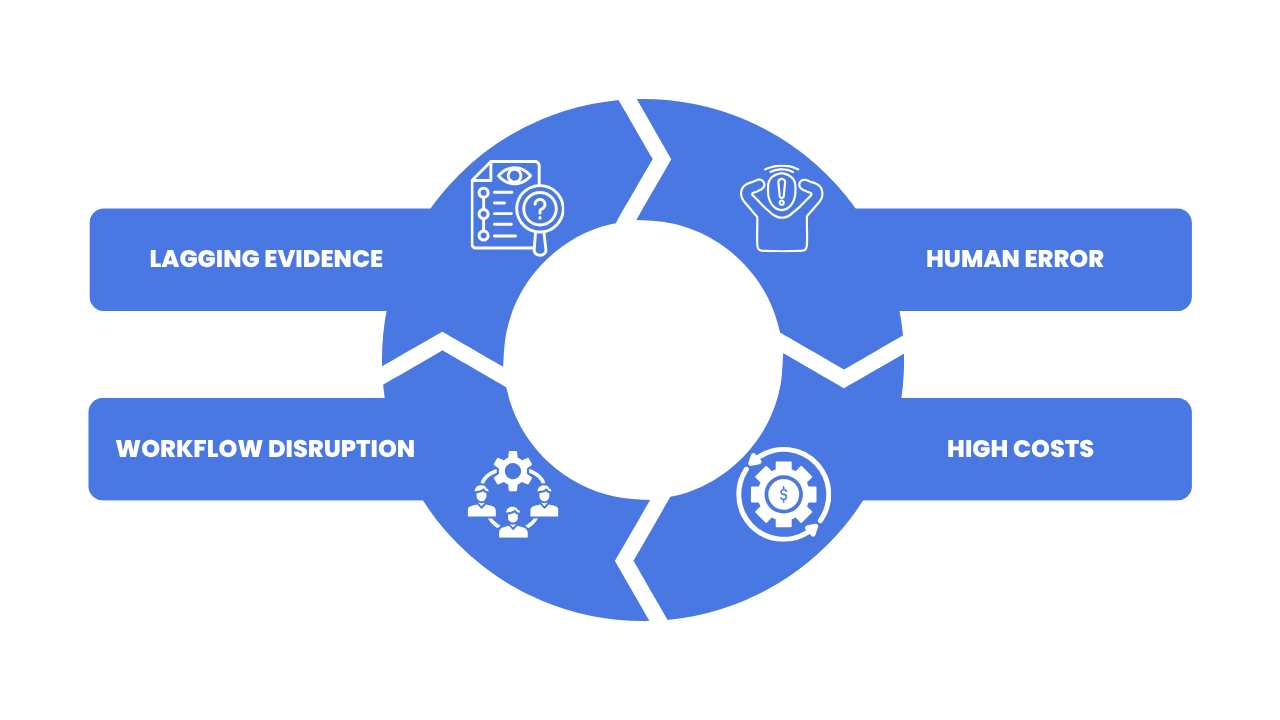
  • Lagging evidence: By the time you’ve gathered proof, it’s already out of date.
  • Human error: Copy pasting controls into spreadsheets almost always creates gaps.
  • Workflow disruption: Engineers pulled into audit prep stop focusing on building and shipping features.
  • High costs: Consultants charge by the hour often for work your team is already doing.

This model doesn’t just waste resources, it actually makes it harder to stay compliant. Compliance becomes episodic, a dreaded “audit season” instead of a continuous state of readiness.

And in a world where customers demand transparency every day, that’s no longer good enough.

Turning Evidence into an Always On Process

Your evidence already exists inside the systems you use daily. Cloud providers, HRIS, version control, ticketing tools,they’re already generating logs, events and audit trails.

Instead of chasing down exports twice a year, automated compliance platforms plug directly into those systems. Evidence is pulled continuously, validated against controls and packaged for auditor review.

This isn’t just convenient. It’s a fundamental reframe:

  • From static to real time: Evidence refreshes daily or hourly.
  • From manual to integrated: No more screenshots, just system-to-system pulls.
  • From reactive to proactive: Continuous monitoring catches issues before they derail an audit.

Think of it like finance moving from ledgers to live dashboards. Compliance should be just as dynamic.

How SOCLY.io Reimagines SOC 2 Evidence Collection

Lots of platforms claim “automation,” but SOCLY.io goes beyond evidence collection to re-architect the compliance journey itself.

Here’s what changes when teams use SOCLY.io:

1. A Clear Compliance Journey

Instead of dropping you into endless tasks, SOCLY.io maps the path: 

Onboarding → Gap Analysis → Mitigation → Evidence Validation → Attestation.
Every step is structured, guided, and tied to outcomes.

2.Automatic Evidence Collection

By integrating with cloud providers, HR and code tools, SOCLY.io reduces manual effort by up to 90%. That means fewer screenshots, fewer exports and far less back-and-forth with auditors.

3. Continuous Monitoring and Alerts

Evidence isn’t static. With 24/7 monitoring, SOCLY.io ensures controls stay active and alerts you if something drifts. Instead of waiting for auditors to flag gaps, you catch and fix them in real time.

4. Governance & Reporting Dashboards

Compliance isn’t just for auditors it’s for leadership, investors and customers too. SOCLY.io provides real-time reporting and centralized dashboards that unify your posture across frameworks.

5. Business Impact Beyond Compliance

  • Lower costs: Cut audit expenses by at least 40% compared to manual methods.
  • Faster compliance: Reduce time to compliance by more than 80%.
  • Less effort: Keep stakeholder involvement under 20 hours.
  • Deal acceleration: Replace messy PDF evidence with a live, always-updated Trust Center powered by SOCLY.io.

Enterprise buyers, especially in the U.S. and Europe, aren’t asking “if” you’re SOC 2 compliant they’re asking “how fast can you prove it?” The companies that can answer instantly move forward. Those still stuck chasing documents are left behind.

With SOCLY.io, compliance is no longer something that slows down sales, it becomes a sign of trust and maturity. Founders use it to:

  • Unlock new markets faster.
  • Shorten enterprise sales cycles.
  • Increase investor confidence with audit-ready transparency.

In other words SOC 2 stops being a chore and starts being a lever for growth.

SOC 2 doesn’t need to be a twice a year fire drill. It doesn’t need to drain engineering hours or delay your next funding round.

By moving from manual evidence collection to automation and by choosing platforms like SOCLY.io that don’t just patch the old process but reimagine it and align compliance with the pace of modern business.

Compliance becomes lighter. Faster. Continuous.
And most importantly it becomes proof of the trust your customers, investors and partners are already looking for.

Ready to simplify your SOC 2 journey? Get in touch with our team today

Categories
ISO 27001

How to Prepare for Your First ISO 27001 Audit

How to Prepare for Your First ISO 27001 Audit

How to Prepare for Your First ISO 27001 Audit

How to Prepare for Your First ISO 27001 Audit

>How to Prepare for Your First ISO 27001 Audit

How to Prepare for Your First ISO 27001 Audit

A clear path will take shape once we walk through each step. Only then the full picture comes into view.

How to Prepare for Your First ISO 27001 Audit

ISO 270001 audit

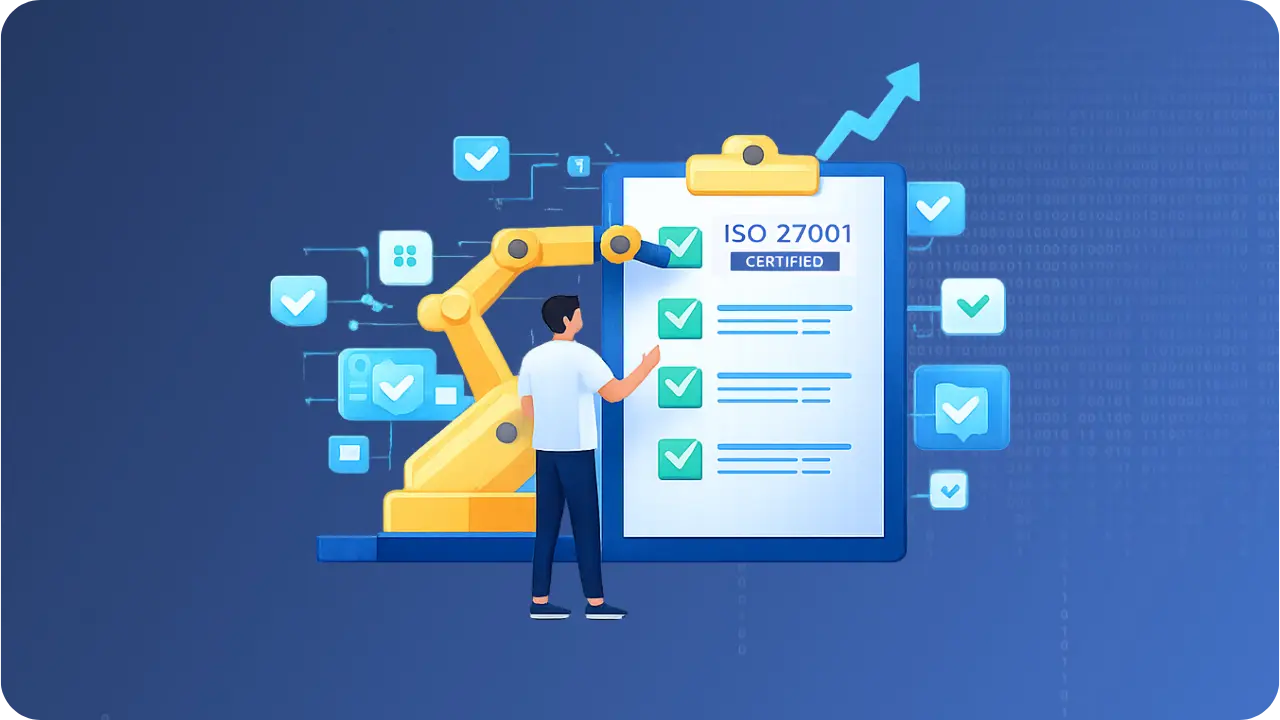
Preparing for your first ISO 27001 audit can feel overwhelming, especially if your organization has never gone through a formal compliance process before. This global benchmark for handling information safely shapes how companies manage risks around data. Passing the review shows others you treat protection of digital assets as a priority. 

Because trust matters, meeting this bar counts. Right now, people you work with want proof that data stays safe. Getting through your initial ISO 27001 check isn’t only paperwork  trust grows when risks drop. Being seen as someone others can count on often starts here.

This guide will explain:

  1. What an ISO 27001 audit is
  2. Different types of ISO 27001 audits
  3. Key requirements you must meet
  4. Wrong moves companies often take.
  5. A step-by-step plan to get ready for your first audit

A clear path will take shape once we walk through each step. Only then the full picture comes into view.

ISO 27001 Audit Explained

An ISO 27001 checks how your company manages information security. Its purpose? Making sure your system actually follows the required standards

  1. Fulfills what ISO 27001 asks for
  2. Your organization’s unique security rules fit naturally into how things are already done
  3. Is effectively implemented and maintained

Not every security framework uses several kinds of checks ISO 27001 does, mixing inside reviews with outside ones. These evaluations happen at different times, yet they work as a pair. One follows company rules, another tests against outside standards. Because of this mix, gaps show up more clearly. Each round builds on what came before it. Over time, weak spots get found earlier. Results add up without needing extra steps

  • Proof that your ISMS reduces information security risks
  • Documentation of weaknesses and corrective actions
  • Assurance for stakeholders that you are committed to continuous improvement

Successfully passing an ISO 27001 audit provides peace of mind and serves as a strong business differentiator.

Faster progress comes easier when tasks run on their own – SOCLY.io handles proof gathering without help. Controls find their place under ISO 27001 through smart matching. Year after year, the system stays prepared for review, quietly ready.

ISO 27001 audit essentials to address

Every now and then, ISO/IEC 27001 expects companies to carry out checks inside their own systems; this is laid out in Clause 9.2. These reviews happen on a set schedule. Instead of waiting for outsiders, you look closely at how things are running. The goal? To see if your information security setup follows the rules it should. Each checkpoint measures real actions against what the standard asks

  1. Fits within the rules set by ISO 27001 standards
  2. Your organization’s unique ISMS policies are reflected here
  3. Stays steady through the years

When it comes to checks inside the company, they’re something you have to do. Outside reviews come into play just when aiming for ISO 27001 status  or keeping it. Many businesses go after that badge simply because an outside body says it’s legit. A little edge over others often keeps them moving forward.

Key benefits of ISO 27001 certification audits include:

  1. Faster sales cycles with security conscious clients
  2. Increased trust with partners and regulators
  3. A framework for continuous risk management

One way to handle tasks such as managing policies, collecting proof, or watching risks is how SOCLY.io shapes them into clear steps. Small groups find this helpful because it lightens their load without extra effort.

ISO 27001 Audit Types

There are four main types of ISO 27001 audits:

1.Internal Audit

   This check, done by your own staff or someone outside the company, makes sure your information security system works as it should and follows ISO 27001 rules. Every year, without exception, one of these reviews must happen. 

2.Certification Audit

Audit happens in two steps, carried out by a recognized certifier, checking if your group meets ISO 27001 standards. Though not automatic, approval depends on how well systems align with required controls.
Stage 1: Review of ISMS documentation and design
Stage 2: Review of actual processes, controls, and implementation
Achieving it means a certificate that lasts three years lands in your hands.

3.Surveillance Audit

Every now and then, during the first couple of years post-certification, auditors come back to see how things are holding up. They peek at whether rules from Annex A still apply day to day. What happened before matters too – fixes for past issues get another look. How well changes stuck around becomes clear only through these follow ups.

4.Recertification Audit

Once every three years, companies go through another check to keep their ISO 27001 status. Not just paperwork, actual practices get reviewed too, along with how well improvements are kept up over time.

Essential ISO 27001 Documentation

Before your first ISO 27001 audit, you must prepare specific documents. The ISO27k Forum checklist identifies 14 mandatory documents, including:

  1. ISMS Scope (Clause 4.3) 
  2. Information Security Policy (Clause 5.1 & 5.2) 
  3. Information Security Risk Assessment Procedure (Clause 6.1.2) 
  4. Statement of Applicability (Clause 6.1.3d) 
  5. Information Security Risk Treatment Procedure (Clause 6.1.3) 
  6. Information Security Objectives (Clause 6.2) 
  7. Personnel Records (Clause 7.2) 
  8. ISMS Operational Information (Clause 8.1) 
  9. Risk Assessment Reports (Clause 8.2) 
  10. Risk Treatment Plan (Clause 8.3) 
  11. Security Metrics (Clause 9.1) 
  12. ISMS Internal Audit Programme and Audit Reports (Clause 9.2.2) 
  13. ISMS Management Review Reports (Clause 9.3.3) 
  14. Records of Nonconformities and Corrective Actions (Clause 10.1)

The Statement of Appraisals matters more than most realize. Inside, every one of the 114 Annex A safeguards gets a spot  marked yes, no, or maybe. Each choice ties back to how risks line up with what the group actually faces. Leftout items? They come with clear reasons rooted in real analysis.

When paperwork is missing, approval from ISO 27001 reviewers becomes impossible. Compliance stays unverified if records aren’t in place. Auditors need clear proof without it, nothing passes. Missing documents block every check. Evidence must exist, otherwise validation fails completely.

Starts messy, right. Paper trails scatter when teams dive into cold audits. That one gap – chaos in files  gets fixed a different way now. Enter SOCLY.io, slipping in ready-made checklists baked for ISO 27001 rules. Updates stick automatically, so nothing slips behind. Old drafts fade out, quietly. Fresh steps lock in place without nudging.

Common Audit Failures (and How to Avoid Them)

 Many first time ISO 27001 audits fail due to avoidable mistakes. The most frequent issues include:

Incomplete documentation- Missing paperwork shows rules that haven’t kept up with how things are really done

Weak risk assessments- Poor checks on possible dangers – often skipped entirely or done without care. What hides inside these gaps? A lack of real digging into how data could be exposed.

Insufficient training- Employees unaware of their security responsibilities

Poor management involvement- When leaders stay distant, efforts stall. Without their time or attention, projects starve. Commitment slips when priorities lie elsewhere

Neglected internal audits- Skipping or rushing through mandatory annual reviews

Steering clear of these mistakes demands thorough preparation and ongoing oversight of your ISMS

A Practical Roadmap for Audit Preparation

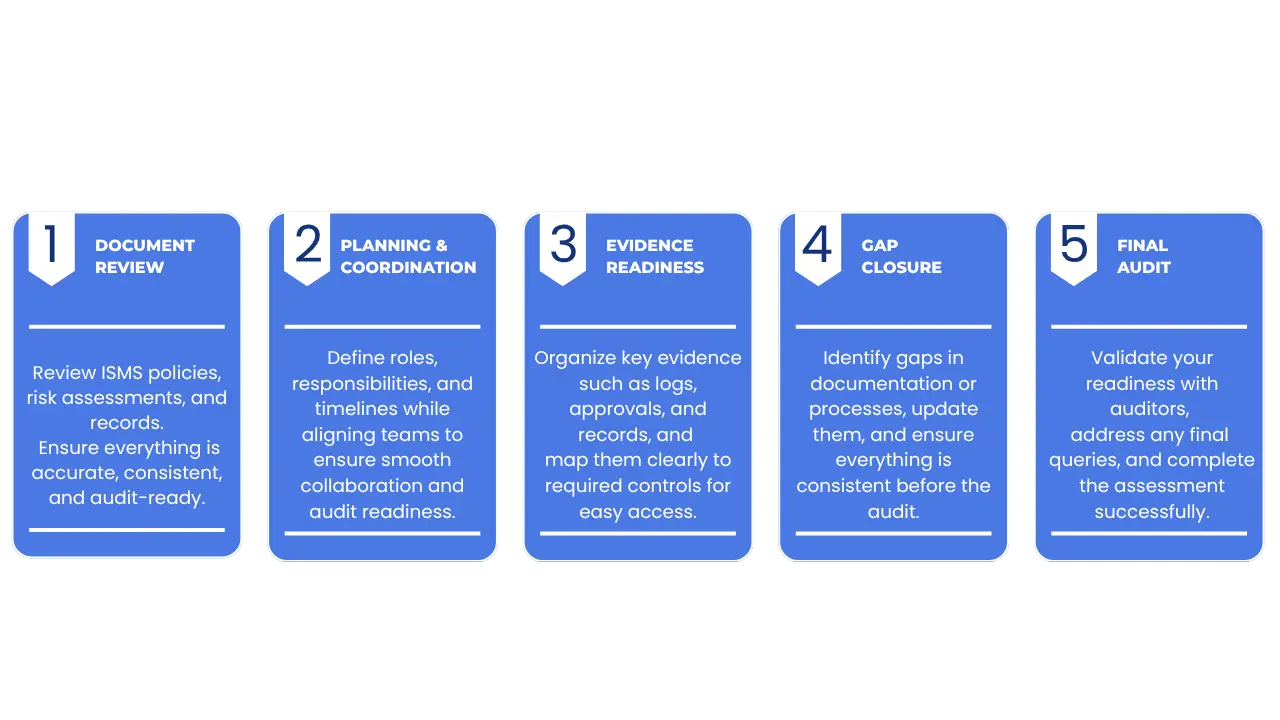
 Here’s a practical 5-step roadmap to get audit-ready:


1. Document Review

Begin by reviewing all ISMS documentation policies, risk assessments, the Statement of Applicability, and supporting records.

These should accurately reflect current practices and remain consistent across the system. Since documentation is reviewed in a shared, independent manner, it needs to be clear, self-explanatory, and easy to validate without additional guidance.

2. Planning and Coordination

Define roles, responsibilities, and timelines upfront to ensure a smooth audit flow.

Plan how information will be shared, accessed, and tracked across teams. Ensure stakeholders are available for timely responses and that documents, systems, and communication channels are structured to support distributed collaboration.

Strong coordination and leadership support help avoid delays and keep the process aligned.

3. Evidence Readiness and Organization

Prepare and organize evidence so it can be easily accessed and reviewed at any point.

This includes records such as logs, approvals, training completion, policy acknowledgements, and operational outputs. Evidence should be clearly mapped to controls and maintained in a structured repository, allowing it to be reviewed asynchronously without relying on live demonstrations.

4. Iterative Review and Gap Closure

As documentation and evidence are reviewed, feedback is shared in cycles.

Teams address gaps, update records, and refine submissions based on observations. This ongoing exchange continues until all requirements are clearly met and supported by verifiable, well-structured evidence.

The emphasis is on consistency between documentation, implementation, and what is ultimately presented for review.

5. Final Audit and Validation

Once readiness is established, auditors conduct their assessment based on the shared documentation and evidence.

Follow-ups, clarifications, or walkthroughs are handled through scheduled interactions where required. After validation, findings are documented and the audit proceeds toward final attestation.

ISO 27001 audit success with effective practices

Centralize evidence: Keep audit trails, images, rules, and learning proof – all in a single spot.

Conduct regular internal audits: Spot checks inside the company matter most when done often. When scheduled yearly, they catch weak spots before problems grow. Timing beats waiting till the official date comes around.

Involve leadership: When management steps in, funds follow  commitment and turn plans into action. Picture a team moving forward only when bosses clear the path ahead.

Train employees: People at work need to know how safety fits their daily tasks. Ongoing learning helps them stay aware. Each person plays a role, so practice matters just as much as knowledge.

Use compliance tools: Start smart. Tools that follow rules automatically gather proof, watch activity, report results cutting hours plus expense without extra effort.

ISO 27001 Audit Timeline

Picture how it unfolds:

Year 1:  Certification Audit Stages 1 and 2

Year 2&3:  Surveillance and Internal Audits

Year 4: Recertification Audit

Over time, it keeps moving forward, holding steady while getting better little by little.

Achieving  ISO 27001 certified sharpens how your group handles safety. It lowers threats while showing those who matter that you take responsibility seriously.

Key benefits include:

  • Increased customer trust
  • Faster enterprise deals
  • Stronger defense against cyber threats
  • A culture of continuous security improvement

A solid start on your initial ISO 27001 check builds momentum that lasts. Though details matter, clarity matters more; each step shapes what comes next.

How SOCLY.io Supports Company Readiness

Getting ready for ISO 27001 can seem like too much work especially if you are a smaller business without an army of staff to handle rules. Yet here’s where SOCLY.io steps in, quietly changing how it’s done.

One spot holds everything when SOCLY.io pulls docs together. Chasing proof by hand fades away once automation takes over. Teams move easier because tasks flow without hiccups. Risk checks live beside compliance statements, no jumping around needed. Audit trails stay put, always within reach. Nothing slips, each piece stays where it should.

Every day runs smoother when tasks follow a clear path. With automated steps built in, SOCLY.io keeps teams prepared without last-minute rushes. Proof is ready because it lives in the routine. Certification becomes part of how work already happens. Order comes from consistency, not pressure.

Starting out with ISO 27001? The initial check usually feels toughest. Getting things right means putting safeguards in place, rounding up paperwork, then making sure staff understand their roles. Still, doing it builds strength, keeps operations steady, and earns confidence over time. When done well, security becomes part of how work happens every day.

Starting with clear steps means checking documents first. Then comes the internal review, which happens before fixes are made. Where gaps exist, corrections follow right after. Leadership gets involved once things are ready. Passing the ISO 27001 check becomes likely when these pieces line up. Over time, habits form around safety because of how people engage. The way work shifts stays useful far beyond the initial goal.

Getting through compliance can feel like a maze. SOCLY.io steps in quietly, smoothing out each turn without fuss. Every step forward becomes simpler, almost natural. The path clears up, just enough to keep going.

Get a free demo and discover how SOCLY.io can save you time, reduce risk and simplify ISO 27001 certification.

Categories
GDPR

Breaking the Biggest GDPR Myths That Hold Back Startups

Breaking the Biggest GDPR Myths That Hold Back Startups

Breaking the Biggest GDPR Myths That Hold Back Startups

Breaking the Biggest GDPR Myths That Hold Back Startups

>Breaking the Biggest GDPR Myths That Hold Back Startups

Breaking the Biggest GDPR Myths That Hold Back Startups

Ask most founders about GDPR and you’ll get a sigh as many still think it’s just a European issue.

Breaking the Biggest GDPR Myths That Hold Back Startups

Biggest GDPR Myths That Hold Back Startups

If you’ve ever brushed off GDPR thinking that it’s just for enterprises with lawyers and compliance teams, then you’re not alone. Many founders believe data protection laws are a corporate headache, not a startup concern.

Ask most founders about GDPR and you’ll get a sigh as many still think it’s just a European issue. We will deal with it when we are bigger. Sounds familiar?

GDPR Compliance isn’t a European headache you can ignore. It’s the front door to winning EU customers and attracting global investors. In 2026, if you want access to that market and the trust that comes with it, GDPR isn’t optional, it’s table stakes. And if done right, GDPR doesn’t slow you down. It makes you faster. It removes friction in sales, boosts investor confidence, and helps you scale with credibility

So, let’s break down the biggest myths holding startups back and what the reality looks like.

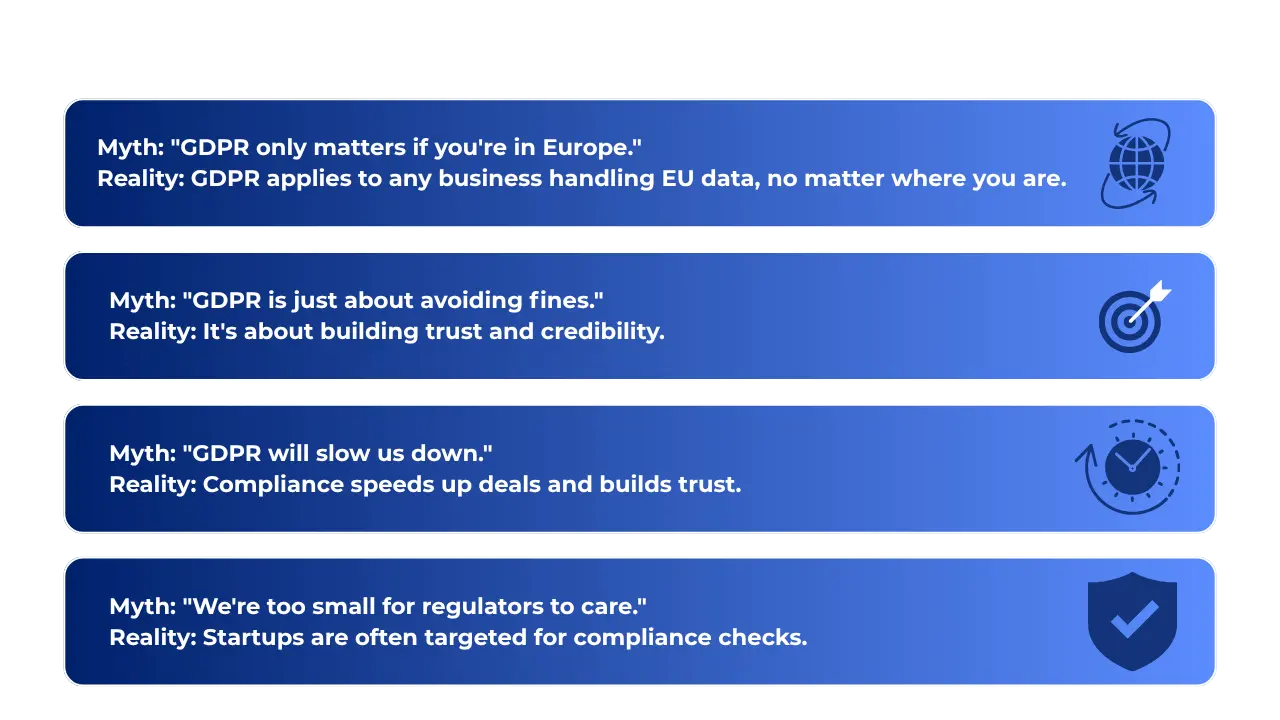
Myth 1: Many founders assume GDPR only matters if their company is based in Europe.

GDPR applies to any business handling EU citizen data,  whether you’re in Berlin, Bangalore, or Boston. If your SaaS app has EU sign-ups, or if your analytics track EU visitors, you’re in scope.

Ignoring this doesn’t just mean risking fines. It also means cutting yourself off from one of the world’s biggest and most lucrative markets.

With SOCLY.io, your geography doesn’t matter. The platform maps where your customer data lives across systems like AWS, Google Workspace, or Salesforce, automatically spotting GDPR sensitive flows. Instead of hiring a consultant to do weeks of discovery, you get clarity in hours.

Myth 2: We’re too small for regulators to care.

Regulators don’t just target tech giants. In fact, small and mid-sized businesses are often easier targets because they lack compliance maturity. 

For a startup trying to land an enterprise deal or raise a funding round, the question isn’t “Will the EU fine us?” It’s “Will this prospect or VC even consider us without GDPR?”

SOCLY.io’s Compliance Co-Pilot guides lean teams through GDPR step by step,  from lawful data processing to handling subject access requests. No legal jargon, no endless manuals. Just actionable tasks that help you keep moving.

Myth 3: GDPR slows us down. We’ll do it later.

Delaying GDPR is what really slows you down. Every enterprise buyer in Europe will eventually ask for proof of compliance. Without it, you’re stuck answering endless questionnaires, dragging engineers into security reviews, and losing weeks of momentum.

By the time you finally decide to get compliant, you’ve already lost deals to competitors who made compliance part of their growth strategy.

SOCLY.io makes GDPR compliance faster and simpler. Automated evidence collection saves time, while pre-built policy templates reduce weeks of work to just hours. With Truday, SOCLY’s live trust center, you can share compliance status in real-time instead of going back and forth on long email threads with procurement.

Myth 4: “GDPR is just about avoiding fines.”

Fines do make the headlines, but the real value of GDPR is in the trust it builds. Customers want to know their data is safe. Investors want to see risks minimized. Partners want assurance you won’t expose them.

GDPR is less about punishment and more about proof. Proof that you take data seriously. Proof that you’re investor ready. Proof that you’re safe to work with.

We don’t just make you compliant. We provide you with tools to turn compliance into a business advantage. With Truday, prospects and investors see your certifications, policies, and security posture on one page. That transforms compliance from invisible paperwork into a visible sales asset.

Myth 5: “GDPR is a one-time project.”

GDPR isn’t a one-time task. It’s an ongoing framework. Privacy laws keep evolving, threats change, and customer expectations continue to rise. So staying compliant means keeping up with these changes, not just completing it once.

Continuous monitoring is built into SOCLY.io so it keeps an eye on your controls, alerts you when something drifts, and updates you when regulations change. Instead of last-minute panic, you stay investor ready and audit ready all year long.

Case in Point

A fast-growing AI startup in Bangalore had its sights set on the European market. They’d just closed a Series A, the product was gaining traction, and an enterprise client in Germany was ready to sign a multi-year deal. For the founders, it was the moment they had been waiting for.

The startup had strong security practices in place, but nothing formal. No policies written, no processes for handling subject access requests, no audit-ready evidence. Suddenly, the deal that looked certain was slipping through.

The founders did what most do in that situation. They pulled in employees to document processes, hired a legal consultant to interpret GDPR requirements and spent late nights filling out endless spreadsheets. But every week spent chasing compliance was another week the German client grew colder. Investors started asking questions too: “If you can’t show GDPR, how will you scale in Europe?”

At this breaking point, they came across SOCLY. What stood out wasn’t just the automation or the templates (though those saved them weeks of effort). It was the feeling that they finally had a clear path forward. Instead of reading legal jargon, the founders saw simple, guided steps through SOCLY.io’s Compliance Co-Pilot. Instead of hounding engineers for screenshots, evidence was pulled automatically from their systems.

The startup not only closed their first EU enterprise customer but also unlocked new investor confidence. Compliance stopped being the drag on their growth story; it became the proof point that fueled it.

Founders often see GDPR as an obstacle. In reality, it’s a filter: companies that get it right move faster, land bigger clients and earn trust at scale. Those who delay are quietly filtered out of the market.

We will help you land on the right side of that filter. Faster compliance, lower costs, less stress  and the ability to show proof of trust.

If you’re ready to make GDPR your growth edge then: Book a 15-minute demo with us today.

Let's Talk

Tell us about your compliance needs and we’ll get back to you within 24 hours.

By submitting, you agree to our Privacy Policy and Terms of Service