Categories
ISO 27001 SOC 2

SOC 2 vs ISO 27001: What’s The Difference and Which Does Your SaaS Company Need?

SOC 2 vs ISO 27001: What’s The Difference and Which Does Your SaaS Company Need?

SOC 2 vs ISO 27001: What’s The Difference and Which Does Your SaaS Company Need?

SOC 2 vs ISO 27001: What’s The Difference and Which Does Your SaaS Company Need?

>SOC 2 vs ISO 27001: What’s The Difference and Which Does Your SaaS Company Need?

SOC 2 vs ISO 27001: What’s The Difference and Which Does Your SaaS Company Need?

Learn the key differences between SOC 2 and ISO 27001, compare their benefits, costs, and certification requirements, and discover which security framework best aligns with your SaaS company's customers and growth goals.

SOC 2 vs ISO 27001: What’s The Difference and Which Does Your SaaS Company Need?

SOC 2 vs ISO 27001

You can build a genuinely secure SaaS product and still lose weeks to one thing: proving it.

So, now you have two acronyms, a security questionnaire, an engineering team already stretched thin and a compliance budget that definitely did not magically appear overnight.

This creates an extremely tricky question for a startup company: where should you spend your time and money?

Do you do SOC 2 compliance because all your US-based prospects are demanding it? Do you work toward getting an ISO 27001 certification since you are targeting an international customer base? Will you need both at some point? And, if so, will you be paying for essentially the same thing twice?

While there are some key similarities between the two frameworks, they cannot be used interchangeably due to differences in their structure and assessment models. The more effective framework will depend entirely on who you are selling to, in what regions, and at what stage of security maturity you are at.

What Are SOC 2 and ISO 27001 Actually For?

SOC was initially defined as Service Organization Controls, but the American Institute of Certified Public Accountants has now adopted a new name for its SOC series called System and Organization Controls.

SOC 2 is based on the Trust Services Criteria for the Assurance and Reporting Standard as developed by the AICPA. These criteria are used to evaluate and report on controls related to security, availability, processing integrity, confidentiality and privacy.

For ISO 27001, the official name is SO/IEC 27001 since it has been jointly developed by the International Organization for Standardization (ISO) and the International Electrotechnical Commission (IEC).

The standard’s main goal is to set specified requirements for an ISMS to identify security risks, how to treat those risks, put controls in place so that they don’t happen in the first place, and then continue to improve these security measures.

In simpler words:

SOC 2: “Prove to me that your controls are in place and are working.”

ISO 27001: “Prove to me that you have a system for managing information security risks.”

They both can be very useful, just in different ways. Here’s how:


SOC 2

ISO 27001

What is it?

Independent attestation report

International management-system standard

Certification?

It’s a report, not a certification

Yes, you get ISO 27001 certification

Best known in

US focused B2B SaaS

Global markets

Core focus

Controls & trust criteria

Information security management system

Audit outcome

SOC 2 report

ISO 27001 certificate

Scope

Defined system and selected Trust Services Criteria

Defined ISMS scope

Type 1 / Type 2

Yes

No equivalent Type 1 / 2 naming

Best for

Proving controls to customers

Demonstrating a mature, structured security program

If You’re A US-Focused Startup, SOC 2 Compliance Makes More Sense First

SOC 2 Type II attestation gives your customer more visibility regarding the controls implemented and audited on the controls over a period of time.

For an entrepreneur starting his journey in the world of SaaS, that would mean:

Less explaining. Less back-and-forth. More evidence for the security team reviewing your product.

If an enterprise customer has come to you and said, “We have to see your SOC 2 report before we move forward,” well, you know what to do. Get ready for SOC 2 compliance.


If You’re Selling Globally, ISO 27001 Certification Is a Stronger Option
ISO 27001 Certification

This is an internationally accepted standard, and the certification can show your dedication and capacity in information management.

In addition to that, it gives you what SOC 2 cannot. A formal certification against an international standard. This can be especially useful if your business is trying to enter markets where ISO certifications are already familiar to procurement and security teams.

And unlike SOC 2, ISO 27001 isn’t only about demonstrating a set of controls. It requires you to establish, maintain and continually improve an ISMS.

For a growing SaaS company, that’s a bigger operational commitment, but it can also give you a more structured foundation for managing security as the company scales.

But Which One Is Cheaper?

SOC 2 compliance or ISO 27001 certification

There isn’t a universal price point for SOC 2 compliance or ISO 27001 certification. The cost varies heavily based on the size of your organization, scale, already existing security controls, how much remediation is required and more.

The bigger question is:

How Much of The Work Have You Already Done?

If your SaaS company already has a solid IAM system, logging, incident response, vendor management, secure development and evidence collection, either of these options is simple.

If you’re starting from scratch, the expensive part isn’t the certificate or report.

It is the engineering, the tools, the documentation, the process adjustments needed to make your controls real.

In a time when one out of four attacks is perpetrated using AI technology, a 56% rise from the previous year, while the cost for each attack on average is $6 million, about $1 million higher than the worldwide average of $4.99 million per attack, as reported in IBM’s 2026 Cost of a Data Breach Report, the most economical choice is not necessarily the one that has the lowest cost of compliance.

It’s the one that gives you useful assurance without creating unnecessary operational overhead.

SOC 2 or ISO 27001? Make The Decision With A Few Points in Mind

Go for SOC 2 compliance first when:

  • Your target customers are in the US
  • Enterprise prospects are explicitly requesting a SOC 2 report
  • You want to move through SaaS vendor checks quicker
  • Your buyers care heavily about evidence of operating controls.
  • You want a clear first security win that’s practical

Pick ISO 27001 first when:

  • You are selling in multiple countries
  • Buyers ask for ISO 27001 certification specifically
  • You want a formal international credential
  • You are trying to run a wider security program based on risk
  • Your customer base sits across multiple regions and industries


Sometimes You May Need Both

It does not necessarily have to be an either-or decision.

Once your security program is mature enough, the work you do for one can help support the other. There is overlap across areas such as access control, risk management, incident response, supplier management, policies and security monitoring.

The exact mapping isn’t one-to-one, though. SOC 2 compliance and ISO 27001 certification have different requirements, structures and assessment approaches, so having one does not automatically mean you have the other.

Build The Right Compliance Path with SOCLY.io

You don’t need to choose between SOC 2 and ISO 27001 based on whichever acronym sounds more impressive.

SOCLY.io helps SaaS companies understand where they stand, identify what’s missing and build a practical path toward the compliance frameworks their customers actually require.

From gap analysis and control implementation to evidence collection, audit preparation and ongoing compliance, we combine automation with expert support so your team can spend less time wrestling with compliance and more time building the company. Sounds like what you’re looking for? We’re just a call away.

Because the right compliance strategy isn’t about doing more. It’s about doing what your business and its clients actually need.

Ready to Simplify Your Compliance Journey?
Categories
DPDPA

Why the DPDPA Act Matters for Indian Startups and SaaS Companies?

Why the DPDPA Act Matters for Indian Startups and SaaS Companies?

Why the DPDPA Act Matters for Indian Startups and SaaS Companies?

Why the DPDPA Act Matters for Indian Startups and SaaS Companies?

>Why the DPDPA Act Matters for Indian Startups and SaaS Companies?

Why the DPDP Act Matters for Indian Startups and SaaS Companies?

Learn how the DPDP Act helps Indian Start-ups and SaaS companies protect customer data, strengthen privacy practices, reduce data security risks, and build trust with customers.

Why the DPDPA Act Matters for Indian Startups and SaaS Companies?

DPDP Act Matters for Indian Startups

For Indian startups, customer data is one of their most valuable business assets. It is also a major responsibility.

The DPDP Act for startups makes data privacy an important business priority. Startups shouldn’t wait until they grow into big businesses to handle privacy.

It is more important for SaaS companies. An average SaaS company could be collecting data such as customer names, emails, phone numbers, employee details, payment methods, and other forms of data.

The startups who have knowledge about Digital Personal Data Protection Act early will benefit in terms of good privacy practices and risk reduction.

What Is the DPDP Act?

Digital Personal Data Protection Act 2023 (DPDP Act) is the primary legislation in India for regulating digital personal data.

This Act specifies the obligations of enterprises for processing digital personal data. Besides, it establishes individual rights over their personal data.

In plain language, the DPDP Act obliges enterprises to know:

  • What personal data they collect
  • Why they collect it
  • How they use it
  • How they protect it
  • Who they share it with
  • How long they keep it
  • What they do when something goes wrong

The above issues should form part of business practice. This is more so to startups who handle customer information in bulk.

Why Is the DPDP Act Important for Indian Startups?

Many startups believe that data privacy is mainly a concern for large companies. That approach is becoming difficult to maintain.

Startups may start off with just a few people using the product. But soon enough, they may have thousands or even millions of users.

As the organization expands, the personal information increases. Fixing privacy problems later can be costly.

The DPDP Act for startups matters for several key reasons.

1. Startups Handle More Personal Data Than They Realize

A SaaS startup may collect personal data through many different systems.

For example:

  • Website forms
  • Product registrations
  • User accounts
  • Customer support
  • Marketing campaigns
  • HR systems
  • Analytics tools
  • Payment systems
  • CRM platforms

Data collection may not be the main purpose of the business. Still, personal data can exist across different parts of the technology stack. Knowing where this data exists is the first step toward protecting it.

2. Privacy Builds Customer Trust

Consumers want to know how organizations treat their personal information. It may influence their purchasing decisions. It becomes especially relevant in the case of SaaS startups offering products to other enterprises.

Enterprise buyers may ask vendors about:

  • Data management
  • Security controls
  • Breach response
  • Compliance practices

Strong privacy practices can therefore become a competitive advantage for Indian startups.

3. Privacy Risks Can Become Business Risks

A data privacy issue can create problems beyond regulatory concerns.

For a startup, a personal data incident could lead to:

  • Customer complaints
  • Loss of customer trust
  • Contractual problems
  • Higher security costs
  • Business disruption
  • Reputation damage

Building privacy practices early can help startups reduce these risks.

Key DPDP Act Requirements Startups Should Understand

The Act introduces several concepts that SaaS companies should understand when building their privacy programs.

Consent and Lawful Processing

Organizations need a valid legal basis to process personal data. This may include obtaining consent where required.

There must be meaningful consent related to an intended use.

For instance, when a software-as-a-service firm collects an individual’s email address to create a user account, there must be a specific reason for doing this.

Notice and Transparency

Organizations need to communicate to individuals how their personal data will be used.

The privacy notice provided by organizations needs to be understandable.

A startup should clearly explain:

  • What data it collects
  • Why it collects the data
  • How it uses the data
  • How individuals can exercise applicable rights

Data Security

Organizations should use reasonable security safeguards to protect personal data.

For SaaS companies, these safeguards may include:

  • Access controls
  • Authentication
  • Encryption
  • Security monitoring
  • Vulnerability management
  • Employee security training
  • Incident response procedures
  • Secure software development practices

The right controls will depend on the company’s size, systems, risks, and data processing activities.

Data Retention

Startups should not keep personal data forever without a valid reason.

A practical data retention process should define:

  1. What data is stored
  2. Why the data is needed
  3. How long the data should be kept
  4. When the data should be deleted or disposed of

This is especially important for SaaS companies.

They may keep information from former customers or inactive accounts. Clear retention rules can help prevent unnecessary data storage.

DPDP Compliance for SaaS Companies

DPDP compliance for SaaS companies involves more than publishing a privacy policy.

A SaaS application can use many systems and third-party vendors. Each system may process personal data.

For example, customer information may move through:

Website
CRM
SaaS applications
Cloud infrastructure
Analytics platform
Analytics platform
Customer support system

Each part of this data flow should be considered when building a privacy program.

Map Your Data

Start by identifying the personal data your business collects.

Then, identify where that data goes.

Create a simple data inventory that includes:

  • Data type
  • Data source
  • Processing purpose
  • Storage location
  • Access permissions
  • Third-party recipients
  • Retention period

A data inventory gives your team a clearer view of its data environment.

Review Third-Party Vendors

SaaS companies often rely on third-party vendors for:

  • Hosting
  • Analytics
  • Payments
  • Communications
  • Customer support
  • Other business activities

Review each vendor that processes personal data.

Check:

  • What data the vendor receives
  • Why the vendor processes it
  • What security measures it uses
  • What contractual protections apply
  • What happens when the relationship ends

Vendor management should be part of your overall privacy and security program.

How Indian Startups Can Comply With the DPDP Act

Indian startups can become compliant with DPDPA on a phased basis.

Start with getting an idea of the kind of personal data collected by your firm. Next, examine the processes involved with such personal data.

Step 1: Identify Personal Data

Create a list of the personal data your organization processes, stores, or transfers.

Include data managed through:

  • Employees
  • Applications
  • Databases
  • Vendors
  • Marketing systems

This gives your team a starting point for its privacy program.

Step 2: Understand Why You Collect It

The purpose of every main type of personal data should be known.

Ask a basic question:

Is this data needed at all? And if some data is not needed, think about whether it is necessary to collect it. Reduced data collection will decrease privacy threats as well.

Step 3: Review Your Privacy Notices

Check your privacy notices from time to time. Ensure that they provide clear information about your processing operations.Don’t use confusing terminologies which might be difficult for the users to comprehend.

Step 4: Establish Data Retention Rules

Establish time frames for keeping each category of personal data. Develop policies on deleting information once it is no longer required. This will involve the processes for handling data in the systems and through the vendors using the data.

Step 5: Strengthen Security Controls

Review the technical and organizational measures used to protect personal data.
Depending on your environment, these may include:

  • MFA
  • Role-based access
  • Encryption
  • Logging
  • Vulnerability management
  • Backup procedures
  • Security awareness training

Review these controls as your startup grows and your systems change.

Step 6: Prepare for Data Breaches

Create an incident response process for personal data breaches.
Your team should know what to do when an incident occurs.

Define:

  • Who investigates the incident
  • Who makes key decisions
  • Who communicates internally
  • How affected systems are contained
  • What regulatory or contractual notifications may be required

A clear process can help your team respond faster and more consistently.

Step 7: Document Your Compliance Program

Keep records of important privacy and security activities.
Your documentation may include:

  • Privacy policies
  • Risk assessments
  • Vendor evaluations
  • Security measures
  • Compliance activities
  • Other relevant records

Good documentation can help demonstrate that your startup actively manages privacy risks.

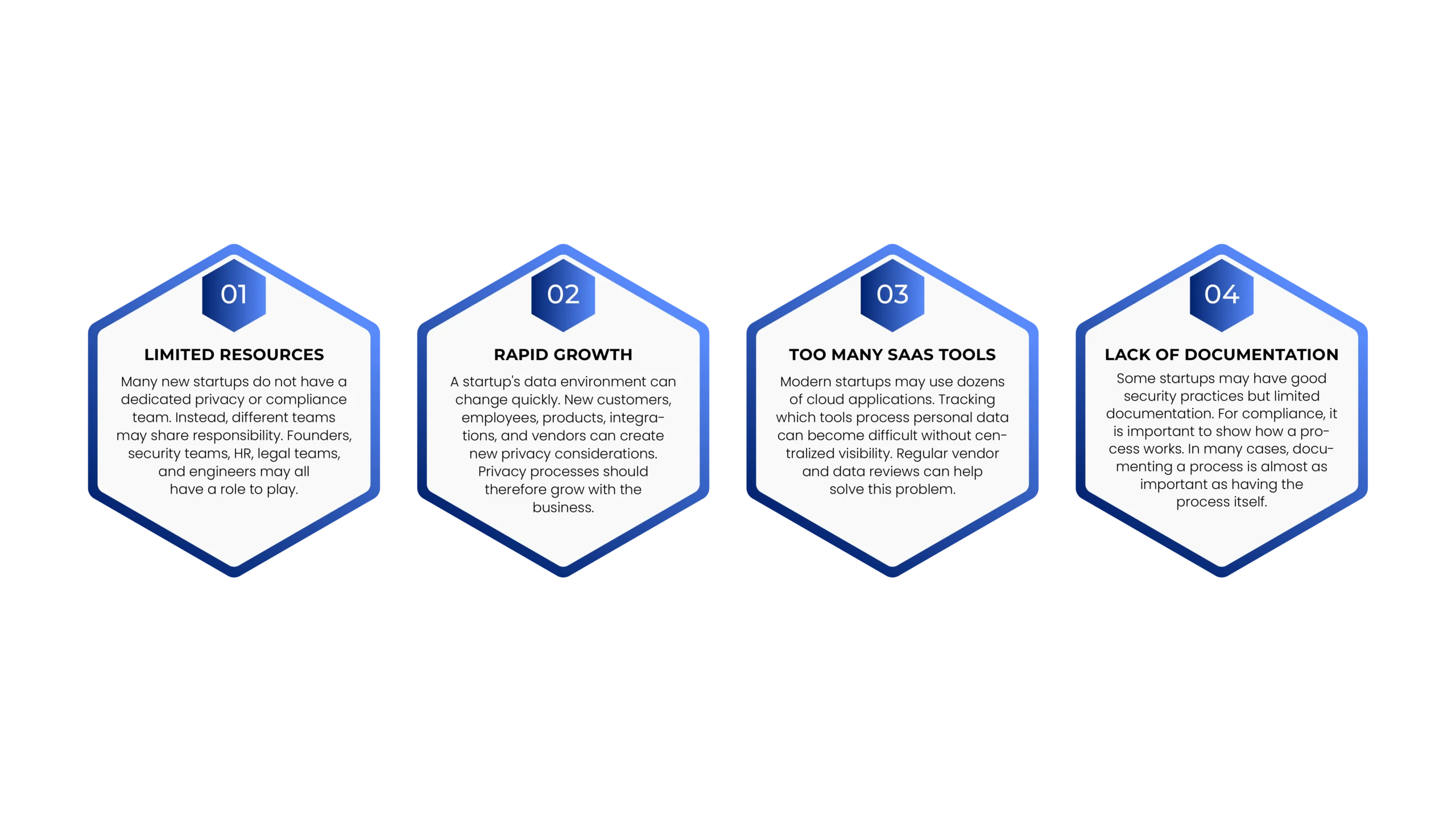
DPDP Act Compliance for Indian Startups: Common Challenges

Startups often face similar challenges when they begin their privacy journey.

DPDP Act Compliance for Indian Startups

DPDP Act vs. GDPR: Are They the Same?

The DPDP Act and the European Union’s GDPR both focus on protecting personal data. However, there are different laws.

They differ in areas such as:

  • Scope
  • Terminology
  • Individual rights
  • Organizational responsibilities
  • Regulatory requirements

Therefore, GDPR compliance does not automatically mean DPDPA compliance.

Companies should review their existing privacy framework against the requirements that apply to their Indian operations. They should then identify and address any gaps.

For SaaS companies that operate in multiple countries, a privacy program should consider the requirements of each relevant jurisdiction. This can also make customer due diligence easier.

What Happens If Startups Ignore Data Privacy?

Ignoring privacy can create problems as a startup grows.

A company may initially think:

“We’re too small for this to matter.”

However, customers, investors, enterprise procurement teams, and business partners may expect evidence of responsible data handling.

Poor privacy practices can also create operational problems.

For example, a startup may suddenly need to:

  • Respond to a customer data request
  • Investigate a data incident
  • Remove data from multiple systems
  • Review a vendor’s data access
  • Explain its data practices to an enterprise customer

Building a privacy foundation early is usually easier than fixing gaps later.

How SOCLY.io Helps With DPDP Act Compliance

Managing privacy policies, risks, controls, evidence, and compliance tasks in spreadsheets can become difficult as a SaaS startup grows.

SOCLY.io helps startups organize these activities through a more structured and centralized workflow.

With SOCLY.io, teams can:

  • Organize compliance requirements and tasks
  • Track risks and security controls
  • Manage policies and documentation
  • Monitor compliance gaps
  • Centralize evidence
  • Improve visibility into their compliance posture
  • Reduce repetitive manual compliance work

This can help startups maintain more consistent compliance processes as they grow.

The goal is not to treat compliance as a one-time project.

Instead, privacy and security should become part of regular business operations.

A Practical DPDPA Compliance Checklist for SaaS Startups

Before considering your privacy program mature, check whether your startup has addressed the following:

This checklist is not a substitute for legal advice.

However, it can provide a useful starting point for building a structured privacy program.

Frequently Asked Questions

1. Why is the DPDP Act important for Indian startups?

Indian startups usually deal with personal information of their customers, employees, prospects, and other users. Applying proper privacy principles could be beneficial for startups when dealing with such information.

2. What is DPDPA compliance for Indian startups?

The adherence to DPDPA will entail the establishment of processes in relation to collecting, utilizing, safeguarding, storing and managing digital personal data. This will depend on the organization and its operations.

3. Does the DPDP Act apply to SaaS companies in India?

The DPDP Act may be relevant to the firms managing digital personal data in India based on the applicability of the Act. SaaS firms need to consider the type of personal data that is handled by them and its processing.

4. How can Indian startups comply with the DPDP Act?

These startups can start with checking on their personal data and the use of it. They will need to check on privacy notices, consents, security, data retention, vendors, incident response, and compliance documents.

5. What kind of data does the DPDP Act protect?

The DPDP Act is concerned with personal data in a digital environment. Personal data is defined as information that is identifiable to a person. Start-ups must take into consideration their methods of collecting, storing, processing, and utilizing personal data.

6. Does DPDPA compliance require a dedicated privacy team?

Not necessarily. The requirements could vary based on the company’s size, activities, data processing techniques, and duties. For smaller startups, they can start by delegating their responsibilities for privacy and security and setting processes in place.

7. How is DPDPA compliance different from GDPR compliance?

DPDP Act and GDPR are two different regulations with different obligations and terminologies. If organizations are required to comply with both, they need to analyze each regulation independently. Adherence to one regulation does not guarantee adherence to another.

Conclusion: 

The DPDP Act for startups is not only a legal or compliance issue. It can affect product development, customer data, vendor selection, system security, and customer trust. For Indian startups, starting early is important.As your startup grows, your data environment will grow too.

Building a strong privacy foundation early can make compliance easier in the future.

Ready to organize your compliance efforts in a SaaS startup?
Categories
ISO 27001

ISO 27001 for SaaS Companies: What It Takes to Become Certified

ISO 27001 for SaaS Companies: What It Takes to Become Certified

ISO 27001 for SaaS Companies: What It Takes to Become Certified

ISO 27001 for SaaS Companies: What It Takes to Become Certified

>ISO 27001 for SaaS Companies: What It Takes to Become Certified

ISO 27001 for SaaS Companies: What It Takes to Become Certified

Learn what ISO 27001 certification means for SaaS companies, what it takes to achieve certification, and how a structured information security management system can strengthen security and customer trust.

ISO 27001 for SaaS Companies: What It Takes to Become Certified

ISO 27001 for SaaS Companies

When a potential business customer in Germany, India or Singapore asks, “Are you ISO 27001 certified?”

Simply saying “we take security seriously” is no longer sufficient.

Evidence that your company has a structured, repeatable way to identify information security risks, manage them and keep improving.  and getting them involves considerably more than downloading an ISO 27001 PDF, writing a few policies and showing up for an audit. That is where many SaaS founders underestimate the work

ISO 27001 reviews your infrastructure, software development, access controls, vendors, employees, incident response and even how leadership manages security risk.  The goal is not just to make your company look good on paper; it is to create an information security management system that really works in the world if, unfortunately, the time ever comes.

So, what is ISO 27001 exactly? What does your SaaS company need to do to get an ISO 27001 certification?

Let’s take a look.

So, What Is ISO 27001?

ISO IEC 27001:2022, often called ISO 27001, is a standard for creating an Information Security Management System (ISMS). It is jointly published by the International Organization for Standardization (ISO) and the International Electrotechnical Commission (IEC). That is why you might see both names interchangeably, ISO 27001 and ISO IEC 27001, in vendor documents, RFPs and buying lists.

In plain English, an ISMS is the system your company uses to figure out:

  • What data and records do we have?
  • What problems could happen?
  • What steps do we take to handle those risks?
  • How can we show our controls are actually working?
  • How do we keep improving as time goes on?
ISO 27001 Is Especially Important for SaaS Firms

SaaS firms often store customer information, source code, authentication details, employee details, intellectual property, and business information in cloud environments and third-party software applications. That is why clients ask for a standard framework to ensure that the data provided is safe from any sort of breach because the proper controls are in place.

ISO 27001 is meant to assist you in managing all the risks associated with the data while ensuring its confidentiality, integrity, and accessibility.

What Does the Auditor Check While Certifying for ISO 27001?
Auditor Check While Certifying for ISO 27001

The core requirements of ISO/IEC 27001 certification sit in Clauses 4-10. This is the first layer.

Context of the Organization (Clause 4)

Determining the ISMS scope: identifying what products, environment, and locations are actually included in scope for certification

Leadership (Clause 5)

ISMS information security policy statement, including ownership and management commitment (not a policy statement in a PDF that is never read)

Planning (Clause 6)

Identifying and assessing risks, planning how said risks should be handled and also setting information security objectives in place.

Support (Clause 7)

Supplying the necessary resources, competence, awareness, communication and documented information for establishing and maintaining the ISMS.

Operations (Clause 8)

Implementation of the planned risk treatment, managing the process and fulfilling requirements.

Performance Evaluation (Clause 9)

The authority team must conduct periodic reviews of the ISMS to manage and review the process as it goes on.

Improvement (Clause 10)

Handling of nonconformities, implementing corrective actions and continual improvement of the ISMS over time.

Then Comes Annex A: A Reference Set of Information-Security Controls

The latest version comprises 93 controls across the four themes of organizational controls (37), people control (8), physical controls (14), and technological controls (34).

For a SaaS company, this may involve controls related to access management, encryption, secure coding practices, incident response, vendor management, backup and more.

Here’s What You Need to Get in Order When Looking into ISO 27001 Certification
ISO 27001 Certification

Before you begin planning out the audit process, here are some components that your SaaS company should have sorted out beforehand. Not just on paper, but in practice.

A risk assessment methodology

You must develop an approach that enables you to identify and measure the information security risks within your business. Think about:

  • Unauthorized access
  • Lost or compromised credentials
  • Insider threats
  • Software vulnerabilities
  • Cloud infrastructure
  • Third-party vendors
  • Employee devices
  • Data leakage
  • Security incidents
  • Business disruption
  • Loss or corruption of information

A Statement of Applicability (SoA)

Ever heard of the infamous 93 Annex A controls? Assess which controls make sense for your risks, then document what applies, what doesn’t and why.

Cloud-specific security controls

Cloud environments require appropriate security controls based on your risks, such as configuration management, access controls, and data protection measures.

Access control and IAM evidence

Depending on your risks, your auditor may expect to see evidence of controls like MFA implementation, least privilege access reviews, role approval, and offboarding procedures.

Supplier and sub-processor management

You need to assess your suppliers, identify any inherited risks and maintain evidence of your assessment process, regardless of their own ISO 27001 certification or SOC 2.

Incident response and business continuity plans

Yes, these would need to be tested. Having a perfect incident response procedure that was never actually used in practice is not going to help in case of an emergency.

Your People Are Part of The Security
People Are Part of The Security

Your HR processes may need to address information-security responsibilities and employee life cycle processes. Management must be aware of its responsibilities. The employees should have adequate security awareness. Procurement might need to assess supplier risks. Engineering requires secure software development practices.

Then Comes the Audit

After implementation and functioning of the ISMS, you can proceed to certification to ISO 27001 by using a certification body.

This will involve evaluation of preparedness, auditing the organization’s ISMS and assessment of conformance to the standard. Certification organizations like BSI describe the journey as including preparation, optional gap analysis, certification auditing and ongoing improvement.

But certification does not mark the end.

ISMS is intended for continuous improvement. Meaning that you will have to keep monitoring, reviewing and improving your ISMS even after you have been certified.

But How Much Does ISO 27001 Certification Cost?
ISO 27001 Certification Cost

There isn’t one price for ISO 27001 certification. The cost changes based on how large your company is, how complex your information security management system is and other factors as well.

For example, let’s take a company with 20 to 100 employees.

  • The documentation audit review usually costs between $3,000 and $10,000.
  • The certification audit can range from $10,000 to $30,000.
  • The certification body fees are generally between $13,000 and $20,000.
  • Surveillance audits in the third-year cost about $5,000 to $18,000 each year.
  • The recertification audit in the fourth year is around $10,000 to $20,000.
Make ISO 27001 Simpler with SOCLY.io

Developing an ISMS from scratch while managing a SaaS organization is quite a task for an already busy team.

From understanding your current gaps and building the required controls to organizing evidence and preparing for the audit, SOCLY.io helps turn a complex certification process into a structured, manageable roadmap.

Your product team should be building the product. Let your ISO 27001 compliance process be something you can actually manage.

Ready to Make ISO 27001 Simpler? Get Your Custom Compliance Roadmap →
Categories
ISO 27001

How to Conduct an ISO 27001 Risk Assessment: A Practical Guide for SaaS Startups

How to Conduct an ISO 27001 Risk Assessment: A Practical Guide for SaaS Startups

How to Conduct an ISO 27001 Risk Assessment: A Practical Guide for SaaS Startups

How to Conduct an ISO 27001 Risk Assessment: A Practical Guide for SaaS Startups

>How to Conduct an ISO 27001 Risk Assessment: A Practical Guide for SaaS Startups

How to Conduct an ISO 27001 Risk Assessment: A Practical Guide for SaaS Startups

Learn how ISO 27001 Risk Assessment helps SaaS Startups identify security threats, evaluate potential risks, protect sensitive data, and build a stronger information security management system.

How to Conduct an ISO 27001 Risk Assessment: A Practical Guide for SaaS Startups

ISO 27001 Risk Assessment

An information security strategy that is effective is only possible if one knows what can go wrong and how the company should respond. The ISO 27001 Risk Assessment process will enable the SaaS startup to identify risks and know how to deal with them to ensure protection of sensitive data.

The purpose of risk assessment in this scenario is not just to ensure that the ISO 27001 is complied with but also a pragmatic way through which it becomes easier to identify the vulnerabilities before they lead to any incident.

What Is ISO 27001 Risk Assessment?

ISO 27001 risk assessment can be defined as an approach that entails the identification of security threats, assessing their likelihood and impact, and determining which risks need to be managed. 

Risk assessment is an integral element of the organization’s ISMS.

The following are some of the questions that need to be answered by performing a risk assessment:

  1. What can happen?
  2. How probable is it to happen and what impact will it have?
  3. What action needs to be taken regarding the identified risk?

As an example, a start-up that creates software as a service may detect the threat of unauthorized access to its production database.

Why Is Risk Assessment Important for ISO 27001?

ISO 27001 follows a risk-based approach to information security. Instead of applying every possible security control regardless of circumstances, organizations identify their specific risks and determine appropriate controls.

Effective ISO 27001 risk management can help SaaS startups:

  • Find out security vulnerabilities before any incident
  • Set your security priorities 
  • Protect customer and company data 
  • Support business continuity
  • Strengthen security processes
  • Provide a systematic approach to managing risks 
  • Prepare the ground for the ISO 27001 audit

The framework will be most useful for start-ups since they have limited resources and should concentrate their efforts on the things that really matter.

ISO 27001 Risk Assessment Process: Step-by-Step

How can we perform a risk assessment for ISO 27001 compliance? 

Though various firms adopt different strategies to achieve this, one practical approach is to start by defining the scope, then identifying, analyzing, evaluating, and finally treating the risks.

Step 1: Define the Scope

Prior to the identification of risks, it is necessary to define the scope. The scope definition for a SaaS company could be:

Cloud infrastructure
SaaS applications
Production environments
Customer data
Source code
Employee devices
Identity and access management
Third-party vendors
Internal business processes

Clearly defining the scope prevents the assessment from becoming too broad or disconnected from your actual ISMS.

Step 2: Identify Your Information Assets

Next, identify the information and assets that need protection.

Examples include:

  1. Customer personal information
  2. Financial records
  3. Source code
  4. API keys and credentials
  5. Employee information
  6. Databases
  7. Cloud infrastructure
  8. Intellectual property
  9. Security logs

An inventory of assets could help in comprehending the location of sensitive data.

Step 3: Identify Potential Risks and Threats

Now ask: What could happen to these assets?

Common information security risks for SaaS startups include:

  • Unauthorized access
  • Phishing and credential theft
  • Malware or ransomware
  • Data breaches
  • Accidental data deletion
  • Misconfigured cloud resources
  • Insider threats
  • Third-party security failures
  • Software vulnerabilities
  • Service outages

Don’t limit the assessment to technical threats. Human and operational risks can be equally important.

The case in which an employee makes an accidental revelation of customer-sensitive data to an unintended recipient can be seen as a legitimate information security risk.

Step 4: Analyze the Risks

After identifying risks, the next step is to assess each risk based on criteria such as likelihood and impact. 

A basic risk score can be calculated using:

Risk Score = Likelihood × Impact

For example:

Risk

Likelihood

Impact

Risk Level

Phishing attack

4

4

16 – High

Cloud misconfiguration

3

5

15 – High

Lost employee laptop

2

3

6 – Medium

Minor website outage

2

2

4 – Low

The exact scoring methodology can vary. What matters is that your organization uses a consistent and documented approach.

Step 5: Evaluate and Prioritize Risks

However, not all risks identified have to receive the same treatment.

After scoring them, rank the risks using your organization’s risk criteria.

Some high-priority risks will need immediate attention, while low-level risks may simply be monitored. 

A good example can be the risk of unauthorized production access for a new business venture, where the customers’ personal information could be exposed.

Prioritizing helps avoid wasting valuable resources on every single risk.

ISO 27001 Risk Treatment: What Should You Do With Identified Risks?

After evaluating risks, the next stage is ISO 27001 risk treatment.

Organizations generally have several options for dealing with identified risks.

1. Reduce the Risk

Implement controls that lower the likelihood or impact of the risk.

For example:

Risk: Unauthorized access to production systems.

Possible controls:

  • Multi-factor authentication
  • Role-based access control
  • Privileged access management
  • Access reviews
  • Logging and monitoring

2. Avoid the Risk

Sometimes, it would be most appropriate to avoid an activity altogether due to an unacceptably high level of risk involved.

For instance, a business could decide not to collect certain kinds of sensitive information which are not required for their service.

3. Share or Transfer the Risk

An organization may transfer some risk through mechanisms such as contracts or insurance.

However, transferring risk doesn’t necessarily eliminate the organization’s responsibility for managing it.

4. Accept the Risk

Some risks may be low enough that the organization decides to accept them.

This decision should be documented and approved according to the organization’s risk management process.

The selected treatment options should also inform the Statement of Applicability (SoA), which documents the necessary controls and their justification. 

Create a Risk Treatment Plan

After deciding how to handle each significant risk, create a risk treatment plan.

The plan should make it clear:

For example:

Risk: Former employees retain access to company systems.

Treatment: Automate employee offboarding and revoke access immediately.

Owner: IT/Security

Target: Implement within 30 days.

This turns your risk assessment from a document into an actionable security program.

Maintain a Risk Register

A risk register provides a centralized record of identified risks and their treatment status.

A typical register might include:

Field

Example

Risk ID

R-001

Asset

Customer database

Risk

Unauthorized access

Likelihood

High

Impact

High

Risk rating

Critical

Treatment

Reduce

Control

MFA + access reviews

Owner

Security Lead

Status

In Progress

Keep the register updated as your systems, threats, vendors, and business processes change.

ISO 27001 Risk Assessment for SaaS Companies

An ISO 27001 risk assessment for SaaS companies should reflect the realities of cloud-based businesses.

SaaS startups commonly need to consider risks involving:

Cloud Infrastructure

Misconfigurations of storage, exposure of services, excessive permissions, and insecure cloud infrastructure pose substantial security challenges.

Application Security

Potential vulnerabilities of applications, APIs, dependencies, and developer pipelines could be harmful to both the company and its clients.

Identity and Access Management

Incorrect authentication mechanisms and too much employee privileges may cause threats for the organization.

Third-Party Vendors

SaaS businesses often depend on numerous vendors. A security issue within a critical third-party service can affect your own operations.

Employee Security

Remote work, personal devices, phishing, weak passwords, and accidental data exposure should also be considered.

The assessment should reflect your actual environment rather than simply copying a generic risk register.

ISO 27001 Risk Assessment Process for Startups

For startups, the biggest mistake is making the risk assessment unnecessarily complicated.

A practical ISO 27001 risk assessment process for startups can follow these principles:

You don’t have to do a huge risk assessment with hundreds of risks you can think of.

You need to conduct an accurate risk assessment that helps your organization make better decisions.

How Often Should an ISO 27001 Risk Assessment Be Conducted?

The ISO 27001 risk assessment process is not a one-off exercise.

It needs to be repeated regularly and whenever there is a major change.

Consider reassessing risks when:

  • You launch a new product
  • Your cloud infrastructure changes
  • You introduce a major vendor
  • You experience a security incident
  • Your organization grows significantly
  • Regulations or customer requirements change
  • Major technology changes are introduced

Regular reviews help ensure your risk register remains relevant.

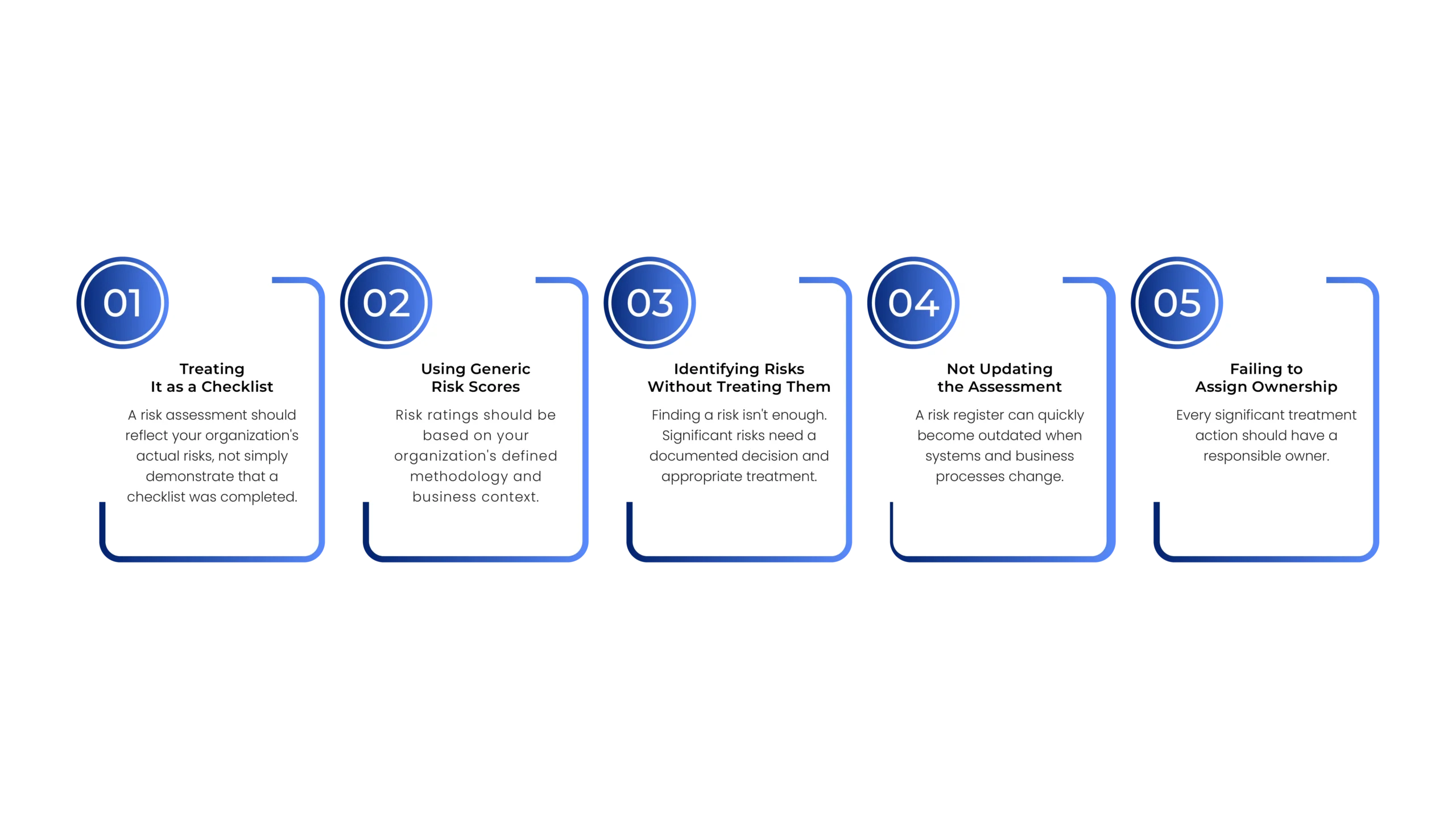
Common Mistakes to Avoid

When conducting an ISO 27001 risk assessment, avoid these common problems:

How SOCLY.io Helps With ISO 27001 Risk Management

Managing risks, controls, evidence, and compliance tasks manually can become difficult as a SaaS startup grows. SOCLY.io helps streamline the process by bringing key compliance activities into a centralized workflow.

With SOCLY.io, teams can:

  • Organize and track compliance activities
  • Manage risks and associated controls
  • Monitor compliance tasks and gaps
  • Centralize important documentation
  • Reduce repetitive manual compliance work
  • Maintain better visibility into their overall compliance posture

Instead of maintaining risk management information across disorganized spreadsheets and documents, startups can adopt a more systematic approach to managing their ISO 27001 activities. 

Risk management should not be considered as an end-of-the-year activity, but rather as an organizational process.

How SOCLY.io Helps SaaS Startups Automate SOC 2 Compliance

It is quite time-consuming for SaaS companies to manage SOC 2 manually. SOCLY.io allows you to streamline compliance management by integrating the whole process of evidence, control, task, and audit management.

With SOCLY.io, startups can:

  • Automate the process of gathering evidence.
  • Perform compliance monitoring continuously rather than just preparing for an audit.
  • Centralize the tracking of your controls and compliance risks.
  • Efficiently manage your policies and compliance activities.
  • Organize audit evidence to simplify the management of auditor requests.

SOCLY.io eliminates spreadsheets, scattered information, and manual tracking allowing SaaS companies to focus more on their product and growth than on compliance management. 

Frequently Asked Questions

1. What is an ISO 27001 risk assessment?

An ISO 27001 risk assessment is a systematic approach to identifying the risks associated with information security, assessing their probability and impacts, ranking and then determining risk treatment strategies.

2. How do you conduct an ISO 27001 risk assessment?

For performing an ISO 27001 risk assessment, the scope should be determined, information assets should be identified, threats and vulnerabilities should be identified, likelihood and impact should be analyzed, risks should be prioritized, and a risk treatment plan should be developed.

3. What are the key stages of a risk assessment according to ISO 27001?

The key stages are setting the scope of the assessment, asset identification and risk identification, risk analysis and evaluation, selection of risk treatment, decision recording, and risk monitoring over time.

4. What is ISO 27001 risk treatment?

ISO 27001 risk treatment is the determination of how an organization will respond to its risks. This may involve any combination of risk reduction, avoidance, transfer, and acceptance.

5. How does ISO 27001 risk assessment apply to SaaS companies?

For SaaS companies, risk assessment should consider cloud infrastructure, customer data, application security, APIs, employee access, third-party vendors, development environments, and business continuity.

6. How often should an ISO 27001 risk assessment be performed?

Risk assessments need to be reviewed on a regular basis as well as in the case of any major changes to the information security environment of the organization.

7. Do startups need a formal ISO 27001 risk assessment?

Yes. In the case of ISO 27001, if a startup wants to achieve the said certification, then it must have an established process for information security risk assessment.

Conclusion

A good ISO 27001 risk assessment helps SaaS companies understand where information security risks exist and what actions they should take. 

The approach does not need to be complex: scope definition, asset identification, realistic risk evaluation, prioritization of those risks, and action plan development with designated owners of those actions.

What is most critical is not allowing your risk assessment to turn into another document that you update once a year when preparing for an audit. Your risk assessment needs to be dynamic and integral to your security management process.

Your risks will evolve along with your company; your risk assessment needs to keep up with them.

Get started with ISO 27001 today with SOCLY.io.

Ready to Take Control of Your Security Risks?
Categories
SOC 2

SOC 2 Compliance for SaaS Startups: What Does It Actually Prove?

SOC 2 Compliance for SaaS Startups: What Does It Actually Prove?

SOC 2 Compliance for SaaS Startups: What Does It Actually Prove?

SOC 2 Compliance for SaaS Startups: What Does It Actually Prove?

>SOC 2 Compliance for SaaS Startups: What Does It Actually Prove?

SOC 2 Compliance for SaaS Startups: What Does It Actually Prove?

Learn what SOC 2 compliance actually proves, how it demonstrates the effectiveness of security controls, and why it matters for building enterprise customer trust and accelerating sales.

SOC 2 Compliance for SaaS Startups: What Does It Actually Prove?

SOC 2 Compliance for SaaS Startups

Somewhere around your first $500K enterprise deal, a procurement manager is going to ask you a question that stops your sales cycle cold: “Can you send us your SOC 2 report?”

Because saying you take security seriously and proving that you do are two very different things.

That is the real value of SOC 2 compliance. It gives customers something more useful than a security promise: independently examined evidence about the controls your company has in place to protect the systems and information it handles.

But what does SOC 2 actually prove? And what doesn’t it prove?

Let’s get into it.

First, What Is SOC 2?

SOC 2 is an attestation framework set by the American Institute of Certified Public Accountants (AICPA) to evaluate controls in service organizations that handle customer data and systems.

The AICPA defines SOC 2 around five Trust Services Criteria: security, availability, processing integrity, confidentiality and privacy. An organization doesn’t necessarily have to be tested under all five. It depends on the engagement.

In the case of a SaaS company, it can entail reviewing controls for items like:

  • Who gets access to production systems
  • How user access is administered
  • How security incidents are identified and dealt with
  • How customer information is secured
  • How changes to production systems are controlled
  • Whether systems are monitored and backed up
  • Management of vendors and third parties

In other words, SOC 2 compliance is not simply a case of slapping a “secure” badge on your website. It involves establishing security controls and ensuring those controls work.

SOC Type I vs Type II: What Separates the Two That Affects Your Sales

You have surely heard the term ‘SOC certification’, however, SOC 2 is an attestation report and not a certification. There are two types of SOC reports.

SOC 2 Type 1 looks into whether the controls are designed properly and implemented as of a specified date.

SOC 2 Type 2 goes further by looking into the operating effectiveness of the controls over a specified examination period.

  • So, while Type 1 is asking: “Do you have the right controls?”
  • Type 2 is asking: “Are these controls being executed properly?”

For enterprise buyers, that distinction can be significant. A beautifully written security policy is one thing. Evidence that your team consistently followed the associated process is another.

So, What Does A SOC 2 Report Cover?
SOC 2 Report Cover

A SOC 2 report shows, on the date(s) audited, your organization had documented, operating controls that were mapped to one or more of the Trust Services Criteria: Security (mandatory), Availability, Confidentiality, Processing Integrity, and Privacy.

Security shows up in every report. Availability appears in roughly 55-65% of reports, and Confidentiality in 35-45%, according to Agency Insights’ 2026 market data. Meaning most companies scope in only what their customer base actually requires, not all five.

In practical terms, SOC 2 compliance can provide evidence that:

The company maintains security controls.

The review considers controls applicable to criteria like security, availability, processing integrity, confidentiality, and privacy. It depends on the scope of the engagement which criteria will be used.

Those controls are intended to mitigate specific risks.

SOC 2 reviews how controls help the company fulfill its service commitment and system requirements. You’re not just looking at a list of security tools. You’re looking at whether the organization has processes designed to manage relevant risks.

The company can demonstrate how its controls operate.

A SOC 2 report includes a description of the system being examined and, depending on the report type, information about the auditor’s testing and results. This shows your relevant controls are designed and, for a Type II examination, how effectively those controls operated during the examination period.

Type II report offers evidence over a period of time.

That is one of the reasons why enterprise customers care about Type II vs Type I. Type I only considers controls at a specific moment in time. Type II not only assesses controls but also their effectiveness during the whole period of time.

An independent auditor reviewed the controls.

That’s what makes a SOC 2 report more meaningful than a company’s own claim that it has “robust security.” The auditor performs an examination and provides an opinion within the defined scope.

Common SOC 2 Misconceptions You Need to Understand
SOC 2 Misconceptions

Considering that the average cost of a data breach has hit $4.99 million, per IBM’s 2026 research, which is a rise of 12% year over year, it is easy to conclude that being SOC 2 compliant ensures full protection from a data breach. It doesn’t.

So, here are some things a SOC 2 report does not cover:

Your entire business isn’t secure

An enterprise prospect may still have additional security, privacy, availability or contractual requirements.

Your business doesn’t meet all privacy laws

SOC 2 compliance and compliance with privacy laws are not synonymous. Your business may be required to comply with things like GDPR or HIPAA, even if you’re SOC 2 compliant.

You can still have a data breach
data breach

While SOC 2 assesses your security controls, this doesn’t mean that you will never face cyber threats.

One report doesn’t last forever

A SOC 2 report doesn’t technically expire, but it covers a specific point in time. Type II reports are performed within a specific time frame, and customers expect the latest report, which is normally done yearly.

It’s not just for companies selling to big enterprises

Bessemer Venture Partners data found that 72% of enterprise-track SaaS startups now complete SOC 2 compliance before their Series A, up from just 31% in 2020.

What Else Does Getting SOC 2 Do for You?

1. Close enterprise deals with fewer obstacles

When purchasing a solution, an enterprise has to evaluate the risk of transferring its information to your application. A SOC 2 report helps your sales and security teams provide something tangible to your audience, rather than explaining everything from scratch every time.

2. Turn security claims into evidence

Saying “we have strong security” doesn’t tell a buyer much. SOC 2 examines the controls behind that claim, including controls related to security, availability, processing integrity, confidentiality and privacy. In other words, a SOC 2 report provides assurance about how access to systems and data is controlled within its defined scope.

3. Identify your gaps before your customers do

Who has access to production data? Are former employees removed promptly? Proof that security assessments were performed? What’s your response to an incident? Preparing for SOC 2 can uncover vulnerabilities that you wouldn’t discover otherwise during regular operation.

4. Build a security program that scales with you

SOC 2 gives you a structured way to establish, operate and demonstrate those controls. And with the right support, getting there doesn’t have to become another massive project competing with your product roadmap. As your customers, team and infrastructure grow, your security processes need to grow with them.

The Practical Takeaway

SOC 2 doesn’t prove you’re perfect; it proves you’re accountable. That someone outside your own organization evaluated how you handle client data and was willing to sign their name on the answer.

For a SaaS start-up seeking to close its first enterprise logos, that is not a compliance checkbox, it’s an asset, and a growing one at that.

The challenge is getting there without turning your engineering team into a full-time compliance department.

That’s where SOCLY.io comes in.

Get SOC 2 Ready Without the Chaos
SOC 2 Ready

Our SOC 2 compliance preparation uses intelligent automation together with hands-on expertise to help SaaS companies move from readiness and gap assessment to implementation, evidence collection, auditing, and compliance.

Rather than trying to piece together evidence through spreadsheets, creating policies from scratch, and identifying gaps during the audit, SOCLY.io will help you determine what’s lacking, develop effective controls, and maintain audit readiness with ongoing monitoring.

Getting ready for SOC 2 compliance, have an enterprise requesting a SOC 2 report, or just looking to find out where your security program stands? Contact SOCLY.io.

Get a custom SOC 2 compliance roadmap for your organization.
Categories
SOC 2

How SOC 2 Automation Reduces Audit Time and Effort?

How SOC 2 Automation Reduces Audit Time and Effort?

How SOC 2 Automation Reduces Audit Time and Effort?

How SOC 2 Automation Reduces Audit Time and Effort?

>How SOC 2 Automation Reduces Audit Time and Effort?

How SOC 2 Automation Reduces Audit Time and Effort?

Learn how SOC 2 Automation streamlines evidence collection, continuous control monitoring, and compliance management to reduce audit time, minimize repetitive work, and improve audit readiness.

How SOC 2 Automation Reduces Audit Time and Effort?

SOC 2 Automation Reduces Audit Time

A SOC 2 audit can be a time-consuming process for a SaaS company when evidence gathering, control monitoring, and documentation are performed manually. SOC 2 Automation takes care of evidence gathering, control monitoring, and compliance management all in one place, continuously.

For SaaS companies undergoing SOC 2 audit for the first time, automation is not only about saving some time but also about getting rid of repetitive processes, minimizing compliance risks, improving audit readiness, and letting security teams concentrate on building their product.

What Is SOC 2 Automation?

SOC 2 Automation makes use of software that enables automation of the processes that occur in preparation for and maintenance of SOC 2 compliance.

It eliminates the need to manually gather evidence from the cloud infrastructure, HR systems, code repositories, identity providers, and other business tools but connects to these tools and gathers the necessary evidence automatically.

Depending on the platform, automation can help with:

  • Evidence collection
  • Security control monitoring
  • Policy management
  • Employee security training tracking
  • Access reviews
  • Vulnerability management
  • Risk assessments
  • Compliance task management
  • Audit preparation
  • Auditor evidence requests

It’s similar to having an automated compliance assistant who keeps checking on important controls and organizing supporting evidence.

Why a Traditional SOC 2 Audit Is Such a Time-Consuming Process

Compliance procedures appear simple enough at first glance.

A startup might maintain a spreadsheet containing its security controls, store policies in Google Drive, collect screenshots from different systems, and assign compliance tasks through email or project-management software. The problem appears when the audit approaches.

Teams suddenly need to answer questions such as:

  • When was this access review completed?
  • Who approved this user?
  • Where is the evidence for this security control?
  • Have employees completed security awareness training? 
  • Has this vulnerability been fixed?
  • Is this evidence collected during the right auditing period?
  • Which controls still need supporting documentation?

Employees may spend hours searching through different systems and manually organizing evidence.

This creates what is often called compliance busywork that is necessary but doesn’t directly contribute to building or improving the company’s product.

How SOC 2 Automation Reduces Audit Time

The biggest advantage of automation is that compliance activities can happen continuously instead of becoming a last-minute project.

Here’s how.

1. Automates Evidence Collection

Automated Evidence Collection is among the most tedious processes when preparing for SOC 2.
Without automation, the team will need to take screenshots, download reports, and export log files.

SOC 2 compliance automation can connect with commonly used business and technology systems to collect relevant evidence automatically.
For example, a SaaS startup may need evidence related to:

User Access

Multi-Factor Authentication

Employee Onboarding and Offboarding

Security Monitoring

Cloud Configuration

Code Changes

Vulneraibility Management

Security Training

Rather than asking an engineer or security manager to collect this information manually, automated integrations can continuously gather relevant evidence.
Result: Less manual evidence chasing and a more organized audit trail.

2. Continuously Monitors Security Controls

Traditional compliance often involves checking controls periodically.
Automation enables continuous monitoring. Rather than manually checking whether access is appropriate, an automated system can monitor the identity and access management system. 

If there is any configuration anomaly, the compliance officer would conduct investigations before the audit takes place.

This changes the approach from:

“Let’s prepare for the audit.”

to:

“We’re continuously ready for the audit.”

That shift can significantly reduce the workload during audit preparation.

3. Reduces Spreadsheet-Based Compliance Work

Spreadsheets can be useful when a company is small.

But as the startup grows, spreadsheet-based compliance becomes increasingly difficult to maintain.

A single compliance spreadsheet might contain:

  • Control owners
  • Evidence status
  • Risk information
  • Task deadlines
  • Policy status
  • Audit requests

As more individuals make changes to the spreadsheet, errors and out-of-date information may arise.

Having a dedicated compliance management system for SOC 2 compliance will consolidate all this information and provide a better understanding of the compliance progress.

The compliance officers will no longer have to ask various people for an update since the information will be in one place.

4. Makes Audit Evidence Easier to Find

It is necessary for auditors to gather evidence of proper design and effective operation of controls.

The process of finding appropriate evidence manually can be very time-consuming.

Using SOC 2 audit automation, evidence can be organized by controls, and it becomes easy to determine what evidence is available and what needs to be gathered.

Example:

Control: Access to production systems is restricted.

Supporting evidence might include:

  • Access-control configuration
  • User access lists
  • Access review records
  • Employee termination records
  • Approval documentation

When this information is organized within a compliance platform, teams spend less time searching for individual files.

5. Automates Employee Compliance Tasks

SOC 2 isn’t only a technical exercise.

The employees might have to undergo security awareness training, accept corporate policies, be involved in access reviews, or do other things related to compliance.

Manual tracking of all this might become challenging with the increase in the size of the team.

Automation will help manage these compliance activities. 

For example:

  1. A new employee joins the company.
  2. Required security training is assigned.
  3. The employee receives notifications.
  4. Completion is recorded.
  5. The compliance dashboard updates automatically.

This removes repetitive administrative work from HR and security teams.

How SOC 2 Automation Speeds Up Audit Preparation

The most common error made by startups is that they consider the SOC 2 readiness project as something they have to do just once.

What startups should focus on is continuous readiness.

Through automation, there are many processes that can occur throughout the year:

Continuous monitoring → Automated evidence collection → Compliance gap detection → Remediation → Audit-ready evidence

At the start of the audit engagement, some of the evidence might already have been gathered.

Example: A SaaS Startup Preparing for SOC 2

Imagine a 40-person SaaS company preparing for its first SOC 2 audit.

With a manual process, the team might need to:

The CTO, engineering team, HR team, and operations staff may all become involved.

With SOC 2 compliance automation, many of these activities can be tracked continuously.

The compliance department will discover any gaps in advance, while integration processes will help preserve all evidence during the auditing period.

The difference isn’t just speed. It’s predictable.

How to Automate SOC 2 Compliance: A Practical Approach

If you’re wondering how to automate SOC 2 compliance, start with the processes that consume the most manual time.

Step 1: Identify Repetitive Compliance Tasks

List every recurring compliance activity.

Look for tasks such as:

  • Manual screenshots
  • Spreadsheet updates
  • Evidence requests
  • Access reviews
  • Training reminders
  • Policy acknowledgments
  • Vulnerability tracking

These are strong candidates for automation.

Step 2: Map Controls to Your Existing Systems

Identify where the evidence already exists.

For example:

  • Identity provider → Access information
  • Cloud provider → Infrastructure configuration
  • HR platform → Employee lifecycle information
  • Code repository → Development activity
  • Ticketing system → Security remediation records

The objective is to connect compliance requirements with the systems that already generate the evidence.

Step 3: Choose a SOC 2 Compliance Platform

When evaluating a platform, SaaS startups should look beyond the number of integrations.

Consider:

  • Automated evidence collection
  • Continuous monitoring
  • Control mapping
  • Policy management
  • Risk management
  • Task automation
  • Auditor collaboration
  • Reporting capabilities
  • Ease of implementation
  • Scalability

The best SOC 2 automation platform for startups isn’t necessarily the platform with the longest feature list. It should be one that fits your existing technology stack and reduces the amount of manual compliance work your team performs.

Step 4: Establish Continuous Monitoring

Once your systems are connected, configure monitoring around important controls.

Don’t wait until the audit begins to discover compliance gaps.

Continuous monitoring allows your team to identify and address issues earlier.

Step 5: Review Your Compliance Dashboard Regularly

Automation does not remove human accountability.

There needs to be someone to check compliance status, investigate alerts, assign remediation actions, and make risk decisions. 

Automation handles repetitive tasks; decision-making remains your responsibility. 

SOC 2 Automation vs. Manual Compliance
AreaManual ComplianceSOC 2 Automation
Evidence collectionRepeated manuallyAutomated/continuous
MonitoringPeriodic checksContinuous monitoring
DocumentationMultiple folders/spreadsheetsCentralized platform
Employee tasksManual remindersAutomated workflows
Audit preparationOften last-minuteContinuous readiness
Gap detectionManual reviewsAutomated alerts
ScalabilityBecomes harder over timeEasier to scale

The key difference is consistency.

Manual systems rely largely on people knowing what is required. Automation enables repetitive processes to keep running even when the team is occupied. 

What SOC 2 Automation Doesn’t Replace

Automation is powerful, but it doesn’t mean your startup can completely remove people from the compliance process.

You still need people to:

  • Define security policies
  • Assess business risks
  • Make security decisions
  • Investigate unusual activity
  • Remediate issues
  • Assign control ownership
  • Communicate with auditors
  • Maintain an appropriate security culture

Automation does not aim at eliminating the human element in compliance processes.

Rather, it is about eliminating the unnecessary human effort and enabling people to make better decisions.

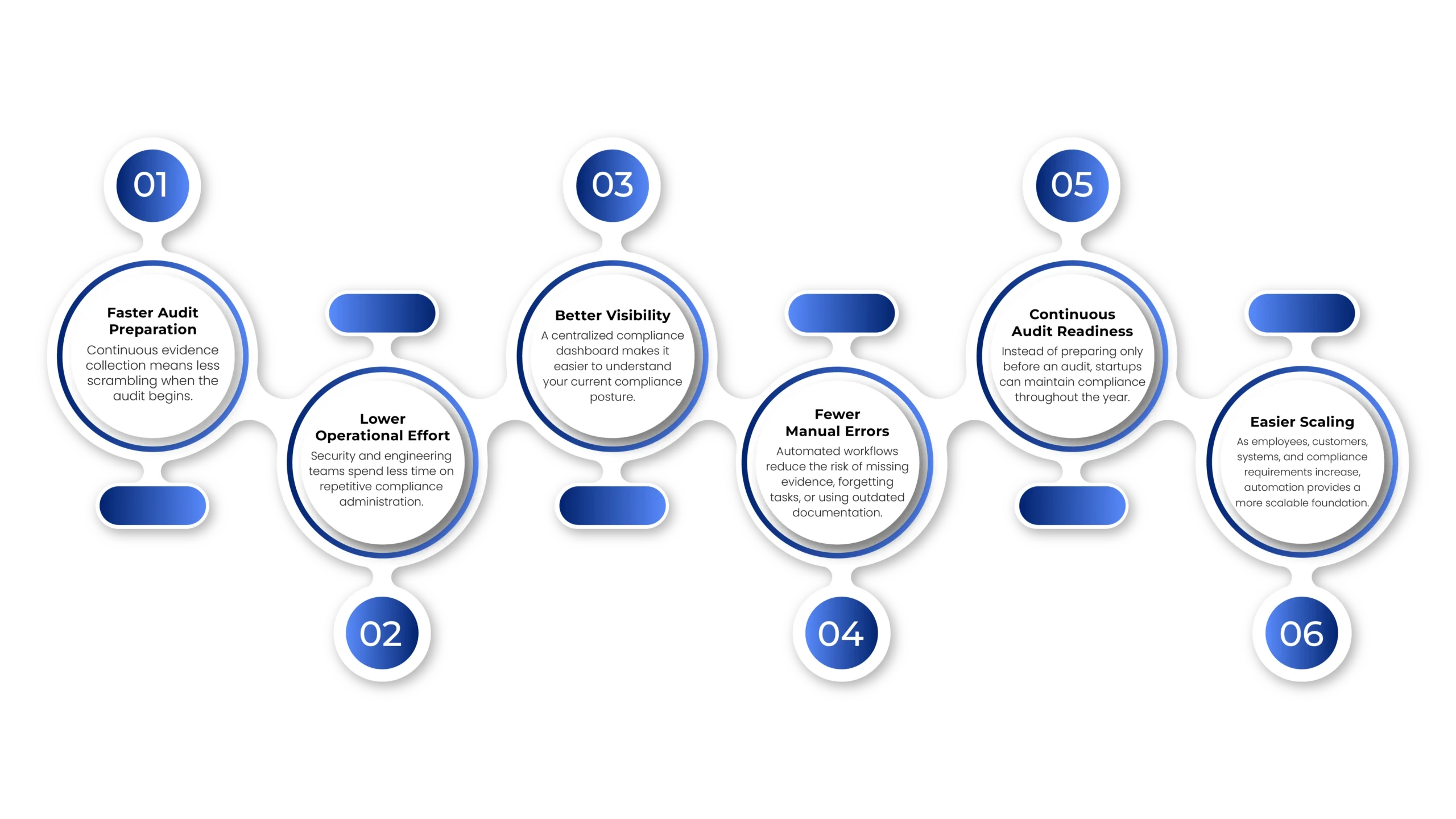
Key Benefits of SOC 2 Automation for SaaS Startups

For growing SaaS companies, the benefits extend beyond the audit itself.

SOC 2 Automation Reduces Audit Time
Is SOC 2 Automation Worth It for a Startup?

For a very small company with limited systems, manual compliance may initially be manageable.

But automation becomes increasingly valuable when:

  • Your company is preparing for its first SOC 2 audit.
  • You have multiple cloud and SaaS systems.
  • Your team is growing quickly.
  • Engineers are spending significant time on compliance tasks.
  • Customers are requesting security documentation.
  • You plan to pursue additional compliance frameworks.
  • You need continuous evidence collection.

For startups selling to enterprise customers, reducing compliance friction can also help security reviews and customer due diligence move more efficiently.

How SOCLY.io Helps SaaS Startups Automate SOC 2 Compliance

It is quite time-consuming for SaaS companies to manage SOC 2 manually. SOCLY.io allows you to streamline compliance management by integrating the whole process of evidence, control, task, and audit management.

With SOCLY.io, startups can:

  • Automate the process of gathering evidence.
  • Perform compliance monitoring continuously rather than just preparing for an audit.
  • Centralize the tracking of your controls and compliance risks.
  • Efficiently manage your policies and compliance activities.
  • Organize audit evidence to simplify the management of auditor requests.

SOCLY.io eliminates spreadsheets, scattered information, and manual tracking allowing SaaS companies to focus more on their product and growth than on compliance management. 

Frequently Asked Questions

1.How can SOC 2 automation save time in audits?

SOC 2 automation can save time in audits by automating evidence collection, control monitoring, compliance processes, and documentation. This means that there is no need to collect evidence at the end of the auditing period.

 2. How do you automate SOC 2 compliance?

SOC 2 compliance can be automated by identifying repeatable compliance activities,   integrating your current business and technology systems with a compliance management system, automating evidence gathering and monitoring, and continuous tracking of control performance and remediation.

3. What is SOC 2 audit automation?

The SOC 2 audit automation process entails automating repetitive processes that are involved in SOC 2 audit preparation, such as evidence gathering, control, task management, and compliance documentation using software.

4. Is SOC 2 automation suitable for SaaS startups?

Yes. SOC 2 automation can prove to be very useful for SaaS startup companies, since these usually operate in cloud environments, use multiple SaaS applications, and have remote employees.

5. What should I look for in a SOC 2 compliance platform?

Look for automated evidence collection, continuous monitoring, integrations with your technology stack, control mapping, policy management, risk tracking, remediation workflows, and features that make auditor collaboration easier.

6. Does SOC 2 automation eliminate the need for an auditor?

Not at all. SOC 2 automation aids in the gathering of evidence, control testing, and compliance activities; however, an independent auditor is still necessary in order to evaluate if the company’s controls meet SOC 2 requirements.

7. How does SOC 2 automation speed up audit preparation?

SOC 2 automation simplifies the process of auditing preparation by doing most of the job through continuous evidence gathering, controls monitoring, detecting gaps, and documenting everything.

Conclusion: Make SOC 2 Compliance Less Manual

SOC 2 should not be made into a regular fire drill for your SaaS startup.

SOC 2 Automation makes it possible to turn the concept of compliance into an ongoing and organized process that is not merely based on spreadsheets, screenshots, emails, and urgent requests.

This can help startups cut down the time and effort needed for audits.

But more importantly, by leveraging automation, you allow your security and engineering teams to dedicate less time to proving the existence of controls and more time enhancing the underlying systems. 

If your startup is ready to undergo SOC 2 attestation or seeks to automate its existing compliance process, consider using SOCLY.io services.

Ready to reduce the manual work behind SOC 2?

Let's Talk

Tell us about your compliance needs and we’ll get back to you within 24 hours.

By submitting, you agree to our Privacy Policy and Terms of Service