
System and Organization Controls
Information Security Management System
Artificial Intelligence Management System
General Data Protection Regulation
Health Insurance Portability and Accountability Act
California Consumer Privacy Act
Digital Personal Data Protection Act
For Indian startups, customer data is one of their most valuable business assets. It is also a major responsibility.
The DPDP Act for startups makes data privacy an important business priority. Startups shouldn’t wait until they grow into big businesses to handle privacy.
It is more important for SaaS companies. An average SaaS company could be collecting data such as customer names, emails, phone numbers, employee details, payment methods, and other forms of data.
The startups who have knowledge about Digital Personal Data Protection Act early will benefit in terms of good privacy practices and risk reduction.
Digital Personal Data Protection Act 2023 (DPDP Act) is the primary legislation in India for regulating digital personal data.
This Act specifies the obligations of enterprises for processing digital personal data. Besides, it establishes individual rights over their personal data.
In plain language, the DPDP Act obliges enterprises to know:
The above issues should form part of business practice. This is more so to startups who handle customer information in bulk.
Many startups believe that data privacy is mainly a concern for large companies. That approach is becoming difficult to maintain.
Startups may start off with just a few people using the product. But soon enough, they may have thousands or even millions of users.
As the organization expands, the personal information increases. Fixing privacy problems later can be costly.
The DPDP Act for startups matters for several key reasons.
1. Startups Handle More Personal Data Than They Realize
A SaaS startup may collect personal data through many different systems.
For example:
Data collection may not be the main purpose of the business. Still, personal data can exist across different parts of the technology stack. Knowing where this data exists is the first step toward protecting it.
2. Privacy Builds Customer Trust
Consumers want to know how organizations treat their personal information. It may influence their purchasing decisions. It becomes especially relevant in the case of SaaS startups offering products to other enterprises.
Enterprise buyers may ask vendors about:
Strong privacy practices can therefore become a competitive advantage for Indian startups.
3. Privacy Risks Can Become Business Risks
A data privacy issue can create problems beyond regulatory concerns.
For a startup, a personal data incident could lead to:
Building privacy practices early can help startups reduce these risks.
The Act introduces several concepts that SaaS companies should understand when building their privacy programs.
Consent and Lawful Processing
Organizations need a valid legal basis to process personal data. This may include obtaining consent where required.
There must be meaningful consent related to an intended use.
For instance, when a software-as-a-service firm collects an individual’s email address to create a user account, there must be a specific reason for doing this.
Notice and Transparency
Organizations need to communicate to individuals how their personal data will be used.
The privacy notice provided by organizations needs to be understandable.
A startup should clearly explain:
Data Security
Organizations should use reasonable security safeguards to protect personal data.
For SaaS companies, these safeguards may include:
The right controls will depend on the company’s size, systems, risks, and data processing activities.
Data Retention
Startups should not keep personal data forever without a valid reason.
A practical data retention process should define:
This is especially important for SaaS companies.
They may keep information from former customers or inactive accounts. Clear retention rules can help prevent unnecessary data storage.
DPDP compliance for SaaS companies involves more than publishing a privacy policy.
A SaaS application can use many systems and third-party vendors. Each system may process personal data.
For example, customer information may move through:


Each part of this data flow should be considered when building a privacy program.
Map Your Data
Start by identifying the personal data your business collects.
Then, identify where that data goes.
Create a simple data inventory that includes:
A data inventory gives your team a clearer view of its data environment.
Review Third-Party Vendors
SaaS companies often rely on third-party vendors for:
Review each vendor that processes personal data.
Check:
Vendor management should be part of your overall privacy and security program.
Indian startups can become compliant with DPDPA on a phased basis.
Start with getting an idea of the kind of personal data collected by your firm. Next, examine the processes involved with such personal data.
Step 1: Identify Personal Data
Create a list of the personal data your organization processes, stores, or transfers.
Include data managed through:
This gives your team a starting point for its privacy program.
Step 2: Understand Why You Collect It
The purpose of every main type of personal data should be known.
Ask a basic question:
Is this data needed at all? And if some data is not needed, think about whether it is necessary to collect it. Reduced data collection will decrease privacy threats as well.
Step 3: Review Your Privacy Notices
Check your privacy notices from time to time. Ensure that they provide clear information about your processing operations.Don’t use confusing terminologies which might be difficult for the users to comprehend.
Step 4: Establish Data Retention Rules
Establish time frames for keeping each category of personal data. Develop policies on deleting information once it is no longer required. This will involve the processes for handling data in the systems and through the vendors using the data.
Step 5: Strengthen Security Controls
Review the technical and organizational measures used to protect personal data.
Depending on your environment, these may include:
Review these controls as your startup grows and your systems change.
Step 6: Prepare for Data Breaches
Create an incident response process for personal data breaches.
Your team should know what to do when an incident occurs.
Define:
A clear process can help your team respond faster and more consistently.
Step 7: Document Your Compliance Program
Keep records of important privacy and security activities.
Your documentation may include:
Good documentation can help demonstrate that your startup actively manages privacy risks.
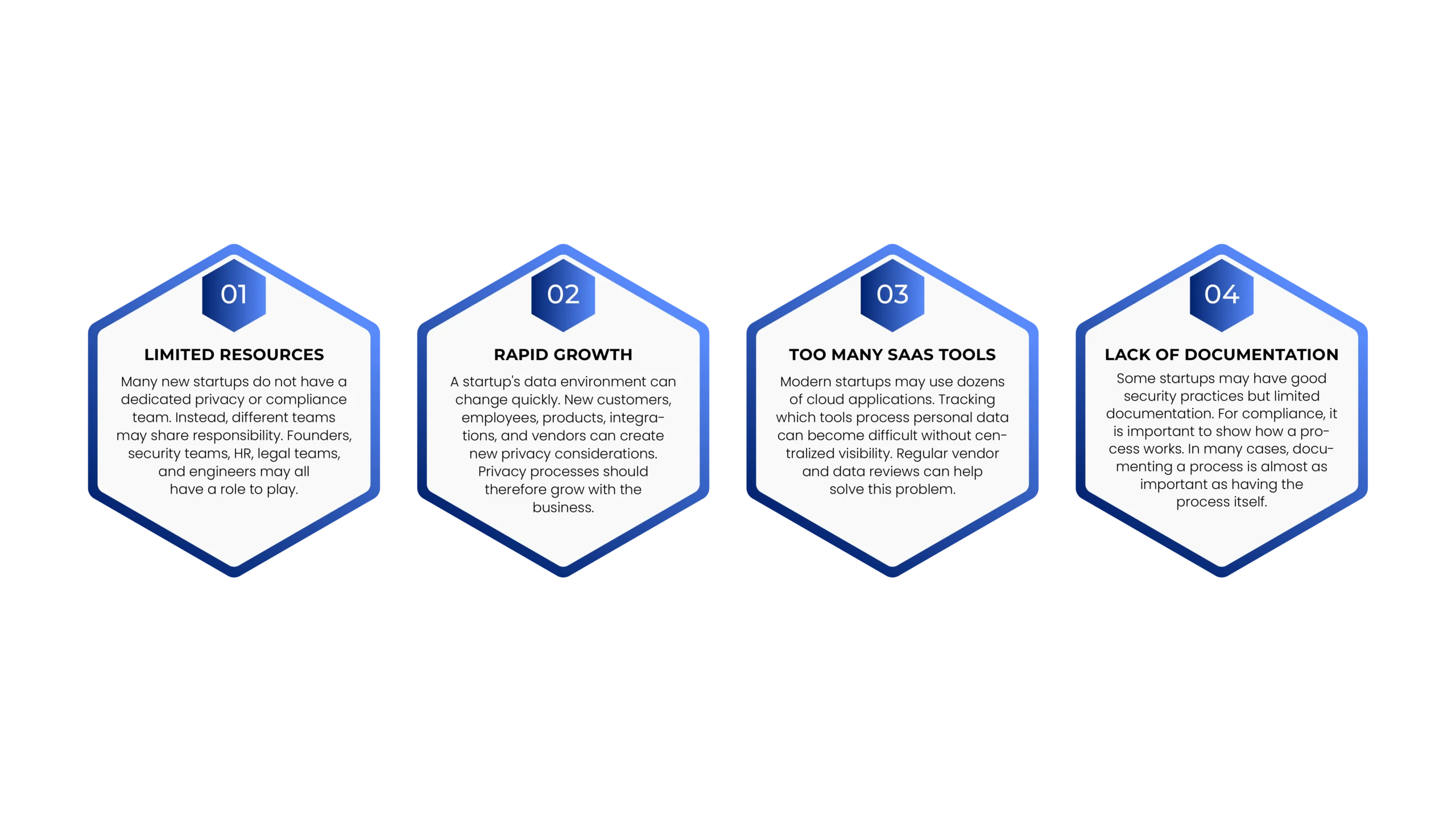
Startups often face similar challenges when they begin their privacy journey.
The DPDP Act and the European Union’s GDPR both focus on protecting personal data. However, there are different laws.
They differ in areas such as:
Therefore, GDPR compliance does not automatically mean DPDPA compliance.
Companies should review their existing privacy framework against the requirements that apply to their Indian operations. They should then identify and address any gaps.
For SaaS companies that operate in multiple countries, a privacy program should consider the requirements of each relevant jurisdiction. This can also make customer due diligence easier.
Ignoring privacy can create problems as a startup grows.
A company may initially think:
“We’re too small for this to matter.”
However, customers, investors, enterprise procurement teams, and business partners may expect evidence of responsible data handling.
Poor privacy practices can also create operational problems.
For example, a startup may suddenly need to:
Building a privacy foundation early is usually easier than fixing gaps later.
Managing privacy policies, risks, controls, evidence, and compliance tasks in spreadsheets can become difficult as a SaaS startup grows.
SOCLY.io helps startups organize these activities through a more structured and centralized workflow.
With SOCLY.io, teams can:
This can help startups maintain more consistent compliance processes as they grow.
The goal is not to treat compliance as a one-time project.
Instead, privacy and security should become part of regular business operations.
Before considering your privacy program mature, check whether your startup has addressed the following:
This checklist is not a substitute for legal advice.
However, it can provide a useful starting point for building a structured privacy program.
1. Why is the DPDP Act important for Indian startups?
Indian startups usually deal with personal information of their customers, employees, prospects, and other users. Applying proper privacy principles could be beneficial for startups when dealing with such information.
2. What is DPDPA compliance for Indian startups?
The adherence to DPDPA will entail the establishment of processes in relation to collecting, utilizing, safeguarding, storing and managing digital personal data. This will depend on the organization and its operations.
3. Does the DPDP Act apply to SaaS companies in India?
The DPDP Act may be relevant to the firms managing digital personal data in India based on the applicability of the Act. SaaS firms need to consider the type of personal data that is handled by them and its processing.
4. How can Indian startups comply with the DPDP Act?
These startups can start with checking on their personal data and the use of it. They will need to check on privacy notices, consents, security, data retention, vendors, incident response, and compliance documents.
5. What kind of data does the DPDP Act protect?
The DPDP Act is concerned with personal data in a digital environment. Personal data is defined as information that is identifiable to a person. Start-ups must take into consideration their methods of collecting, storing, processing, and utilizing personal data.
6. Does DPDPA compliance require a dedicated privacy team?
Not necessarily. The requirements could vary based on the company’s size, activities, data processing techniques, and duties. For smaller startups, they can start by delegating their responsibilities for privacy and security and setting processes in place.
7. How is DPDPA compliance different from GDPR compliance?
DPDP Act and GDPR are two different regulations with different obligations and terminologies. If organizations are required to comply with both, they need to analyze each regulation independently. Adherence to one regulation does not guarantee adherence to another.
The DPDP Act for startups is not only a legal or compliance issue. It can affect product development, customer data, vendor selection, system security, and customer trust. For Indian startups, starting early is important.As your startup grows, your data environment will grow too.
Building a strong privacy foundation early can make compliance easier in the future.
Your trusted partner in compliance automation. Turn complex regulations into clear, automated workflows.
By submitting, you agree to our Privacy Policy and Terms of Service

