


DPDP Act Compliance Checklist: Everything You Need to Meet the Digital Personal Data Protection Act
DPDP Act Compliance Checklist: Everything You Need to Meet the Digital Personal Data Protection Act
DPDP Act Compliance Checklist: Everything You Need to Meet the Digital Personal Data Protection Act
>DPDP Act Compliance Checklist: Everything You Need to Meet the Digital Personal Data Protection Act
DPDP Act Compliance Checklist: Everything You Need to Meet the Digital Personal Data Protection Act
DPDP Act Compliance Checklist: Everything You Need to Meet the Digital Personal Data Protection Act
Table of Contents
- Why DPDP compliance matters
- Digital Personal Data Protection Act 2023 in a nutshell
- Who must comply with the DPDP Act?
- Key DPDP Act requirements
- DPDP compliance checklist for businesses
- DPDP Act 2023 compliance checklist (downloadable)
- DPDP Act penalties at a glance
- How to comply with DPDP Act: step-by-step roadmap
- DPDP compliance automation tools
- Sector-specific considerations
- DPDP compliance date & timelines
- Frequently asked questions (FAQ)
- Final thoughts & next steps
Why DPDP Compliance Matters
India’s Digital Personal Data Protection Act (DPDPA) is no longer a distant concept. For every company that collects, stores, or uses personal data in India, DPDP compliance is now a core business requirement. And with the Data Protection Board of India now operational, DPDPA compliance is moving from “eventually” to “this year.”
- Builds customer trust
- Fends off large monetary fines
- Keeps board members and investors happy
- Simplifies cross-border operations
If your business also builds or deploys AI systems, it’s worth reading this alongside our ISO 42001 certification guide — the data governance requirements under DPDP compliance in India overlap significantly with AI governance obligations.
Digital Personal Data Protection Act 2023 in a Nutshell
The Act, passed in August 2023, sets rules for the entire life cycle of digital personal data. Below is a quick snapshot:| Area | What the DPDP Act Says |
|---|---|
| Scope | Applies to personal data collected online or digitised later, if the processing is in India or relates to Indian residents. |
| Principles | Lawful purpose, consent or legitimate use, data minimisation, accuracy, storage limits, security, accountability. |
| Roles | Data Fiduciary (controller) and Data Processor. |
| Regulator | Data Protection Board of India. |
Who Must Comply With the DPDP Act?

- Indian companies of all sizes
- Foreign firms that target Indian users
- Start-ups, MSMEs, large conglomerates
- NGOs and government bodies that process personal data
There is no turnover threshold. If you handle personal data digitally, DPDP Act compliance is a must.
Key DPDP Act Requirements
Below are the practical requirements businesses must meet
1. Lawful processing
- Identify a clear purpose.
- Avoid incompatible secondary uses.
2. Valid consent management
- Obtain consent that is free, specific, informed, unconditional, and unambiguous.
- Make withdrawing consent just as easy as giving it.
3.Transparent privacy notice
- Draft notices in plain language, available in English and local languages.
- Include purpose, categories of data, retention period, grievance contact.
4. Honour Data Principal rights
- Right to information, correction, erasure, revoke consent, and grievance redressal.
- Set up a simple portal or email channel for requests.
5. Security safeguards
- Risk-based technical and organisational measures.
- Encryption at rest & transit, regular audits, role-based access.
6. Breach notification
- Report personal data breaches to the Data Protection Board and affected users without delay, with a more detailed report typically expected within 72 hours.
- Maintain an incident response plan.
7.Cross-border transfers
- Allowed by default, except to countries the Government may restrict in the future.
- No countries have been restricted as of this writing, but the mechanism exists, so monitor for updates.
Tip: Align the above with ISO/IEC 27001 controls for faster DPDP Act compliance. If you’re building out security safeguards from scratch, our ISO 27001 certification guide covers the same underlying controls in more depth.
DPDP Compliance Checklist for Businesses
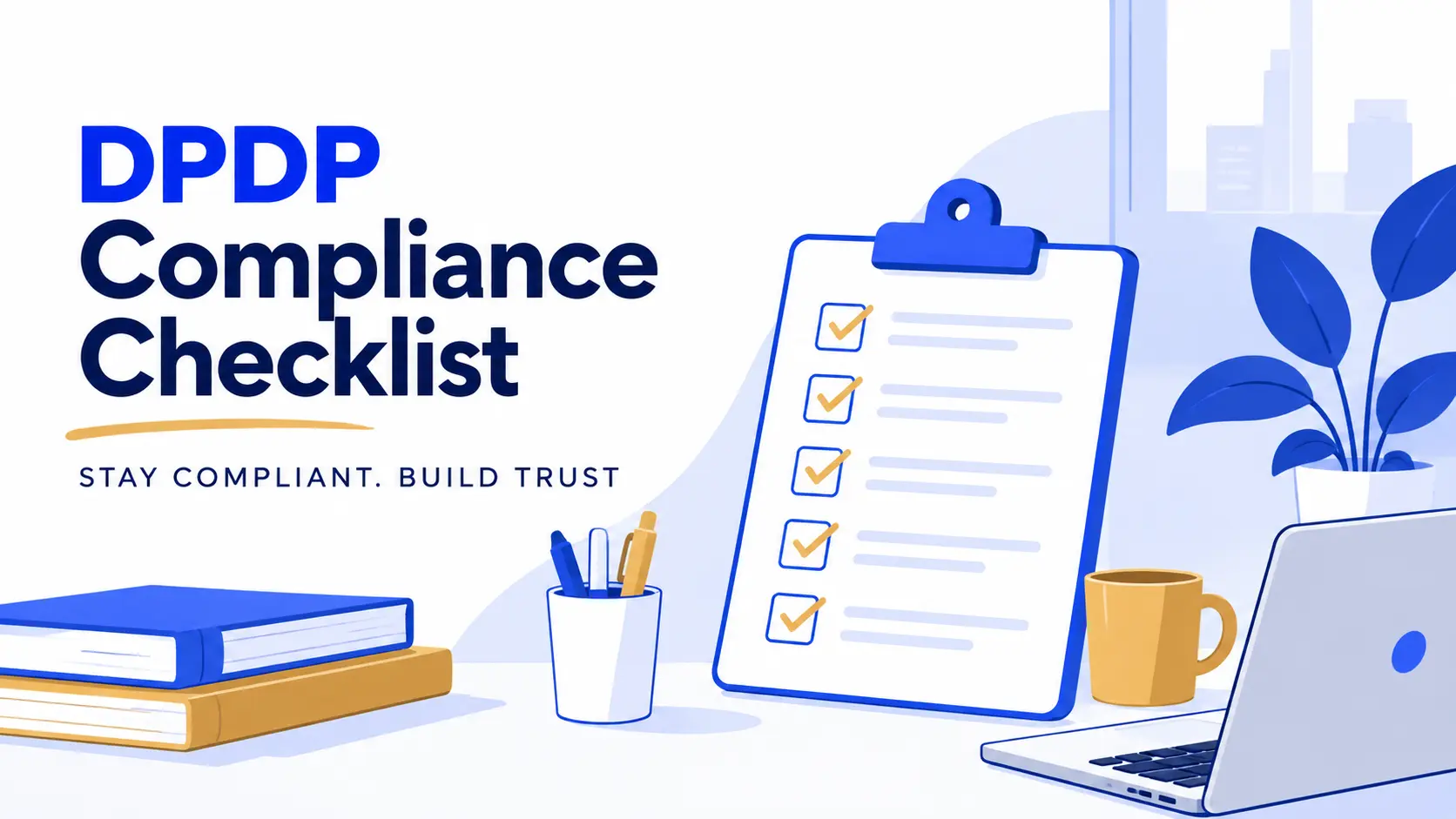
Use the quick list below to track progress:
| S.No | Action Item |
|---|---|
| 1 | Map personal data flows |
| 2 | Classify data & identify high-risk processing |
| 3 | Draft/update privacy policy & consent forms |
| 4 | Appoint a Grievance Officer (and DPO if Significant Data Fiduciary) |
| 5 | Deploy a consent-management platform |
| 6 | Update contracts with Data Processors |
| 7 | Conduct Data Protection Impact Assessment (DPIA) |
| 8 | Run security gap assessment |
| 9 | Set up breach response playbook |
| 10 | Launch employee awareness programme |
In practice, task number 1 – mapping personal data flows – is the one that tends to be underestimated the most by any team. It may seem formal, but in practice, it turns out to be the one that brings up the most unexpected issues: some marketing tool storing email addresses of its customers secretly, or a support system sending out its data to a shared spreadsheet.
DPDP Act 2023 Compliance Checklist (Downloadable)
Need a printable copy?
DPDP Act Penalties at a Glance
The Act introduces a tiered penalty system under Schedule I, with maximum penalties assessed per instance of violation:
| Violation | Maximum Penalty |
|---|---|
| Failure to take reasonable security safeguards (leading to a data breach) | Up to ₹250 crore |
| Failure to notify the Board / affected individuals of a breach | Up to ₹200 crore |
| Non-fulfilment of additional obligations towards children’s data | Up to ₹200 crore |
| Significant Data Fiduciary failing its additional obligations (DPO, DPIA, audits) | Up to ₹150 crore |
| General/residual non-compliance — any other breach of the Act or Rules not listed above | Up to ₹50 crore |
A few things worth understanding about how this actually works in practice:
- These are maximums, not fixed fines. The Data Protection Board considers the nature, gravity, duration, and repetition of the violation, along with mitigation efforts, before setting the actual amount.
- Penalties stack. A single incident can trigger multiple violations at once for example, a breach caused by weak safeguards (up to ₹250 crore) combined with a late notification (up to ₹200 crore) so real exposure can be higher than any single row in this table suggests.
- There’s no size exemption on paper. The statutory maximums apply regardless of company size, though the Board’s actual enforcement approach is expected to weigh an organization’s scale, intent, and remediation efforts.
Penalties can quickly exceed annual profits for a growing business. Staying DPDP compliant in India is a fraction of the cost of paying even one of these fines.
We found out that the founders are more concerned about the big figure of ₹250 crores and think it is only for the large businesses. The truth of the matter is that the ₹50 crores figure is the residual which tends to affect small firms since it covers almost anything not specifically listed above, including things as ordinary as an outdated privacy notice.
Source: Schedule I, Digital Personal Data Protection Act, 2023 (full text, MeitY)
How to Comply With DPDP Act: Step-by-Step Roadmap
Follow the roadmap below, especially if you’re starting late.
A quick, honest note before you dive in: most companies underestimate Step 1. It looks like the “easy” part, but it’s usually where the real timeline gets set. You can’t fix what you haven’t found yet.
Step 1 Assessment (Week 1–4)
- Inventory data systems.
- Interview process owners.
- Identify overseas transfers.
Step 2 Gap analysis (Week 5–6)
- Compare current practice with DPDP compliance requirements for businesses.
- Prioritise high-risk gaps (e.g., children’s data).
Step 3 Remediation (Week 7–16)
- Update notices and contracts.
- Configure technical controls (MFA, encryption).
- Launch consent collection flows.
Step 4 Audit & certification (Week 17–20)
- Conduct internal audit or hire external assessor.
- Keep audit reports for regulators.
Step 5 Ongoing monitoring (Monthly/Quarterly)
- Periodic risk assessments.
- Refresh training.
- Test breach drills.
Not sure where to start? Get a free DPDP Act gap assessment and get a clear, prioritized starting point instead of guessing.
DPDP Compliance Automation Tools
Manual spreadsheets break down fast, data flows change, consent records go stale, and by the time an audit or a Board inquiry comes around, nobody’s confident the paperwork actually matches reality.
Rather than stitching together separate tools for each function, platforms like SOCLY.io are built to cover multiple pieces of DPDP compliance from one place:
- Data mapping – automatically inventory where personal data lives and flows
- Consent record management – centralized, audit-ready consent trails instead of scattered logs
- Rights request handling – a structured way to log and resolve Data Principal requests
- Breach readiness – real-time monitoring so you’re prepared before an incident, not scrambling after one
- Reporting dashboards – one view of your compliance status instead of exporting from five different tools
Benefits of automation, generally:
- Saves time on repetitive tasks
- Creates audit-ready evidence trails
- Reduces human error
If you’re currently piecing together point solutions for data mapping, consent, and reporting separately, it’s worth asking whether a single platform could replace that stack — see how SOCLY.io automates DPDP compliance →
Sector-Specific Considerations

- FinTech – Align DPDPA with the RBI Cyber Security Framework.
- Health-tech – Map with the upcoming Digital Information Security in Healthcare Act (DISHA).
- E-commerce – Combine DPDPA consent requirements with Consumer Protection (E-commerce) Rules.
- Ed-tech – Extra care for children’s data & parental consent.
DPDP Compliance Date & Timelines
Unlike when this guide was first drafted, the DPDP Rules are no longer pending — they were formally notified, and the compliance runway is now clearly defined in phases:
| Milestone | Date |
|---|---|
| DPDP Act passed | August 2023 |
| DPDP Rules, 2025 notified; Data Protection Board established | November 13, 2025 |
| Consent Manager registration opens; mandatory DPO for Significant Data Fiduciaries | By November 13, 2026 |
| Full substantive compliance enforceable (consent, notices, safeguards, breach protocols) | May 13, 2027 |
What this means practically: 2026 is the working year. The gap between “the law exists” and “the law is actively enforced” is closing, and the businesses that wait until early 2027 to start will be doing in weeks what should have taken months. Keep an eye on MeitY updates for any further procedural notifications as the Consent Manager framework rolls out.
Frequently Asked Questions (FAQ)
1. Is DPDP compliance mandatory for small start-ups?
Yes, there are no exceptions with regards to size of companies. However, micro-companies are expected to have slightly less complicated requirements under the Rules in some respects.
2. Do we need a Data Protection Officer?
Only those data fiduciaries who are identified as Significant Data Fiduciaries by the government are mandatorily required to have a DPO. However, most companies choose to do so voluntarily in order to be well-organized.
3. How long can we keep user data?
As long as it is necessary for achieving the initial purpose or until required by law, whichever is shorter.
4.What happens if users withdraw consent?
You will have to cease the processing of their data unless there is any other legal basis, and notify the recipients of such withdrawal.
5. Is anonymised data outside the Act?
Anonymized and irreversibly changed data does not come under the scope of this Act, while pseudonymized data is personal data.
6. What’s the difference between DPDP compliance and DPDPA compliance?
Nothing “DPDP compliance” and “DPDPA compliance” refer to the same thing. Both are shorthand for compliance with the Digital Personal Data Protection Act, 2023.
Final Thoughts & Next Steps
DPDP compliance is not a one-time project; it’s an ongoing commitment to transparency and accountability. Map your data, close the gaps early, and keep records ready for the Board.
Get your free DPDP Act gap assessment and see exactly where your business stands. Or, if you’re also working on ISO 42001, SOC 2, or ISO 27001, check out our other compliance guides to see how these frameworks overlap.
Stay informed, stay secure, and make DPDP Act compliance your competitive edge in 2026 with SOCLY.io.
Our Recent Posts
-
DPDP Act Compliance Checklist: Everything You Need to Meet the Digital Personal Data Protection Act
-
HIPAA Risk Assessment: A Step-by-Step Guide
-
How Compliance Automation Simplifies GDPR Documentation
-
DPDP Rules 2025: Key Requirements and What Businesses Need to Know
-
ISO 27001 Risk Treatment Plan: How to Identify, Evaluate and Treat Security Risks