
System and Organization Controls
Information Security Management System
Artificial Intelligence Management System
General Data Protection Regulation
Health Insurance Portability and Accountability Act
California Consumer Privacy Act
Digital Personal Data Protection Act
Getting ready for SOC 2 compliance can be difficult for a growing SaaS startup business where security practices are still evolving. Whatever mistakes are made in the preparation process will lead to loss of data, delays in the audit process, costs, and challenges in securing enterprise customers.
SOC 2 audit allows a SaaS organization to prove its security risk management process. Nonetheless, a lot of startups start this process without knowing the necessary requirements, which result in the making of unnecessary mistakes.
Learning about these SOC 2 mistakes can help you build a better compliance program.
SOC 2 is an assessment of the controls within a service organization with regards to the criteria set out by the AICPA for the Trust Services Criteria of Security, Availability, Processing Integrity, Confidentiality, and Privacy. The assessment tests the fairness of the system description and whether or not the controls are properly designed. In addition, a Type II assessment tests the effectiveness of such controls.
This is especially applicable to SaaS companies whose systems store, process, or manage their customers’ data.
In many cases, enterprise customers tend to assess the security standards of a SaaS provider prior to any contract signing. A SOC 2 report can help demonstrate how your organization manages information security and protects customer data.
Other uses may include:
It should be noted that a SOC 2 report is not a universal legal requirement for SaaS companies, but it can be commercially important when working with enterprise customers.
Here are ten common compliance mistakes startups should understand before beginning their SOC 2 journey.
1. Starting SOC 2 Preparation Without Understanding the Requirements
Writing
One of the most common SOC 2 readiness mistakes for startups is beginning the process without understanding what the examination covers.
Some startups think that by buying compliance software and formulating security policies, they can achieve SOC 2 compliance.
However, SOC 2 needs organizations to formulate and operate appropriate controls, as well as provide evidence in support of these controls.
How to avoid this:
2. Choosing the Wrong SOC 2 Audit Scope
Scope for your audit will determine what services, systems, people, processes, and infrastructure will be included in the audit.
Some organizations include the entire tech environment without determining whether each system is relevant to the service under audit. Others omit systems that have direct bearing on customer data.
How do I scope my SOC 2 audit mistakes – do I have to include all systems or can I scope it to some products or services only?
In the case of a Software-as-a-Service (SaaS) company with three different products, you may be able to conduct the audit around one product based on system boundaries and dependencies.
How to avoid it:
3. Treating SOC 2 as a One-Time Project
Another common mistake is treating SOC 2 as a one-time activity that ends once the examination is completed.
The security threats constantly evolve along with introducing new apps, recruiting new staff members, adding vendors and upgrading infrastructure.
SOC 2 requires organizations to maintain relevant controls, monitor their operation, and collect supporting evidence on an ongoing basis.
Ways to avoid it:
4. Not Collecting Evidence Continuously
The auditor for SOC 2 examines the evidence to determine whether the controls are well designed and operating properly. In the case of Type II review, they examine whether the controls are effective during the review period.
Some new businesses may choose to start collecting evidence in the form of screenshots, access logs, approval logs, and security reports when the audit starts.
This may cause unnecessary stress and lack of proper documentation.
To prevent it, here is what you should do:
Develop an evidence gathering strategy that spans the whole year.
Document:
5. Ignoring Continuous Monitoring
Startups might use random checks in lieu of continuous monitoring of the security landscape around their business.
How Does Continuous Monitoring Support SOC 2 and ISO 27001 Compliance?
Continuous monitoring will assist companies in recognizing any security problems and tracking whether or not controls are working correctly.
How to avoid it:
The monitoring must be associated with an incident response procedure.
6. Failing to Assign Clear Security Responsibilities
Employees working at a very early stage of SaaS companies work as a very small team, where employees have several responsibilities.
Lack of responsibility leads to skipping compliance processes.
For example, employees from the engineering team think that access reviews will be carried out by the compliance manager, whereas the compliance manager believes that engineering employees need to carry out those reviews.
How to avoid it:
What options does an early-stage startup have for SOC 2 monitoring with no security hire?
In absence of security professionals on a permanent basis, startups have options to assign duties to their different teams, use correct automation software, and get external assistance, if required. However, ultimately, the responsibility lies with the management itself.
7. Choosing the Wrong SOC 2 Type
SOC 2 offers two types of examinations. Choosing the wrong one can affect your preparation timeline and whether the resulting report meets your customers’ expectations.
Should a startup choose a SOC 2 Type I or Type II examination for its first enterprise deal?
Some startups opt for Type I since they wish to prove their first security readiness. Nonetheless, it should be noted that enterprise customers could explicitly demand a Type II report.
How to avoid it:
Before choosing an examination type:
Base your decision on business need rather than merely speed.
8. Overlooking Third-Party Vendor Risks
Most SaaS companies outsource cloud hosting and other business functions to third parties. The third parties can gain access or process customer and company data, which poses certain threats that should be taken into account when managing vendors.
How to avoid it:
Maintain a vendor inventory and document:
Understand how vendor controls affect your own responsibilities. A vendor’s SOC 2 report does not automatically make your organization compliant.
9. Ignoring Multi-Tenant SaaS Security
The vast majority of SaaS applications are developed using multi-tenant architecture, meaning that multiple customers share the same application infrastructure.
One of the most frequently occurring issues in the process of reaching SOC 2 compliance is inability to demonstrate the segregation of customer data.
How do I handle SOC 2 for a multi-tenant SaaS application?
How to avoid it:
Describe how these controls safeguard customer data and provide evidence of their proper operation.
10. Underestimating Audit Preparation Time
Startups may underestimate the amount of time that it takes to be prepared for SOC 2 testing. Security gaps, policy shortcomings, control issues, and lack of documentation can all add to the process.
What are the common challenges companies face during a SOC 2 audit, and how can they be mitigated?
How to avoid it:
Let’s start with the readiness assessment and work on the most crucial deficiencies.
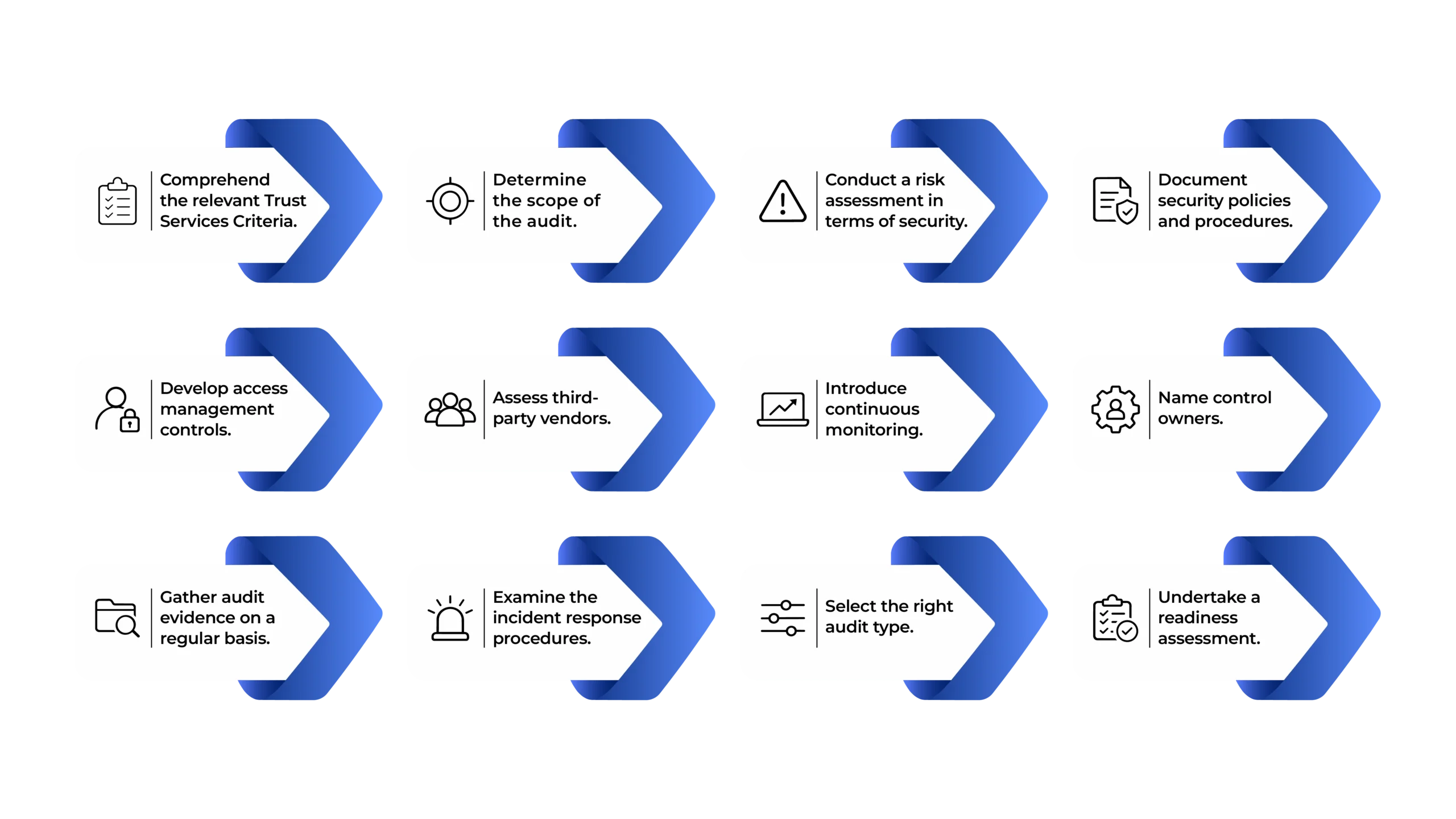
The following is a checklist to be carried out before the conduct of SOC 2 examination:
1. What are the most common SOC 2 mistakes SaaS startups make?
The common mistakes could include absence of scope definition, documentation, evidence for the audit, access control, vendor assessment, and the creation of a one-time-only project for compliance.
2. Can a small startup get SOC 2 ready without hiring a compliance person?
Indeed. A startup business can assign tasks to its own staff, use software to automate compliance and seek outside assistance if required. However, it is essential to provide for the ownership and management control.
3. How do SOC 2 compliance mistakes affect enterprise sales cycles?
Not having any sort of security documentation or unavailability of SOC 2 reports would mean that additional review of vendors and questionnaires for security will be required. A proper SOC 2 program can help in overcoming security concerns of customers.
4. How does SOC 2 shorten SaaS sales cycles?
SOC 2 reports provide a means for third party security control assurance independently. The enterprise clients can make use of the reports while evaluating their vendors.
5. How can startups automate SOC 2 compliance?
SOC 2 compliance software is used by startups to manage documentation, control monitoring, task assignment, policy maintenance, risk tracking, and preparation for audits. Although automation could make the task of compliance easier, it cannot relieve managers of their security responsibilities or auditors from their judgment.
6. How long does it take a SaaS startup to achieve SOC 2 compliance?
All of this depends on the level of security maturity, type of audit to be performed, gaps in controls and size of the audit scope.
7. What should a SaaS startup do before beginning a SOC 2 audit?
A SaaS startup should clearly define its audit scope, evaluate the relevant criteria for Trust Services, assess their current controls, find any security gaps, designate control owners, and create an evidence gathering process prior to beginning a SOC 2 audit.
Avoiding some of the most common SOC 2 errors begins by recognizing that SOC 2 is an ongoing business process and not a one-off auditing process.
For SaaS startups, determining what the correct audit scope will be, what type of examination to perform, controls, evidence, security practices, and assignments can help ease the preparation process.
A SOC 2 program that is properly run can improve security practices and provide opportunities for enterprises.
Ready to simplify your SOC 2 journey? Contact SOCLY.io to discuss your compliance requirements and take the next step toward audit readiness.
Your trusted partner in compliance automation. Turn complex regulations into clear, automated workflows.
By submitting, you agree to our Privacy Policy and Terms of Service

