


How Compliance Automation Simplifies GDPR Documentation
How Compliance Automation Simplifies GDPR Documentation
How Compliance Automation Simplifies GDPR Documentation
>How Compliance Automation Simplifies GDPR Documentation
How Compliance Automation Simplifies GDPR Documentation
How Compliance Automation Simplifies GDPR Documentation
Table of Contents
- What Is GDPR Compliance Automation?
- Why Is GDPR Documentation Difficult to Manage Manually?
- How Compliance Automation Simplifies GDPR Documentation
- How to Automate GDPR Documentation Step by Step
- GDPR Compliance Automation for Businesses: A Practical Example
- Benefits of GDPR Compliance Automation
- What GDPR Compliance Automation Cannot Do
- GDPR Documentation Checklist
- Frequently Asked Questions
- Conclusion
Management of GDPR documentation may quickly become challenging if privacy files are scattered between spreadsheets, email messages, cloud drive files, etc. GDPR Compliance Automation integrates the above activities into an organized workflow process, assisting organizations in managing their privacy documentation.
The reason why this is crucial for businesses is that GDPR compliance is not a simple task of documentation. Businesses have to know what information they are processing, for what purpose, who can access it, where it goes, and how it is secured. And they also have to ensure that their records stay up-to-date.
Automation will be able to eliminate some of the repetitive tasks and make management of this information easier. The idea is not to automate responsibilities away, but rather to provide greater visibility and consistency for the privacy and compliance teams.
What Is GDPR Compliance Automation?
GDPR Compliance Automation makes use of software and automated workflows to assist in managing the repetitive privacy and compliance tasks.
These include, among others:
- Maintaining records of processing activities
- Managing privacy policies and documentation
- Tracking data processing activities
- Monitoring compliance tasks
- Managing data protection assessments
- Maintaining vendor and processor information
- Assigning tasks to responsible employees
- Tracking remediation activities
- Organizing evidence and compliance records
- Monitoring changes that require documentation updates
The capabilities differ from one platform to another. Automation has to be such that it helps to support the organization’s privacy program and the right people have to make decisions.
Why Is GDPR Documentation Difficult to Manage Manually?
Documentation under GDPR is not limited to just a privacy policy.
There is information relating to processing operations, categories of data, purposes, recipients, retention periods, and many other aspects of the privacy program.
The challenge becomes greater as a business grows.
For instance, a SaaS business could implement a new customer support portal. This could lead to the addition of a new data processor along with issues concerning the type of data that is shared, reasons for processing such data, and retention period.
Where documentation is done manually, it becomes difficult for employees to deal with:
This is where automation can make a practical difference.
How Compliance Automation Simplifies GDPR Documentation
1. Centralizes GDPR Documentation
The main benefits of automation are having privacy information in one system.
Without having to search across several spreadsheets and folders, all the necessary compliance information can be managed in one place.
A GDPR compliance software solution may offer such sections for processing activities, vendors, assessments, policies, tasks, and evidence.
This way, there will be a more structured source of information for privacy and compliance teams.
2. Automates Repetitive Compliance Tasks
Many documentation activities are repetitive.
For example, a privacy manager may need to:
- Assign a documentation task.
- Notify the responsible employee.
- Follow up before the deadline.
- Review the completed information.
- Record approval.
- Schedule a future review.
Most of the processes can be automated.
Instead of manually reminding and tracking tasks, it can automate all these processes using workflows that have been defined beforehand.
This way, compliance officers will have more time for analyzing privacy risks and will spend less time on administrative processes.
3. Makes Records of Processing Easier to Maintain
A Record of Processing Activities, commonly called a ROPA, is an important part of GDPR compliance documentation for organizations where the relevant Article 30 requirements apply.
Article 30 of the GDPR sets out the requirements for records of processing activities, including the information these records must contain and the circumstances in which they must be maintained.
A ROPA can contain information such as:
- Processing purposes
- Categories of personal data
- Categories of data subjects
- Recipients
- International transfers
- Retention information
- Security measures
Accuracy of the record keeping may be difficult when the process is constantly changing.
Automation will enable a systematic workflow for creating, reviewing, assigning ownership, and updating the records of the process.
The organization will have to make sure that the information is accurate. This is not what automation does.
4. Improves Vendor and Processor Tracking
Personal data is usually not processed solely by the company itself.
Cloud service providers, analytics platforms, payment processors, customer relationship management software, email providers, and many other vendors may be processing personal data on behalf of an organization.
A compliance automation platform can assist in maintaining an up-to-date vendor inventory and linking vendors to processing activities.
It becomes much easier to answer questions like:
- Which vendors process personal data?
- What information do they process?
- What is their role?
- Where is the data transferred?
- When is it time to review the vendor relationship?
Even a workflow will help in tracking the privacy reviews and documentation of third party processors.
How to Automate GDPR Documentation Step by Step
If you are wondering how to automate GDPR compliance documentation, avoid trying to automate everything at once.
Step 1: Identify Your Documentation
Start by listing the privacy records your organization maintains.
These may include:
- Records of processing activities
- Privacy policies
- Data protection assessments
- Vendor records
- Data retention information
- Data subject request records
- Consent records where applicable
- International transfer documentation
- Security and privacy procedures
Step 2: Identify Ownership
All important records must have an accountable owner.
For instance, a processing activity may have a department manager as its owner and the privacy and legal teams can be tasked to review privacy policies.
The best way for automation is where there are well-defined responsibilities before creation of workflows.
Step 3: Map Recurring Activities
Identify tasks that happen repeatedly.
Examples include:
- Quarterly vendor reviews
- Annual policy reviews
- New processing assessments
- Employee privacy training
- Periodic documentation reviews
These activities are strong candidates for automated reminders and workflows.
Step 4: Establish Review Triggers
Not every update should depend on a calendar reminder.
Some changes should trigger a documentation review.
For example:
New Software → New Vendor → Personal Data Processed → Privacy Assessment → Update Documentation
Establishing these connections may enable organizations to react more uniformly to changes in their processing environment.
Step 5: Monitor and Improve
Automation should not be considered a “set it and forget it” process.
Look at whether workflows are functioning, whether the records are current, and whether tasks have been accomplished by employees.
Identify any overdue processes using compliance dashboards and reports.
GDPR Compliance Automation for Businesses: A Practical Example
Imagine a scaling SaaS business that has more than 50 third-party applications.
The business uses spreadsheets to record all vendor information, and the process activities are recorded in a separate document. Every time a new service comes into play, somebody needs to find out if it processes any personal data and update the documents accordingly.
Using GDPR compliance automation for businesses, the company will be able to develop an organized workflow.
When a new vendor appears:
Vendor added → Privacy review assigned → Data processing assessed → Relevant records updated → Owner notified → Review scheduled
The workflow doesn’t determine whether the process is legal or not. Instead, it ensures that the correct information is communicated to the correct person at the right time.
That distinction is important.
Benefits of GDPR Compliance Automation
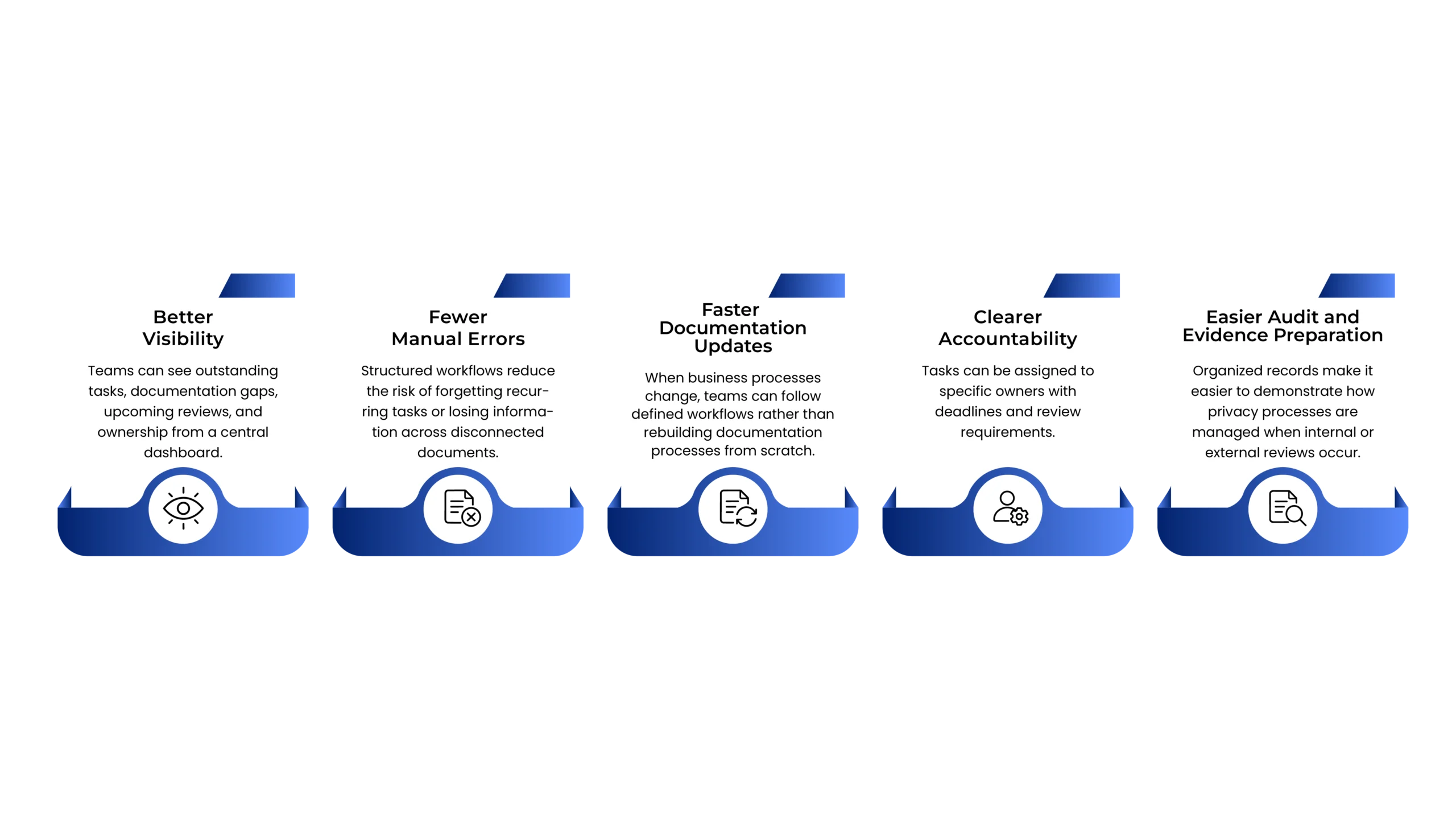
When implemented properly, automation can help organizations achieve several practical benefits.
What GDPR Compliance Automation Cannot Do
Automatization is great, but it doesn’t take the place of privacy knowledge or organizational responsibility.
No matter what software solution you employ, you can’t always know the legal requirements.
Organizations still need people to:
- Make privacy decisions
- Evaluate risks
- Review processing activities
- Approve policies
- Assess contractual requirements
- Determine appropriate safeguards
- Respond to unusual or complex situations
So, automation should be complemented by governance and people’s assessment.
GDPR Documentation Checklist
Before implementing an automation solution, check whether your organization has:
- A clear inventory of personal data processing
- Documented processing purposes
- Identified data categories and recipients
- A current vendor and processor inventory
- Defined documentation owners
- Review schedules
- Data retention information
- International transfer information where relevant
- Privacy risk assessment processes
- Procedures for updating records after business changes
Automation works much better when the information and responsibilities are already well-defined.
Frequently Asked Questions
What is GDPR Compliance Automation?
GDPR Compliance Automation is a process of automation of privacy compliance processes and activities via technology.
How does compliance automation simplify GDPR documentation?
It helps to centralize the records, automate the workflows, assign the tasks, send notifications, track the changes, and get the visibility of the documentation status. Thus, teams save time on administrative work.
Can GDPR documentation be fully automated?
No. Many administrative processes can be automated, but there is always the need for humans to provide oversight into matters related to privacy.
What is GDPR compliance software?
GDPR compliance software is a type of software that assists organizations in carrying out various privacy-related activities such as record processing, assessment, vendor management, task management, policies, and compliance documentation.
What GDPR documents can be automated?
Based on the type of software used, an organization can automate its workflow for record processing, privacy assessment, vendor records, policy review, data subject requests, and many more documentation activities.
Is GDPR automation suitable for small businesses?
Yes. Small organizations can use automation to set up structured privacy workflows without necessarily having to depend on spreadsheets and reminders alone.
Conclusion
GDPR documentation will get more complex as the company gains more customers, employees, applications, vendors, and data processing operations. Manual processes may become a hindrance when ensuring accuracy in documentation and timely execution of critical reviews.
GDPR Compliance Automation will offer a more organized process through consolidation of information, process automation, ownership and visibility of privacy operations.
The trick here is to ensure that automation works as part of a privacy program and not as a substitute for judgment and responsibility.
To simplify GDPR documentation and implement more efficient privacy processes, you can Contact us today for more information on how compliance automation will enhance your compliance program.
Our Recent Posts
-
How Compliance Automation Simplifies GDPR Documentation
-
DPDP Rules 2025: Key Requirements and What Businesses Need to Know
-
ISO 27001 Risk Treatment Plan: How to Identify, Evaluate and Treat Security Risks
-
How to Define Your SOC 2 Scope: A Practical Guide for Startups
-
ISO 42001 Certification: 2026 Guide to Requirements, Cost, Timeline & Process