


What Is GDPR and Why Does Your Business Need GDPR Compliance?
What Is GDPR and Why Does Your Business Need GDPR Compliance?
What Is GDPR and Why Does Your Business Need GDPR Compliance?
>What Is GDPR and Why Does Your Business Need GDPR Compliance?
What Is GDPR and Why Does Your Business Need GDPR Compliance?
What Is GDPR and Why Does Your Business Need GDPR Compliance?
Data is considered one of the biggest assets for your organization in the present digital world and at the same time one of its major responsibilities. No matter if you have created a SaaS startup aimed at your local audience or customers in Europe, data protection has become an obligation rather than choice for your company.
Adherence to the GDPR has turned into both legal and business necessity nowadays. Such companies, which consider data privacy as the topmost priority, have managed to create closer relationships with customers and have been more successful in security and competition. If your company operates within the personal data of people located in the EU region, you should be aware of GDPR compliance.
Here, you will find everything you need to know about GDPR from definition to compliance process.
What Is GDPR?
The General Data Protection Regulation (GDPR) is a law of the EU which stipulates how personal data of citizens of the EU/EEA is to be handled, processed, stored and protected. The primary purpose of this legislation is to empower individuals with control over their data and at the same time give businesses the necessary safeguards on their data.
GDPR applies to everyone in the world as of 25th May 2018, no matter where they are located geographically. If you have customers in the EU using your SaaS product then you are most likely governed by GDPR.
Why Was GDPR Developed?
Each country in Europe had different privacy laws that created a challenge for businesses to comply with the different rules and inconsistent for consumers.
GDPR was introduced to:
- Protect individuals’ privacy rights
- Standardize data protection laws across Europe
- Increase transparency in data processing
- Hold organizations accountable for handling personal information
- Build trust in digital services
Today, GDPR is considered one of the world’s strongest privacy regulations and has inspired similar laws globally.
What Is GDPR Compliance?
Compliance with GDPR necessitates having policies, systems, and processes in place which adhere to GDPR requirements concerning the collection, processing, retention, transmission, and disposal of personal data.
Compliance is about much more than merely having a privacy policy; it involves being accountable through the proper documentation, training, security, and risk management processes.
A compliant organization understands:
- What personal data it collects
- Why it collects the data
- How long the data is retained
- Who has access to it
- How it is protected
- How individuals can exercise their privacy rights
Why Does My Business Need GDPR Compliance?
Your business must adhere to the GDPR for the following reasons; to secure customer data, avoid fines, build customer confidence, increase cybersecurity and to conduct your business dealings with European customers. It is particularly crucial for software-as-a-service startups since software systems process customer data, which include names, emails, payment info, customer behavior, IP addresses and other business data.
Key Benefits of GDPR Compliance
1. Builds Customer Trust
Customers are increasingly aware of how companies use their personal information.
A transparent privacy program demonstrates that your company values customer data and handles it responsibly.
Trusted companies often enjoy:
- Higher customer retention
- Better product adoption
- Increased referrals
- Stronger brand reputation
2. Reduces Legal and Financial Risk
Non-compliance can result in significant financial penalties. More importantly, regulatory investigations can damage your reputation and slow business growth.
Compliance minimizes the likelihood of:
- Regulatory actions
- Customer complaints
- Data misuse
- Privacy lawsuits
3. Strengthens Data Security
GDPR encourages businesses to implement appropriate technical and organizational safeguards.
Examples include:
- Encryption
- Multi-factor authentication
- Access controls
- Secure backups
- Incident response planning
- Regular vulnerability assessments
These practices improve overall cybersecurity, not just compliance.
4. Supports International Expansion
Many SaaS startups eventually expand into European markets.
Being GDPR compliant allows businesses to:
- Serve EU customers confidently
- Meet enterprise procurement requirements
- Simplify international partnerships
- Win larger contracts
5. Creates Better Data Management
GDPR encourages organizations to collect only necessary information.
This results in:
- Cleaner databases
- Lower storage costs
- Better data quality
- Improved analytics
What Personal Data Is Protected Under GDPR?
GDPR protects any information that can identify an individual directly or indirectly.
Examples include:
Personal Identification
- Full name
- Home address
- Email address
- Phone number
- Passport number
Online Identifiers
- IP addresses
- Cookie IDs
- Device IDs
- Login credentials
- Location data
Financial Information
- Bank account details
- Credit card information
- Payment records
Employment Information
- Employee IDs
- Payroll records
- Performance reviews
Sensitive Personal Data
Special categories receive additional protection, including:
- Health records
- Biometric data
- Genetic data
- Religious beliefs
- Political opinions
- Sexual orientation
Who Must Comply with GDPR?
Many startups assume GDPR only applies to European companies.
That’s incorrect.
GDPR applies if your business:
- Offers products or services to EU residents
- Monitors user behavior within the EU
- Collects personal information from EU individuals
- Processes Personal Data on Behalf of Another Organization
GDPR compliance is required even for non-European startups.
GDPR Compliance for Startups
Startups usually consider compliance as something that will be done after growing. The thing is that compliance is way easier to do at the startup level.
Why GDPR Compliance for Startups Matters
Privacy-first startups benefit from:
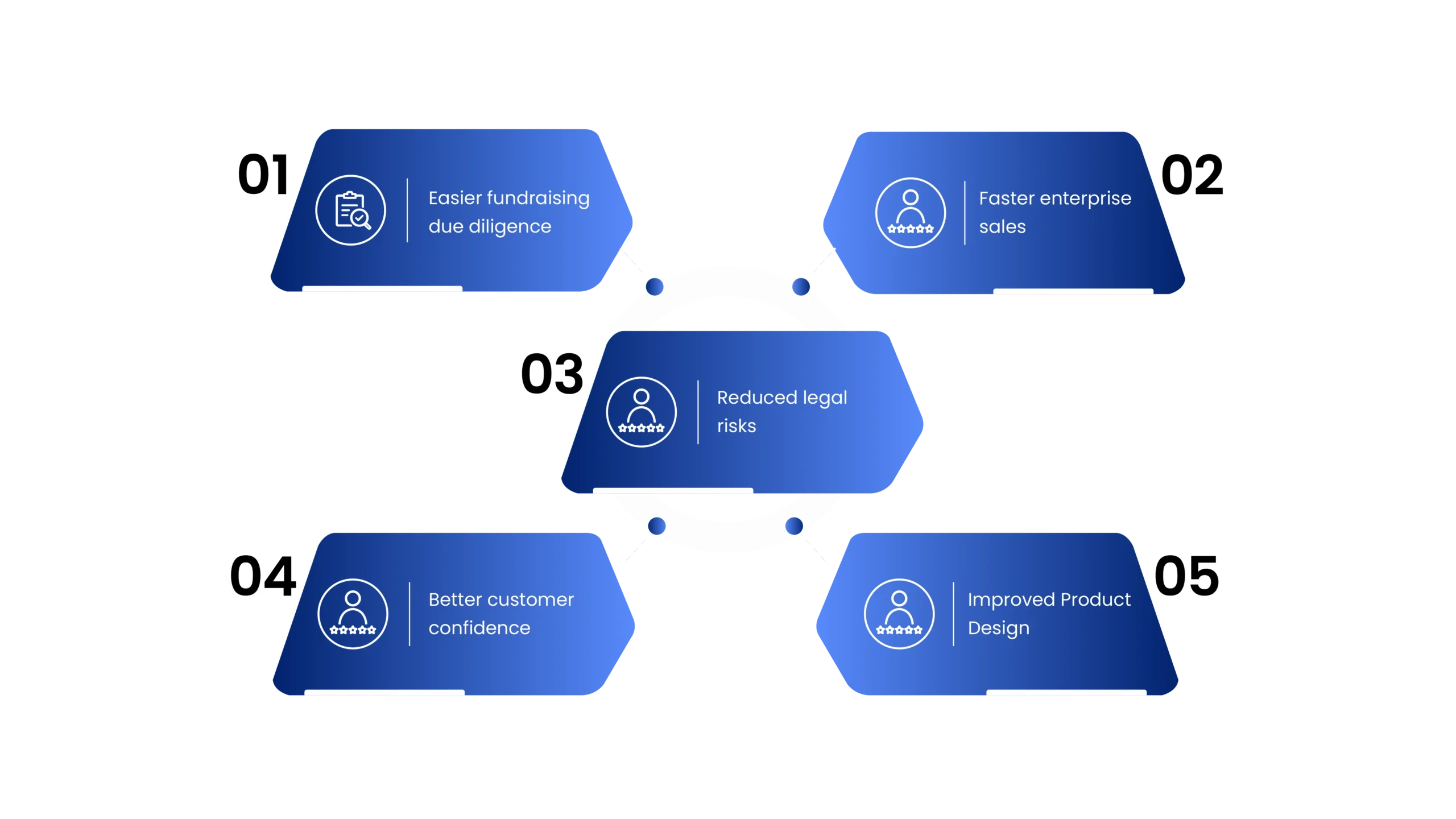
Embedding privacy during development avoids expensive redesigns later.
Core GDPR Principles Every SaaS Company Should Follow
The General Data Protection Regulation is built around several key principles.
Lawfulness, Fairness, and Transparency
Only collect data for legitimate reasons and clearly explain why.
Purpose Limitation
Use personal information only for the purpose originally communicated.
Data Minimization
Collect only the information necessary for delivering your service.
Accuracy
Keep customer records accurate and updated.
Storage Limitation
Delete information once it is no longer needed.
Integrity and Confidentiality
Protect personal data through appropriate security measures.
Accountability
Document your compliance efforts and demonstrate ongoing governance.
GDPR Compliance Checklist
The following GDPR compliance checklist provides a practical starting point.
✔ Map Your Data
Identify:
- What personal data you collect
- Where it is stored
- Who can access it
- Why it is processed
✔ Update Privacy Policies
Ensure your privacy notice explains:
- Data collection
- Processing purposes
- User rights
- Contact details
- Retention periods
✔ Obtain Valid Consent
Consent should be:
- Freely given
- Specific
- Informed
- Easy to withdraw
✔ Strengthen Security Controls
Implement:
- Encryption
- MFA
- Access restrictions
- Endpoint protection
- Secure cloud environments
✔ Create Data Subject Request Procedures
Customers should easily request:
- Data access
- Data correction
- Data deletion
- Data portability
✔ Prepare for Data Breaches
Develop an incident response plan that includes:
- Internal reporting
- Investigation
- Risk assessment
- Notification procedures
- Recovery actions
✔ Train Employees
Human error remains a leading cause of data breaches.
Regular awareness training helps employees recognize:
- Phishing attacks
- Social engineering
- Secure password practices
- Data handling procedures
✔ Conduct Regular Compliance Reviews
Privacy compliance is continuous.
Review policies and controls regularly as your business evolves.
How to Become GDPR Compliant
If you’re wondering how to become GDPR compliant, follow these steps.
Step 1: Understand Your Data
Document all personal information your company processes.
Step 2: Identify Legal Bases
Determine whether processing relies on:
- Consent
- Contract
- Legal obligation
- Legitimate interests
- Public interest
- Vital interests
Step 3: Implement Technical Safeguards
Strengthen infrastructure through:
- Encryption
- Secure authentication
- Network monitoring
- Backup systems
Step 4: Review Vendors
Ensure third-party providers also follow GDPR standards.
This includes:
- Cloud hosting
- CRM platforms
- Payment providers
- Analytics tools
Step 5: Monitor and Improve
Compliance isn’t a one-time project.
Review risks continuously and update controls as regulations and business needs change.
Common GDPR Mistakes Businesses Should Avoid
Many startups unintentionally violate GDPR through avoidable mistakes.
Common examples include:
- Collecting unnecessary customer data
- Using pre-checked consent boxes
- Weak password policies
- Missing privacy notices
- Ignoring customer deletion requests
- Poor third-party vendor oversight
- Lack of employee training
Avoiding these issues significantly improves your compliance posture.
Real-World Example
Imagine a SaaS CRM platform serving customers in Germany and France.
The platform collects:
- Names
- Email addresses
- Company information
- IP addresses
- User activity logs
To align with GDPR data protection requirements, the company:
- Provides a clear privacy notice.
- Requests explicit consent for marketing emails.
- Encrypts customer data.
- Limits employee access based on roles.
- Enables users to download or delete their information.
- Signs data processing agreements with cloud vendors.
- Regularly reviews security controls.
These practices reduce risk while increasing customer confidence.
How SOCLY.io Makes It Easier to Comply with GDPR
Compliance with GDPR can be quite a daunting task, particularly for SaaS start-ups that deal with customer data from several regions. There is collecting accurate information on how data is processed, implementing privacy controls, dealing with any requests from the data subjects, among other things. However, SOCLY.io makes it easier for businesses to comply with GDPR using its intelligent compliance automation platform that enables businesses to collect relevant evidence, conduct risk assessment, monitor compliance controls, and ensure constant readiness for compliance. If you are a SaaS start-up that wants to venture into Europe, or an existing company processing EU customer data, SOCLY.io will assist you.
Frequently Asked Questions (FAQs)
1. What is GDPR and why is it important?
GDPR is the General Data Protection Regulation of the European Union which ensures that the privacy of an individual’s personal information is safeguarded. The significance of this regulation lies in the fact that it lays down rules of good data management.
2. Why does my business need GDPR compliance?
When your business involves the processing of personal data of EU citizens, then you need to be compliant to GDPR. It is a way of handling privacy threats, which plays a part in creating customer confidence and growing your business.
3. How can I comply with GDPR?
Start by reviewing the personal data you collect, update your privacy policies, get proper consent, put security measures in place, train employees and regularly review your
4. What personal data is protected by the GDPR?
GDPR covers data that can identify a person, including names, email addresses, telephone numbers, IP addresses, geolocation data, financial data, health data, biometric data, and other identifiers.
5. Is GDPR applicable to startups outside Europe?
Yes. GDPR is applicable to startups in any country of the world providing that such startups offer their products/services to residents of the EU or track online behaviour of EU residents.
6. What will happen if an organisation fails to comply with GDPR?
Failure to comply with GDPR can lead to investigation by regulators, fines, bad reputation, etc. A compliance programme will help minimise these risks.
Final Thoughts
Nowadays, data privacy is one of the main distinctions between modern SaaS companies. Compliance with GDPR is not just a necessity dictated by regulations. It is also an ability to ensure the integrity, security, and resilience of your organization.
Knowing the GDPR, using the GDPR compliance checklist, enhancing GDPR data protection policies, and integrating privacy at the initial stages, all will help you to work confidently with customers and eliminate risks. It doesn’t matter whether you are a developing SaaS startup or an established tech company. The investment in GDPR compliance will be an investment in your future success.
Looking to Make GDPR Compliance Simple?
Ensure customer privacy and create a strong security posture with a custom GDPR compliance strategy.
Contact us to learn more about your compliance needs, Schedule a Consultation with our specialists, Visit Our Website to learn more about our services, or Start Now to use GDPR compliance as your competitive advantage.
Our Recent Posts
-
ISO 27001 Risk Treatment Plan: How to Identify, Evaluate and Treat Security Risks
-
How to Define Your SOC 2 Scope: A Practical Guide for Startups
-
ISO 42001 Certification: 2026 Guide to Requirements, Cost, Timeline & Process
-
Who Needs to Comply With CCPA? A Guide for SaaS Businesses
-
SOC 2 vs ISO 27001: What’s The Difference and Which Does Your SaaS Company Need?