
System and Organization Controls
Information Security Management System
Artificial Intelligence Management System
General Data Protection Regulation
Health Insurance Portability and Accountability Act
California Consumer Privacy Act
Digital Personal Data Protection Act
Preparing for your first ISO 27001 audit can feel overwhelming, especially if your organization has never gone through a formal compliance process before. This global benchmark for handling information safely shapes how companies manage risks around data. Passing the review shows others you treat protection of digital assets as a priority.
Because trust matters, meeting this bar counts. Right now, people you work with want proof that data stays safe. Getting through your initial ISO 27001 check isn’t only paperwork trust grows when risks drop. Being seen as someone others can count on often starts here.
This guide will explain:
A clear path will take shape once we walk through each step. Only then the full picture comes into view.
An ISO 27001 checks how your company manages information security. Its purpose? Making sure your system actually follows the required standards
Not every security framework uses several kinds of checks ISO 27001 does, mixing inside reviews with outside ones. These evaluations happen at different times, yet they work as a pair. One follows company rules, another tests against outside standards. Because of this mix, gaps show up more clearly. Each round builds on what came before it. Over time, weak spots get found earlier. Results add up without needing extra steps
Successfully passing an ISO 27001 audit provides peace of mind and serves as a strong business differentiator.
Faster progress comes easier when tasks run on their own – SOCLY.io handles proof gathering without help. Controls find their place under ISO 27001 through smart matching. Year after year, the system stays prepared for review, quietly ready.
Every now and then, ISO/IEC 27001 expects companies to carry out checks inside their own systems; this is laid out in Clause 9.2. These reviews happen on a set schedule. Instead of waiting for outsiders, you look closely at how things are running. The goal? To see if your information security setup follows the rules it should. Each checkpoint measures real actions against what the standard asks
When it comes to checks inside the company, they’re something you have to do. Outside reviews come into play just when aiming for ISO 27001 status or keeping it. Many businesses go after that badge simply because an outside body says it’s legit. A little edge over others often keeps them moving forward.
Key benefits of ISO 27001 certification audits include:
One way to handle tasks such as managing policies, collecting proof, or watching risks is how SOCLY.io shapes them into clear steps. Small groups find this helpful because it lightens their load without extra effort.
There are four main types of ISO 27001 audits:
1.Internal Audit
This check, done by your own staff or someone outside the company, makes sure your information security system works as it should and follows ISO 27001 rules. Every year, without exception, one of these reviews must happen.
2.Certification Audit
Audit happens in two steps, carried out by a recognized certifier, checking if your group meets ISO 27001 standards. Though not automatic, approval depends on how well systems align with required controls.
Stage 1: Review of ISMS documentation and design
Stage 2: Review of actual processes, controls, and implementation
Achieving it means a certificate that lasts three years lands in your hands.
3.Surveillance Audit
Every now and then, during the first couple of years post-certification, auditors come back to see how things are holding up. They peek at whether rules from Annex A still apply day to day. What happened before matters too – fixes for past issues get another look. How well changes stuck around becomes clear only through these follow ups.
4.Recertification Audit
Once every three years, companies go through another check to keep their ISO 27001 status. Not just paperwork, actual practices get reviewed too, along with how well improvements are kept up over time.
Before your first ISO 27001 audit, you must prepare specific documents. The ISO27k Forum checklist identifies 14 mandatory documents, including:
The Statement of Appraisals matters more than most realize. Inside, every one of the 114 Annex A safeguards gets a spot marked yes, no, or maybe. Each choice ties back to how risks line up with what the group actually faces. Leftout items? They come with clear reasons rooted in real analysis.
When paperwork is missing, approval from ISO 27001 reviewers becomes impossible. Compliance stays unverified if records aren’t in place. Auditors need clear proof without it, nothing passes. Missing documents block every check. Evidence must exist, otherwise validation fails completely.
Starts messy, right. Paper trails scatter when teams dive into cold audits. That one gap – chaos in files gets fixed a different way now. Enter SOCLY.io, slipping in ready-made checklists baked for ISO 27001 rules. Updates stick automatically, so nothing slips behind. Old drafts fade out, quietly. Fresh steps lock in place without nudging.
Many first time ISO 27001 audits fail due to avoidable mistakes. The most frequent issues include:
Incomplete documentation- Missing paperwork shows rules that haven’t kept up with how things are really done
Weak risk assessments- Poor checks on possible dangers – often skipped entirely or done without care. What hides inside these gaps? A lack of real digging into how data could be exposed.
Insufficient training- Employees unaware of their security responsibilities
Poor management involvement- When leaders stay distant, efforts stall. Without their time or attention, projects starve. Commitment slips when priorities lie elsewhere
Neglected internal audits- Skipping or rushing through mandatory annual reviews
Steering clear of these mistakes demands thorough preparation and ongoing oversight of your ISMS
Here’s a practical 5-step roadmap to get audit-ready:
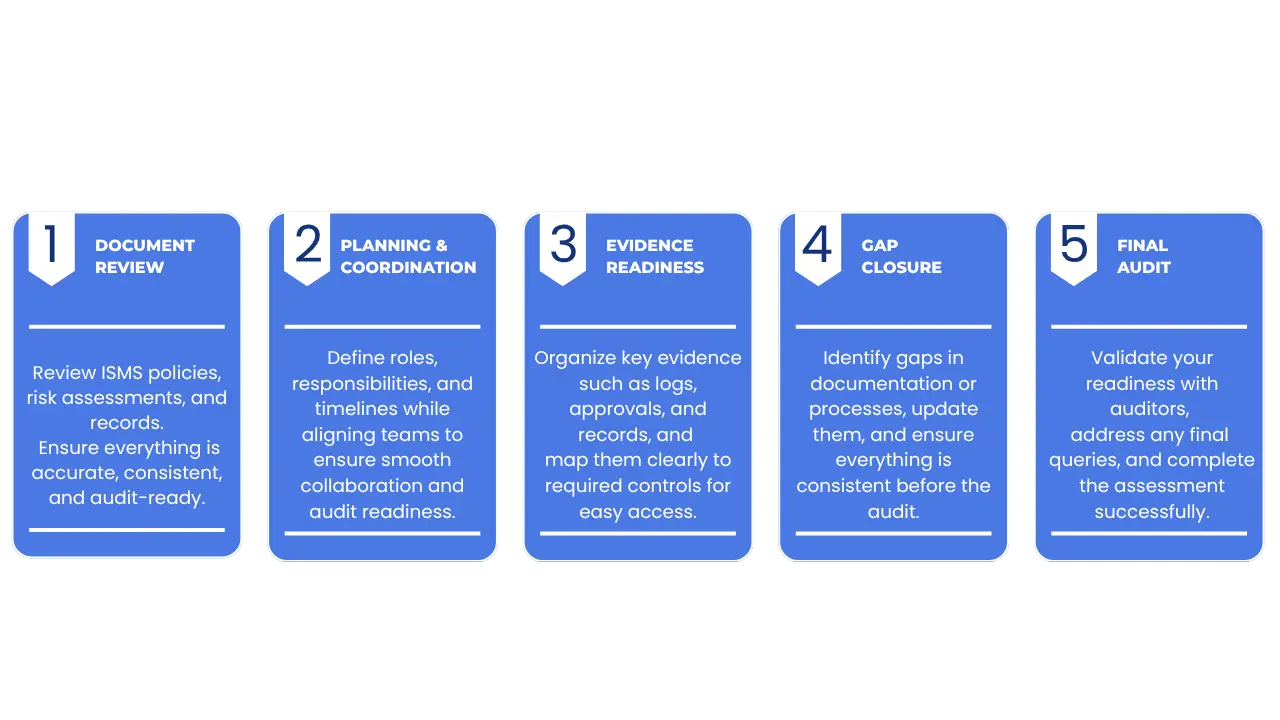
1. Document Review
Begin by reviewing all ISMS documentation policies, risk assessments, the Statement of Applicability, and supporting records.
These should accurately reflect current practices and remain consistent across the system. Since documentation is reviewed in a shared, independent manner, it needs to be clear, self-explanatory, and easy to validate without additional guidance.
2. Planning and Coordination
Define roles, responsibilities, and timelines upfront to ensure a smooth audit flow.
Plan how information will be shared, accessed, and tracked across teams. Ensure stakeholders are available for timely responses and that documents, systems, and communication channels are structured to support distributed collaboration.
Strong coordination and leadership support help avoid delays and keep the process aligned.
3. Evidence Readiness and Organization
Prepare and organize evidence so it can be easily accessed and reviewed at any point.
This includes records such as logs, approvals, training completion, policy acknowledgements, and operational outputs. Evidence should be clearly mapped to controls and maintained in a structured repository, allowing it to be reviewed asynchronously without relying on live demonstrations.
4. Iterative Review and Gap Closure
As documentation and evidence are reviewed, feedback is shared in cycles.
Teams address gaps, update records, and refine submissions based on observations. This ongoing exchange continues until all requirements are clearly met and supported by verifiable, well-structured evidence.
The emphasis is on consistency between documentation, implementation, and what is ultimately presented for review.
5. Final Audit and Validation
Once readiness is established, auditors conduct their assessment based on the shared documentation and evidence.
Follow-ups, clarifications, or walkthroughs are handled through scheduled interactions where required. After validation, findings are documented and the audit proceeds toward final attestation.
Centralize evidence: Keep audit trails, images, rules, and learning proof – all in a single spot.
Conduct regular internal audits: Spot checks inside the company matter most when done often. When scheduled yearly, they catch weak spots before problems grow. Timing beats waiting till the official date comes around.
Involve leadership: When management steps in, funds follow commitment and turn plans into action. Picture a team moving forward only when bosses clear the path ahead.
Train employees: People at work need to know how safety fits their daily tasks. Ongoing learning helps them stay aware. Each person plays a role, so practice matters just as much as knowledge.
Use compliance tools: Start smart. Tools that follow rules automatically gather proof, watch activity, report results cutting hours plus expense without extra effort.
Picture how it unfolds:
Year 1: Certification Audit Stages 1 and 2
Year 2&3: Surveillance and Internal Audits
Year 4: Recertification Audit
Over time, it keeps moving forward, holding steady while getting better little by little.
Achieving ISO 27001 certified sharpens how your group handles safety. It lowers threats while showing those who matter that you take responsibility seriously.
Key benefits include:
A solid start on your initial ISO 27001 check builds momentum that lasts. Though details matter, clarity matters more; each step shapes what comes next.
Getting ready for ISO 27001 can seem like too much work especially if you are a smaller business without an army of staff to handle rules. Yet here’s where SOCLY.io steps in, quietly changing how it’s done.
One spot holds everything when SOCLY.io pulls docs together. Chasing proof by hand fades away once automation takes over. Teams move easier because tasks flow without hiccups. Risk checks live beside compliance statements, no jumping around needed. Audit trails stay put, always within reach. Nothing slips, each piece stays where it should.
Every day runs smoother when tasks follow a clear path. With automated steps built in, SOCLY.io keeps teams prepared without last-minute rushes. Proof is ready because it lives in the routine. Certification becomes part of how work already happens. Order comes from consistency, not pressure.
Starting out with ISO 27001? The initial check usually feels toughest. Getting things right means putting safeguards in place, rounding up paperwork, then making sure staff understand their roles. Still, doing it builds strength, keeps operations steady, and earns confidence over time. When done well, security becomes part of how work happens every day.
Starting with clear steps means checking documents first. Then comes the internal review, which happens before fixes are made. Where gaps exist, corrections follow right after. Leadership gets involved once things are ready. Passing the ISO 27001 check becomes likely when these pieces line up. Over time, habits form around safety because of how people engage. The way work shifts stays useful far beyond the initial goal.
Getting through compliance can feel like a maze. SOCLY.io steps in quietly, smoothing out each turn without fuss. Every step forward becomes simpler, almost natural. The path clears up, just enough to keep going.
Get a free demo and discover how SOCLY.io can save you time, reduce risk and simplify ISO 27001 certification.
Your trusted partner in compliance automation. Turn complex regulations into clear, automated workflows.
By submitting, you agree to our Privacy Policy and Terms of Service

