
System and Organization Controls
Information Security Management System
Artificial Intelligence Management System
General Data Protection Regulation
Health Insurance Portability and Accountability Act
California Consumer Privacy Act
Digital Personal Data Protection Act
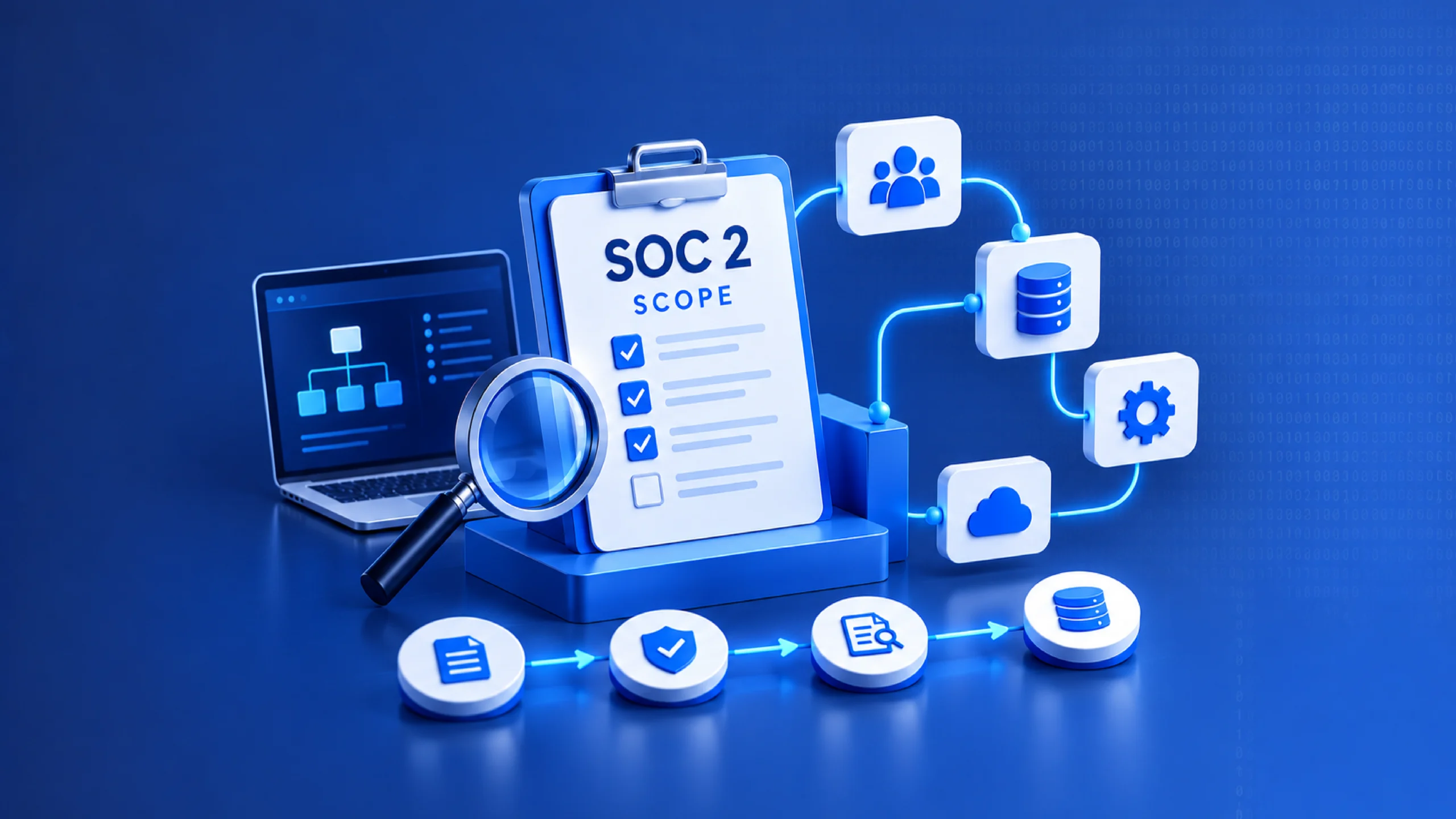
A SOC 2 audit can get unnecessarily complicated if you try to cover all the things that your business does. SOC 2 scope definition will help to limit the audit scope to those systems, individuals, processes, and data that really back up your services.
In startups, defining the scope is perhaps the most crucial step in preparing for a SOC 2 audit. An overly broad scope can lead to an increased compliance burden, whereas an excessively narrow scope may not cover some critical systems and processes.
So, what are the key aspects of defining the scope of SOC 2 for startups? Let’s consider them.
Scope of SOC 2 describes the components, services, premises, individuals, processes, technology, and information to be included in a SOC 2 review.
The scope in effect responds to one main question:
What is actually being examined during the SOC 2 examination?
SOC 2 reviews involve controls associated with one or more of the five AICPA Trust Services Criteria, namely, Security, Availability, Processing Integrity, Confidentiality, and Privacy.
Take, for instance, a cloud software company that offers project management software. Its scope of SOC 2 could be:
It may exclude unrelated internal systems, such as a separate marketing website, if those systems do not support the service being examined.
A clear SOC 2 audit scope gives your team a practical boundary for compliance work.
Without defined boundaries, startups can spend time creating controls and collecting evidence for systems that have little connection to the service being audited.
A well-defined scope can help you:
The AICPA describes SOC 2 examinations as assessments of controls at a service organization relevant to security, availability, processing integrity, confidentiality, or privacy.
That makes scope an important part of establishing what your organization is actually asserting about its systems and controls.
There is no single scope that works for every startup. Your scope should reflect the services you provide and the systems used to deliver them.
Here are the main areas to evaluate.
1. Products and Services
Start with the product or service your customers rely on.
Ask:
If your company has several products, you may not need to include every product in the same SOC 2 engagement. Discuss the appropriate boundary with your auditor.
2. Systems and Technology
Identify the technology that supports the in-scope service.
This may include:
Create an inventory before finalizing the scope. This makes it easier to identify dependencies that could otherwise be missed.
3. Data
Next, determine what information the in-scope systems handle.
Consider:
You should understand where this data is collected, processed, stored, transmitted, and deleted.
4. People and Teams
SOC 2 scope is not limited to technology.
Employees and contractors whose activities affect the in-scope service may also be relevant. Depending on your organization, this could include:
For example, if engineers can deploy changes to production, their access and change-management responsibilities may be relevant to the audit.
5. Third-Party Vendors
Startups often rely heavily on cloud and SaaS providers.
Review vendors such as:
Determine whether each vendor supports an in-scope system or process. Also identify whether the vendor’s controls affect your own control environment.
A practical SOC 2 scope definition can be created in five steps.
Step 1: Identify the Service Being Audited
Begin with the service customers purchase or use.
Write down exactly what the service does and which customer-facing functions are included.
This gives you a starting point instead of attempting to audit the entire company.
Step 2: Map the Supporting Systems
Create a simple flow showing how the service works.
For example:
Customer → Application → API → Database → Cloud Infrastructure
Then add the supporting components around that flow, such as identity management, monitoring, backups, deployment systems, and security tools.
This system map can reveal dependencies that should be considered when defining your scope.
Step 3: Identify People and Processes
Document the teams and processes that support those systems.
Look at areas such as:
Ask whether each process affects the security, availability, integrity, confidentiality, or privacy of the in-scope service.
Step 4: Review the Trust Services Criteria
While security is always an issue for SOC 2, other criteria may be included by the organization depending on its situation, such as Availability, Processing Integrity, Confidentiality, or Privacy.
Don’t just list all the criteria. Identify the criteria that are important to the service and the commitments being made.
Step 5: Test the Boundary Against Your SOC 2 Auditor
Prior to completing your scope, validate it against your SOC 2 auditor.
They can help ensure that the proposed boundary accurately reflects the system under evaluation and that any relevant dependencies have been identified and accounted for.
This step is particularly crucial for startups with complex cloud configurations, shared infrastructure, multiple products, and heavy dependencies on third parties.
Consider a startup that provides an AI-powered customer support platform.
Its initial scope might include:
In scope:
Potentially out of scope:
The exact boundary depends on how the startup’s environment is designed. The goal is not simply to exclude systems. The goal is to establish a defensible boundary that accurately represents the service and controls being examined.
Startups often make a few avoidable mistakes when defining scope.
Review your boundary regularly rather than treating it as permanent.
Before finalizing your scope, ask:
If you can answer these questions clearly, you have a much stronger foundation for your SOC 2 preparation.
1. What is SOC 2 scope?
SOC 2 scope defines the services, systems, people, processes, technologies, and data covered by a SOC 2 examination.
2. How do you define the scope of a SOC 2 audit?
Start by identifying the service being examined, then map its supporting systems, data, people, processes, and vendors. Finally, determine the relevant Trust Services Criteria and validate the boundary with your auditor.
3. What should be included in SOC 2 scope?
Typically, the scope includes systems, infrastructure, applications, data, employees, processes, and third-party dependencies that support the service being examined. The exact scope depends on the organization’s environment.
4. Can a startup exclude systems from SOC 2 scope?
Yes, systems that do not support the in-scope service may potentially be excluded. However, exclusions should be based on the actual system boundary and dependencies rather than simply removing systems to reduce audit effort.
5. Should all five Trust Services Criteria be included?
Not necessarily. SOC 2 can address Security, Availability, Processing Integrity, Confidentiality, and Privacy. The relevant criteria depend on the service, risks, customer expectations, and engagement objectives.
6. Does SOC 2 scope change as a startup grows?
It can. New products, infrastructure, vendors, data flows, and business processes may change the systems supporting the service. Startups should periodically review whether their documented scope still accurately represents their environment.
The task of defining the scope of SOC 2 isn’t about including as many systems into the audit as possible. The goal is to define the scope of your service in a clear and correct manner.
For new businesses, the simplest way is to define the service, map out its dependencies, identify the controls and the Trust Services Criteria related to it, list exclusions, and confirm the boundaries with the help of your auditor.
A properly defined scope will help you to better prepare for SOC 2 and deal with it as your business grows.
Want to simplify SOC 2 preparation? Contact us to discuss your compliance needs.
Your trusted partner in compliance automation. Turn complex regulations into clear, automated workflows.
By submitting, you agree to our Privacy Policy and Terms of Service

