
System and Organization Controls
Information Security Management System
Artificial Intelligence Management System
General Data Protection Regulation
Health Insurance Portability and Accountability Act
California Consumer Privacy Act
Digital Personal Data Protection Act
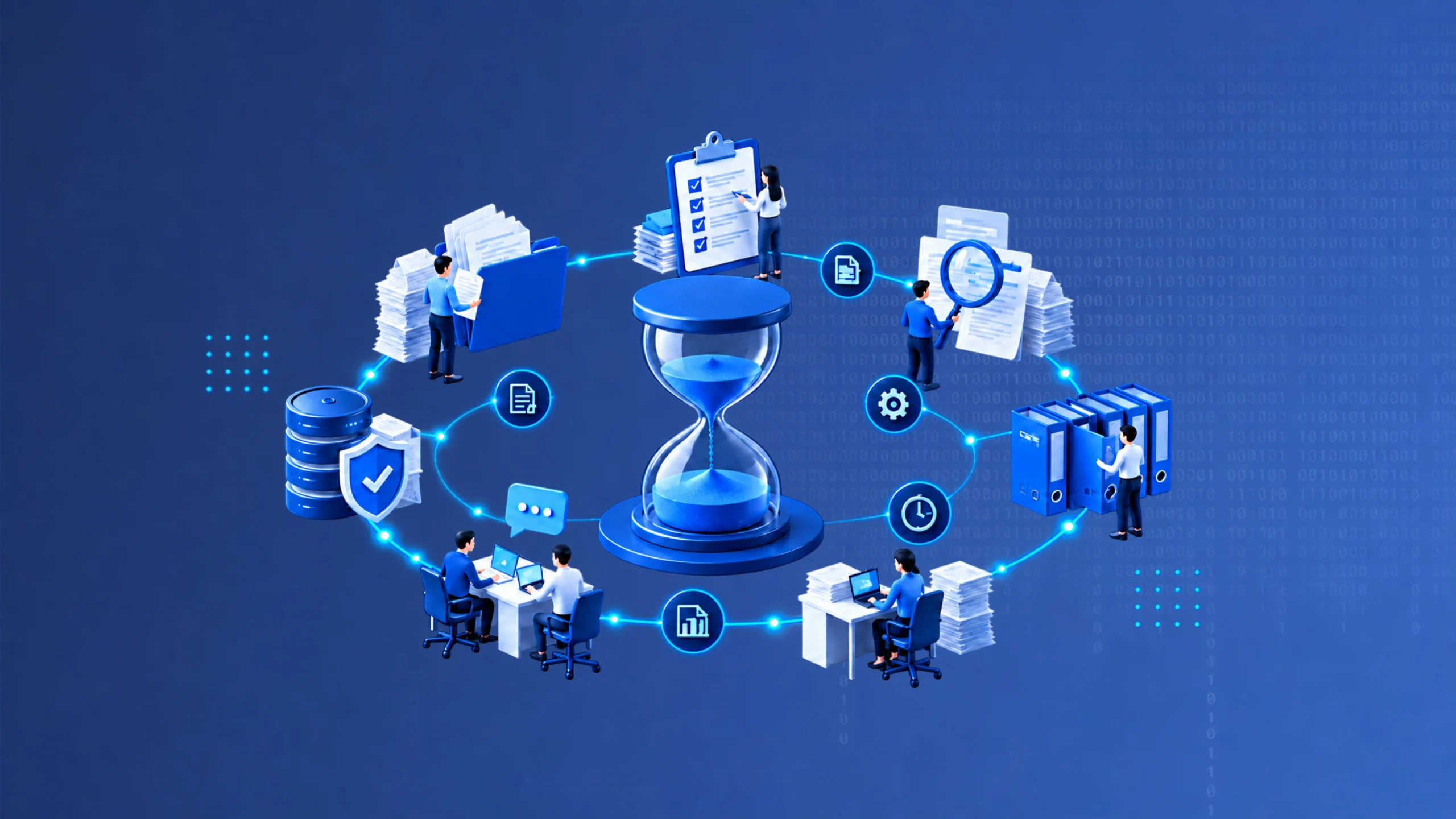
A SOC 2 audit can be a time-consuming process for a SaaS company when evidence gathering, control monitoring, and documentation are performed manually. SOC 2 Automation takes care of evidence gathering, control monitoring, and compliance management all in one place, continuously.
For SaaS companies undergoing SOC 2 audit for the first time, automation is not only about saving some time but also about getting rid of repetitive processes, minimizing compliance risks, improving audit readiness, and letting security teams concentrate on building their product.
SOC 2 Automation makes use of software that enables automation of the processes that occur in preparation for and maintenance of SOC 2 compliance.
It eliminates the need to manually gather evidence from the cloud infrastructure, HR systems, code repositories, identity providers, and other business tools but connects to these tools and gathers the necessary evidence automatically.
Depending on the platform, automation can help with:
It’s similar to having an automated compliance assistant who keeps checking on important controls and organizing supporting evidence.
Compliance procedures appear simple enough at first glance.
A startup might maintain a spreadsheet containing its security controls, store policies in Google Drive, collect screenshots from different systems, and assign compliance tasks through email or project-management software. The problem appears when the audit approaches.
Teams suddenly need to answer questions such as:
Employees may spend hours searching through different systems and manually organizing evidence.
This creates what is often called compliance busywork that is necessary but doesn’t directly contribute to building or improving the company’s product.
The biggest advantage of automation is that compliance activities can happen continuously instead of becoming a last-minute project.
Here’s how.
1. Automates Evidence Collection
Automated Evidence Collection is among the most tedious processes when preparing for SOC 2.
Without automation, the team will need to take screenshots, download reports, and export log files.
SOC 2 compliance automation can connect with commonly used business and technology systems to collect relevant evidence automatically.
For example, a SaaS startup may need evidence related to:
User Access
Multi-Factor Authentication
Employee Onboarding and Offboarding
Security Monitoring
Cloud Configuration
Code Changes
Vulneraibility Management
Security Training
Rather than asking an engineer or security manager to collect this information manually, automated integrations can continuously gather relevant evidence.
Result: Less manual evidence chasing and a more organized audit trail.
2. Continuously Monitors Security Controls
Traditional compliance often involves checking controls periodically.
Automation enables continuous monitoring. Rather than manually checking whether access is appropriate, an automated system can monitor the identity and access management system.
If there is any configuration anomaly, the compliance officer would conduct investigations before the audit takes place.
This changes the approach from:
“Let’s prepare for the audit.”
to:
“We’re continuously ready for the audit.”
That shift can significantly reduce the workload during audit preparation.
3. Reduces Spreadsheet-Based Compliance Work
Spreadsheets can be useful when a company is small.
But as the startup grows, spreadsheet-based compliance becomes increasingly difficult to maintain.
A single compliance spreadsheet might contain:
As more individuals make changes to the spreadsheet, errors and out-of-date information may arise.
Having a dedicated compliance management system for SOC 2 compliance will consolidate all this information and provide a better understanding of the compliance progress.
The compliance officers will no longer have to ask various people for an update since the information will be in one place.
4. Makes Audit Evidence Easier to Find
It is necessary for auditors to gather evidence of proper design and effective operation of controls.
The process of finding appropriate evidence manually can be very time-consuming.
Using SOC 2 audit automation, evidence can be organized by controls, and it becomes easy to determine what evidence is available and what needs to be gathered.
Example:
Control: Access to production systems is restricted.
Supporting evidence might include:
When this information is organized within a compliance platform, teams spend less time searching for individual files.
5. Automates Employee Compliance Tasks
SOC 2 isn’t only a technical exercise.
The employees might have to undergo security awareness training, accept corporate policies, be involved in access reviews, or do other things related to compliance.
Manual tracking of all this might become challenging with the increase in the size of the team.
Automation will help manage these compliance activities.
For example:
This removes repetitive administrative work from HR and security teams.
The most common error made by startups is that they consider the SOC 2 readiness project as something they have to do just once.
What startups should focus on is continuous readiness.
Through automation, there are many processes that can occur throughout the year:
Continuous monitoring → Automated evidence collection → Compliance gap detection → Remediation → Audit-ready evidence
At the start of the audit engagement, some of the evidence might already have been gathered.
Example: A SaaS Startup Preparing for SOC 2
Imagine a 40-person SaaS company preparing for its first SOC 2 audit.
With a manual process, the team might need to:
The CTO, engineering team, HR team, and operations staff may all become involved.
With SOC 2 compliance automation, many of these activities can be tracked continuously.
The compliance department will discover any gaps in advance, while integration processes will help preserve all evidence during the auditing period.
The difference isn’t just speed. It’s predictable.
If you’re wondering how to automate SOC 2 compliance, start with the processes that consume the most manual time.
Step 1: Identify Repetitive Compliance Tasks
List every recurring compliance activity.
Look for tasks such as:
These are strong candidates for automation.
Step 2: Map Controls to Your Existing Systems
Identify where the evidence already exists.
For example:
The objective is to connect compliance requirements with the systems that already generate the evidence.
Step 3: Choose a SOC 2 Compliance Platform
When evaluating a platform, SaaS startups should look beyond the number of integrations.
Consider:
The best SOC 2 automation platform for startups isn’t necessarily the platform with the longest feature list. It should be one that fits your existing technology stack and reduces the amount of manual compliance work your team performs.
Step 4: Establish Continuous Monitoring
Once your systems are connected, configure monitoring around important controls.
Don’t wait until the audit begins to discover compliance gaps.
Continuous monitoring allows your team to identify and address issues earlier.
Step 5: Review Your Compliance Dashboard Regularly
Automation does not remove human accountability.
There needs to be someone to check compliance status, investigate alerts, assign remediation actions, and make risk decisions.
Automation handles repetitive tasks; decision-making remains your responsibility.
| Area | Manual Compliance | SOC 2 Automation |
| Evidence collection | Repeated manually | Automated/continuous |
| Monitoring | Periodic checks | Continuous monitoring |
| Documentation | Multiple folders/spreadsheets | Centralized platform |
| Employee tasks | Manual reminders | Automated workflows |
| Audit preparation | Often last-minute | Continuous readiness |
| Gap detection | Manual reviews | Automated alerts |
| Scalability | Becomes harder over time | Easier to scale |
The key difference is consistency.
Manual systems rely largely on people knowing what is required. Automation enables repetitive processes to keep running even when the team is occupied.
Automation is powerful, but it doesn’t mean your startup can completely remove people from the compliance process.
You still need people to:
Automation does not aim at eliminating the human element in compliance processes.
Rather, it is about eliminating the unnecessary human effort and enabling people to make better decisions.
For growing SaaS companies, the benefits extend beyond the audit itself.
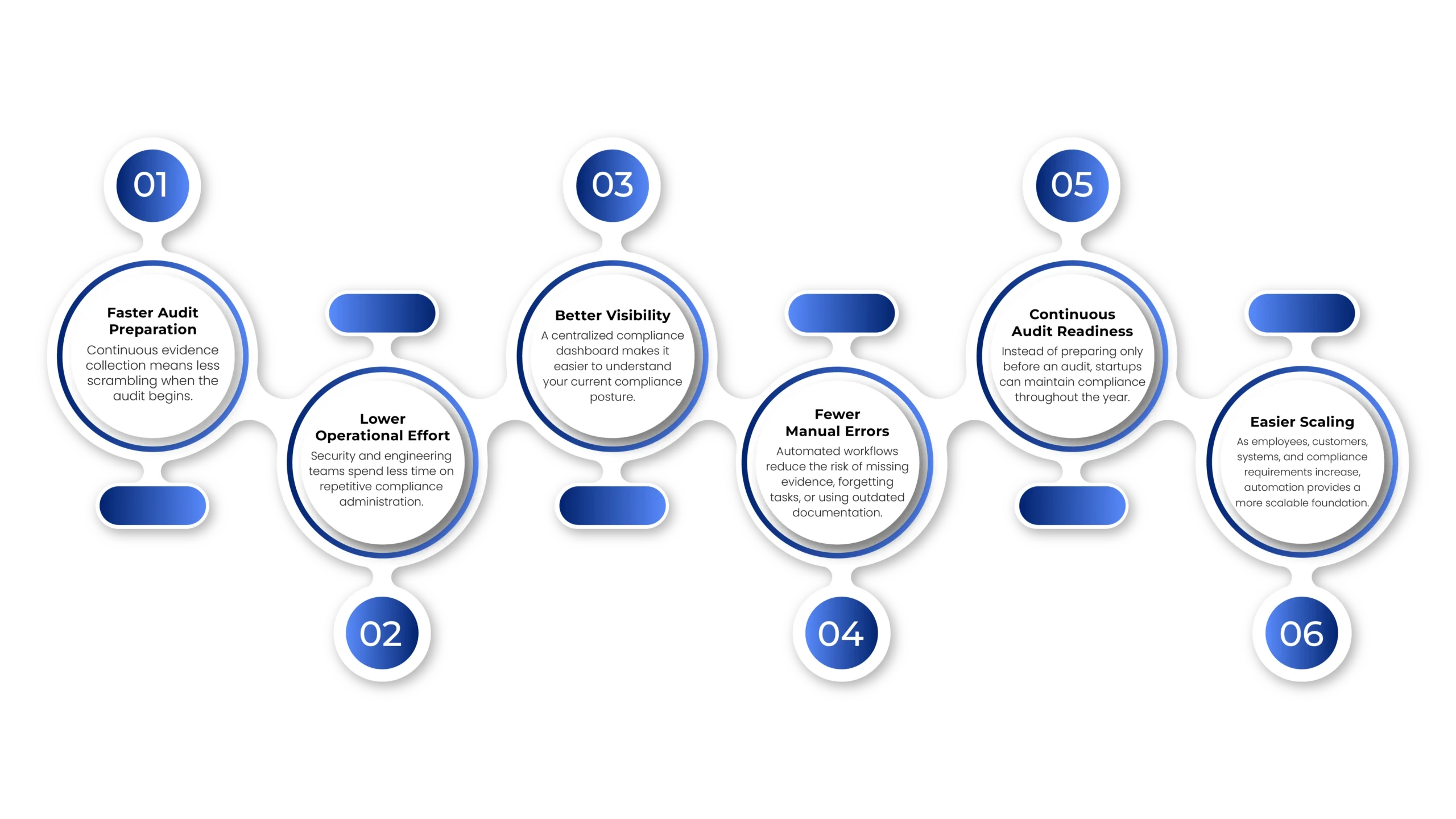
For a very small company with limited systems, manual compliance may initially be manageable.
But automation becomes increasingly valuable when:
For startups selling to enterprise customers, reducing compliance friction can also help security reviews and customer due diligence move more efficiently.
It is quite time-consuming for SaaS companies to manage SOC 2 manually. SOCLY.io allows you to streamline compliance management by integrating the whole process of evidence, control, task, and audit management.
With SOCLY.io, startups can:
SOCLY.io eliminates spreadsheets, scattered information, and manual tracking allowing SaaS companies to focus more on their product and growth than on compliance management.
1.How can SOC 2 automation save time in audits?
SOC 2 automation can save time in audits by automating evidence collection, control monitoring, compliance processes, and documentation. This means that there is no need to collect evidence at the end of the auditing period.
2. How do you automate SOC 2 compliance?
SOC 2 compliance can be automated by identifying repeatable compliance activities, integrating your current business and technology systems with a compliance management system, automating evidence gathering and monitoring, and continuous tracking of control performance and remediation.
3. What is SOC 2 audit automation?
The SOC 2 audit automation process entails automating repetitive processes that are involved in SOC 2 audit preparation, such as evidence gathering, control, task management, and compliance documentation using software.
4. Is SOC 2 automation suitable for SaaS startups?
Yes. SOC 2 automation can prove to be very useful for SaaS startup companies, since these usually operate in cloud environments, use multiple SaaS applications, and have remote employees.
5. What should I look for in a SOC 2 compliance platform?
Look for automated evidence collection, continuous monitoring, integrations with your technology stack, control mapping, policy management, risk tracking, remediation workflows, and features that make auditor collaboration easier.
6. Does SOC 2 automation eliminate the need for an auditor?
Not at all. SOC 2 automation aids in the gathering of evidence, control testing, and compliance activities; however, an independent auditor is still necessary in order to evaluate if the company’s controls meet SOC 2 requirements.
7. How does SOC 2 automation speed up audit preparation?
SOC 2 automation simplifies the process of auditing preparation by doing most of the job through continuous evidence gathering, controls monitoring, detecting gaps, and documenting everything.
SOC 2 should not be made into a regular fire drill for your SaaS startup.
SOC 2 Automation makes it possible to turn the concept of compliance into an ongoing and organized process that is not merely based on spreadsheets, screenshots, emails, and urgent requests.
This can help startups cut down the time and effort needed for audits.
But more importantly, by leveraging automation, you allow your security and engineering teams to dedicate less time to proving the existence of controls and more time enhancing the underlying systems.
If your startup is ready to undergo SOC 2 attestation or seeks to automate its existing compliance process, consider using SOCLY.io services.
Your trusted partner in compliance automation. Turn complex regulations into clear, automated workflows.
By submitting, you agree to our Privacy Policy and Terms of Service

